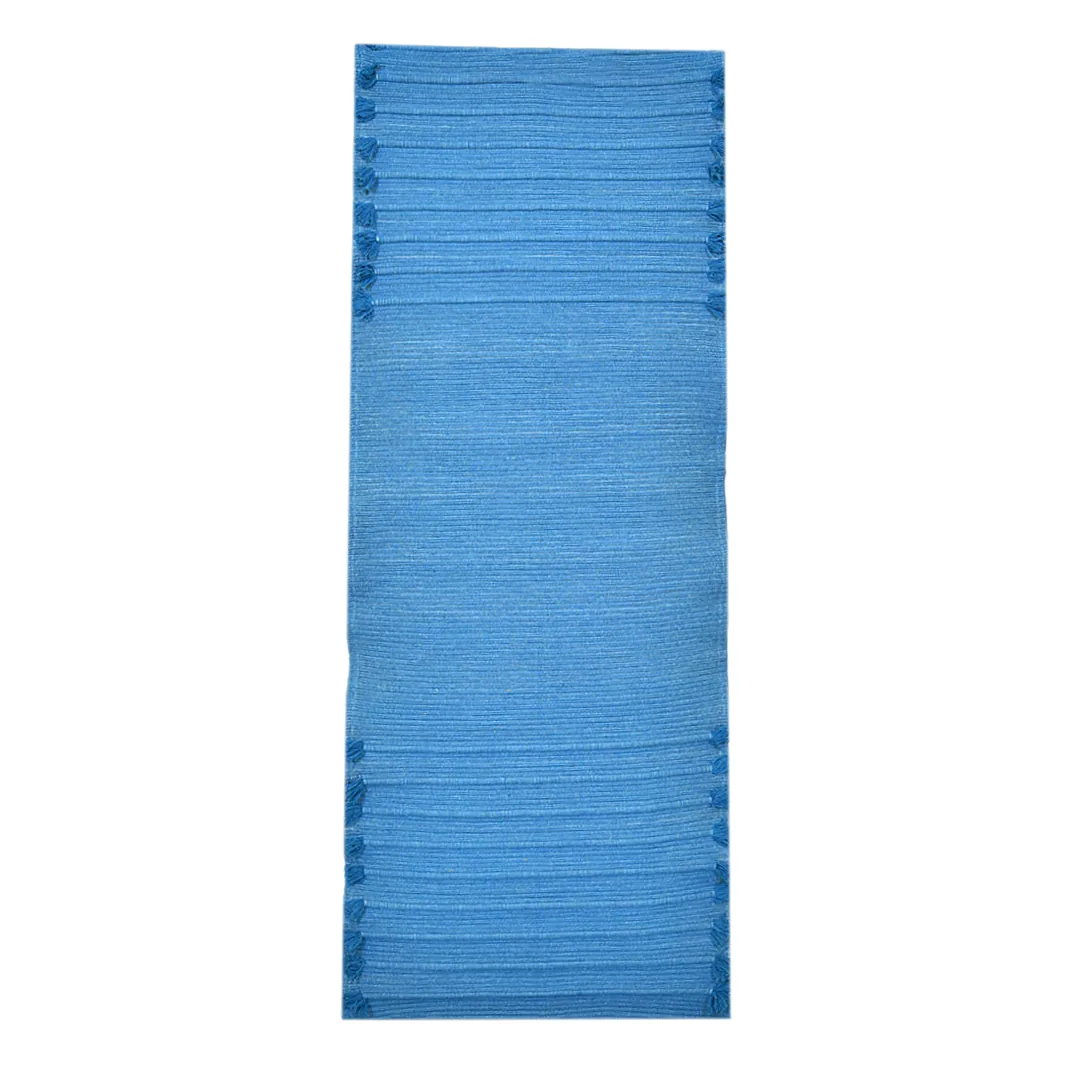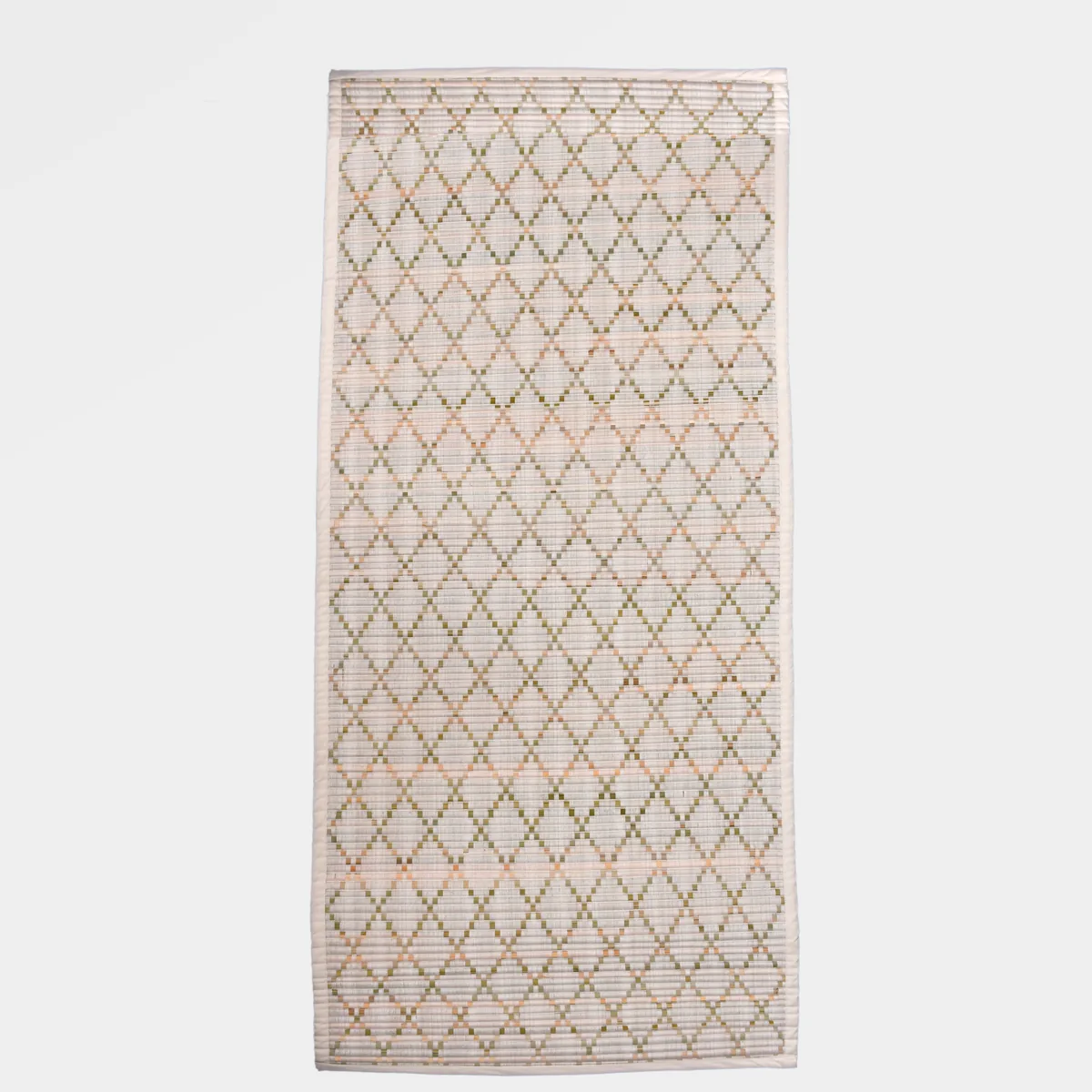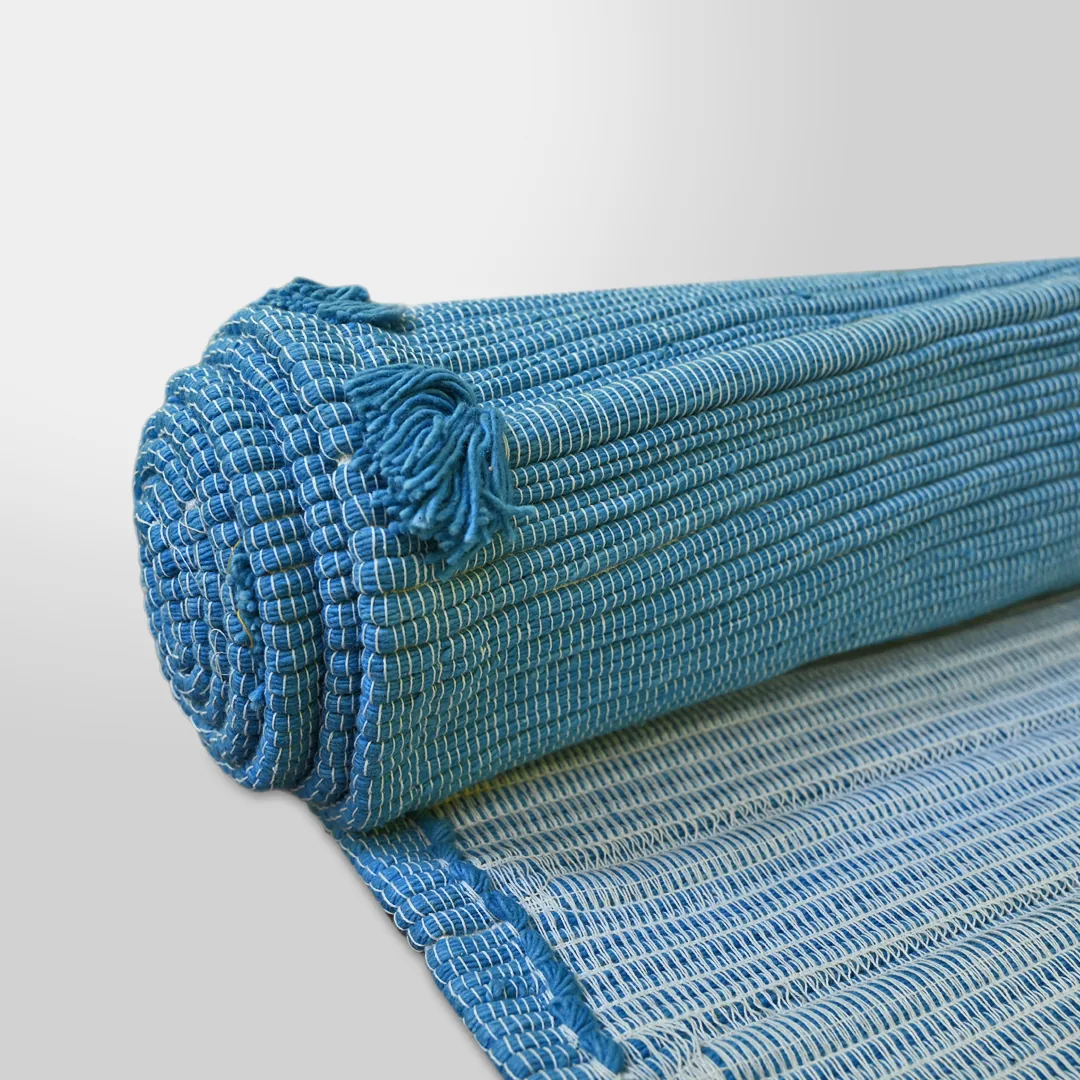
In the monsoon, dry a yoga mat with moving air rather than heat: lay it flat on a rack or across two chair backs under a ceiling fan, turn it every few hours, and roll it up only when the thickest part is dry to the touch. Cotton mats hold more water than grass mats and take longer; neither should go in a tumble dryer or out in direct sun. A damp mat rolled away is where mildew and smell begin.

Airflow beats heat
When the air is already heavy with moisture, a hot room does not dry a mat much faster, and heat is hard on plant dyes and on the natural latex underneath. What dries a mat is air moving across both faces: a fan on a flat mat does more than a sunny window and costs the colour nothing. The second rule is patience. A cotton rug that dries in a day in March may need two in July, so check before you trust it.
How to dry a yoga mat in humid weather
- Get the water out first. After a wash, lay the cotton mat on an old towel, roll the two together and press hard; change the towel and repeat. After a sweaty practice, press a dry towel over the surface.
- Lay it flat, off the floor. A rack, two chair backs or a clothes horse with the mat across two rails, so air reaches both sides. Tile floors are often damp themselves in the monsoon.
- Put a fan on it. A table fan angled along the mat, or the ceiling fan, with a window open on the far side if the rain allows.
- Turn it. Latex side up for the first hour or two, then flip, then every few hours. Cotton rugs are thickest near the tassels, so check there.
- Test before you roll. Press a palm into the thickest part. Cool and damp means more time.
- Store with air. Not a closed cupboard or a plastic bag. If a cupboard is all you have, a few silica gel sachets beside the mat help; swap them when they go soft. See roll or fold? for storage.
Tricks that help
- Newspaper under the mat on a rack wicks water from the underside; change it when limp.
- Stand it overnight. If the mat is still damp at bedtime, stand it loosely rolled on its end so water drains downward, and unroll it under the fan in the morning.
- Wash less, air more. In the wet months, wipe a cotton mat with a damp cloth and air it, and save the full wash for a drier week.
- Rotate two mats. A grass mat dries in an hour or two and gives a cotton mat its two days.
Drying time by mat
| Mat | After a wash | After a sweaty practice |
|---|---|---|
| Indico, Prana Shakti, Prithvi (5 mm cotton) | Flat under a fan, turned; about two days in the monsoon | A few hours under a fan |
| Diamond Clay, Diamond Orange (7 mm cotton) | The slowest; two days or more, turned often | Half a day over two rails |
| Sambu Diamond, Sambu Jute, Sambu Frame (sambhu grass) | Never washed; wipe only | An hour or two in moving air |
| Darbha (cloth-backed grass) | Never washed; wipe only | An hour or two, unfolded |
These are what we see in our own homes in Komarapalayam; a very wet week stretches them.
Signs of mildew
Mildew announces itself as a musty, earthy smell before it shows as grey or dark speckles, usually on the underside or near the tassels where the mat stays wettest. Catch the smell early: unroll the mat, wipe both sides with a cloth wrung out in cold water, and dry it fully under a fan for a day or two. Do not reach for bleach; it strips plant colour and marks grass. Stubborn cases are covered in how to remove smell from a yoga mat.
What not to do
- No tumble dryer. It is hard on handwoven cotton and the latex layer.
- No direct sun, even between showers. Plant dyes fade fastest when wet.
- Do not roll or fold a damp mat, not even for a night, and do not store it in plastic.
- Do not hang a wet cotton rug from one end; the weight pulls the weave. Drape it over two rails.
Our cotton and sambhu grass mats carry a thin layer of natural tree latex on the underside; the Darbha is cloth-backed. If you are allergic to natural latex, choose with care and write to us first.
Frequently asked questions
How long does a yoga mat take to dry in the monsoon?
A 5 mm cotton mat such as the Indico, laid flat under a fan and turned regularly, usually takes about two days to dry fully after a wash in the monsoon; the 7 mm Diamond mats take longer. A sweaty mat that has not been washed needs a few hours. Sambhu grass and darbha mats are only wiped, never washed, and dry in an hour or two in moving air.
Can I dry a yoga mat with a tumble dryer or heater?
No. We do not recommend a tumble dryer for any of our mats; the heat and tumbling are hard on handwoven cotton and on the natural latex layer underneath. Moving air does more than heat in humid weather, so lay the mat flat under a ceiling or table fan and turn it until the thickest part is dry.
Is it all right to roll a yoga mat when it is slightly damp?
No. A mat rolled while even slightly damp has no airflow inside the roll, and that is exactly where mildew and a musty smell begin. Press your palm into the thickest part, near the tassels on a cotton rug; if it feels cool, give it more time under the fan. Roll or fold only when it feels dry right through.
How do I know if my mat has mildew?
The first sign is a musty, earthy smell, followed by grey or dark speckles, usually on the underside or near the tassels where the mat stays wettest. Wipe both sides with a cloth wrung out in cold water and dry the mat fully under a fan for a day or two. Do not use bleach, which fades plant dyes and marks grass.
Next step
Find one spot in your home where a mat can lie flat under a fan, and the monsoon becomes a small inconvenience. If you practise daily through the wet months, a quick-drying sambhu grass mat alongside your cotton Indico means one is always ready.