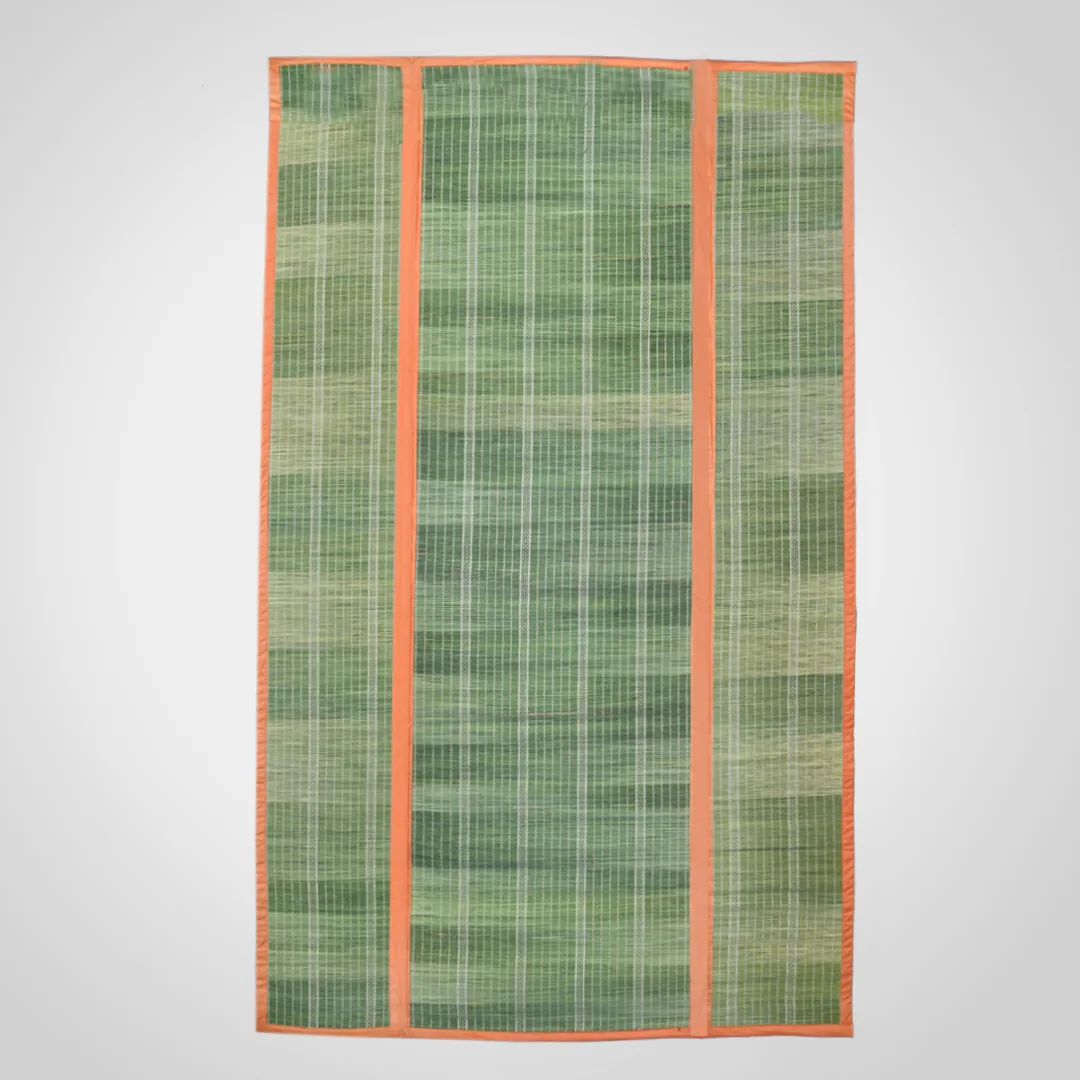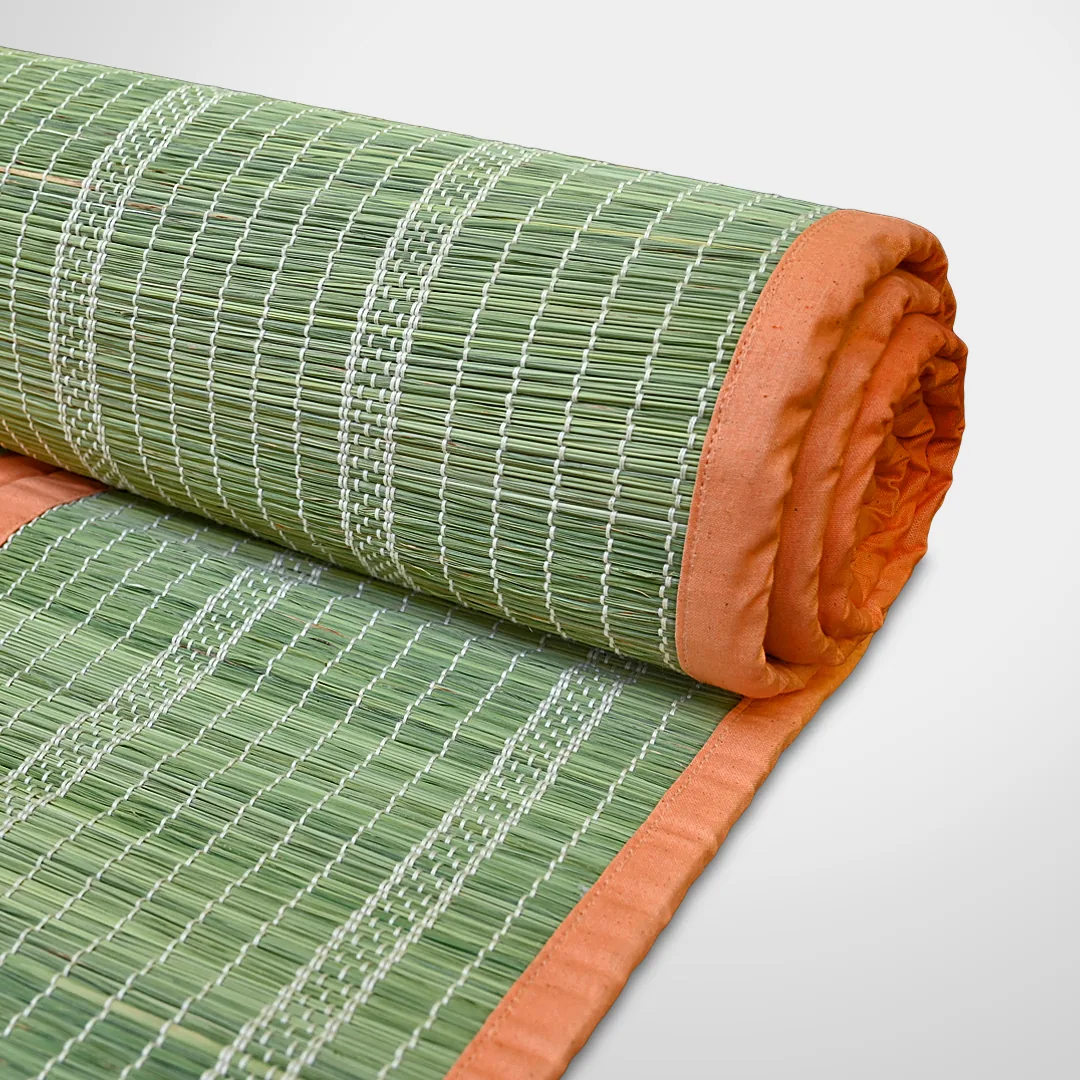
Darbha, also called kusha, is the grass Desmostachya bipinnata, a tall perennial native to India and much of Africa and Asia. In Hindu tradition it is the grass spread as a seat for ritual and for meditation, and in Buddhist tradition it is the grass the Buddha is said to have sat on. We weave it in Komarapalayam into a three-panel mat bound and backed in cotton cloth, so it folds flat, for meditation, pranayama and cool summer sleeping.

The plant
Botanically, darbha is Desmostachya bipinnata, a member of the grass family. The Wikipedia entry for the species describes it as a tall, tufted, leafy perennial grass that branches from the base and grows erect from a stout creeping rootstock. Its native range runs from north and west Africa through the Middle East to India, Nepal, Myanmar, China and Thailand.
The stems are long, fine and stiff, with a smooth surface and a fresh green colour when dried in shade. That combination of fineness and firmness is what makes it a good seat: it lies flat, stays flat, and feels cool and dry.
What darbha means
We want to describe this part carefully, as tradition rather than as claims about what the grass does. Darbha is one of the oldest sacred plants of the subcontinent, and its place in practice is well documented.
In Hindu tradition, according to the same Wikipedia entry, kusha grass is mentioned in the Rig Veda for use in sacred ceremonies and as a seat for priests and the gods. In the Bhagavad Gita (chapter 6, verse 11), Krishna describes the ideal seat for meditation as a firm, clean place laid with kusha grass, with a cloth and a skin over it. In early Buddhist accounts, the Buddha sat on kusha grass when he attained enlightenment, and the plant is also sacred in Jain tradition.
Anyone who has grown up in a Tamil household will recognise darbha from ceremonies: a ring of it on a finger during rites, a bundle laid down before a ritual, a mat for a priest to sit on. It is a grass that marks a place as set aside. People sit on it to meditate because that is what has been done for a very long time, and because it is firm, cool and quiet underneath you.
We make no claims beyond that. Darbha is a beautiful traditional material with a long history, and that is reason enough to weave it well.
How we weave our darbha mat
Our Darbha mat is woven in three panels of natural green grass. The panels are bound in orange cotton and backed with cotton cloth, so the mat folds along the panel seams rather than rolling. Folded, it is a flat bundle you can slide into a cupboard or carry under an arm.
The finished mat is about 4 mm thick, 183 × 90 cm and about 1.2 kg. The 90 cm width is wider than our yoga mats, deliberately: this is a seat and a sleeping mat first.
Unlike our cotton and sambhu mats, the Darbha has no latex grip layer. The underside is cloth, and the mat stays put by its own weight and flatness. If you are allergic to natural latex, this is the one mat in our range that does not contain any; if you are choosing between our other mats, write to us first.
At the time of writing the Darbha is ₹4,999; the price reflects the grass, the panel work and the cloth backing. Handwoven grass varies, so the green and stem thickness differ a little from mat to mat.
What it is for
Meditation and pranayama
This is the mat's first job. Lay it flat, add a cushion if you need your hips above your knees, and sit. The grass is cool, firm and silent; nothing squeaks or compresses. For a wider look at seats for long sits, including grass, banana fibre and cotton, read best meditation mat.
Sleeping on the floor in summer
Across South India, sleeping on a grass mat on the floor or the terrace in the hot months is an ordinary household custom, not a wellness trend. A darbha mat with a thin cotton sheet over it is the traditional way to do it. We have written about the practicalities in sleeping on a grass mat in summer.
What it is not for
The grass is firm and the panels are stitched, not latex-backed, so a standing or flowing asana practice belongs on a cotton rug or a sambhu grass mat instead.
Darbha and sambhu compared
| Darbha | Sambhu grass mats | |
|---|---|---|
| Plant | Desmostachya bipinnata (kusha) | A river grass of Tamil Nadu |
| Construction | Three grass panels, cotton-bound, cotton cloth backing | Grass woven with organic cotton |
| Underside | Cloth, no latex | Natural tree latex |
| Stores by | Folding flat | Rolling |
| Size | 183 × 90 cm, about 4 mm, about 1.2 kg | 183 × 68.5 cm, 3 mm, about 1 kg |
| Best for | Seated practice, ritual, summer sleeping | Hot yoga, seated practice, travel |
Care
Wipe the grass clean with a dry or barely damp cloth. Air the mat in the shade, keep it dry, and fold it along the panels for storage. Never soak it, never leave it in the sun, and never put it away damp. The full routine is in darbha mat care and storage.
Frequently asked questions
What is darbha grass?
Darbha, or kusha, is the grass Desmostachya bipinnata, a tall, tufted perennial in the grass family that grows from a stout creeping rootstock and is native to India, the Middle East and much of Africa. It has been used as a ritual and meditation seat in Hindu, Buddhist and Jain traditions for thousands of years.
Why is kusha grass used for meditation?
By tradition. The Rig Veda refers to kusha as a seat for priests and the gods, the Bhagavad Gita (6.11) describes a meditation seat laid with kusha grass, and Buddhist accounts place the Buddha on kusha grass at his enlightenment. Practically, the grass is firm, cool, flat and quiet, which is what a long sit asks for.
Does your darbha mat have a latex layer?
No. The Darbha is bound and backed in cotton cloth, with no latex, and it folds flat along its three panels. It stays in place by its own weight. Our cotton and sambhu mats do have a natural tree latex underside, so if you are allergic to natural latex, choose with care and write to us first.
Can I do yoga asanas on a darbha mat?
It is designed for seated practice, pranayama, ritual and sleeping rather than for standing or flowing asana. The grass is firm, the mat is stitched in panels, and there is no grip layer, so for an active practice choose a cotton rug or a sambhu grass mat and keep the darbha for sitting.
If a quiet seat is what you are after, the Darbha mat page has the size, weight and current price, and our meditation collection gathers the other mats that suit a long sit.