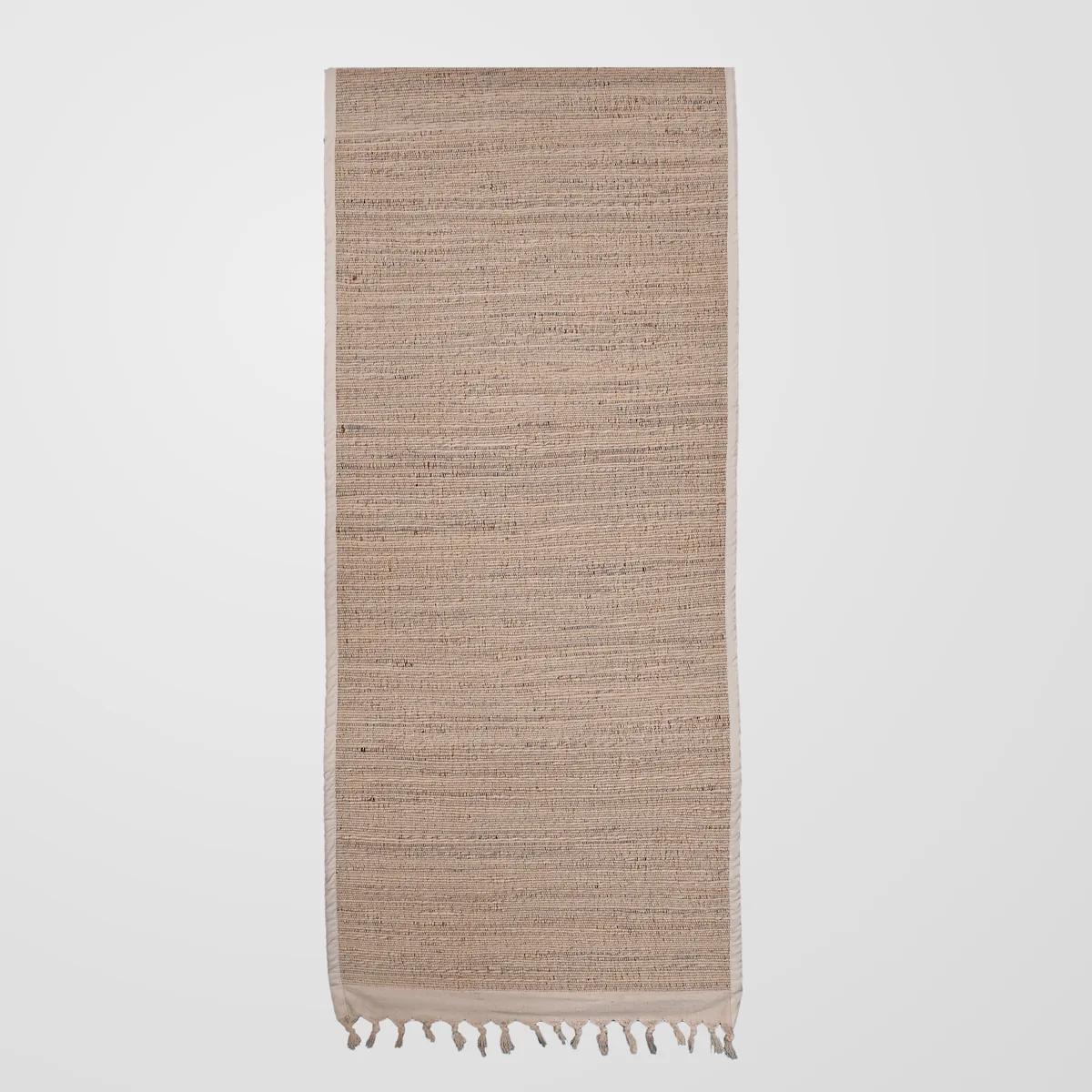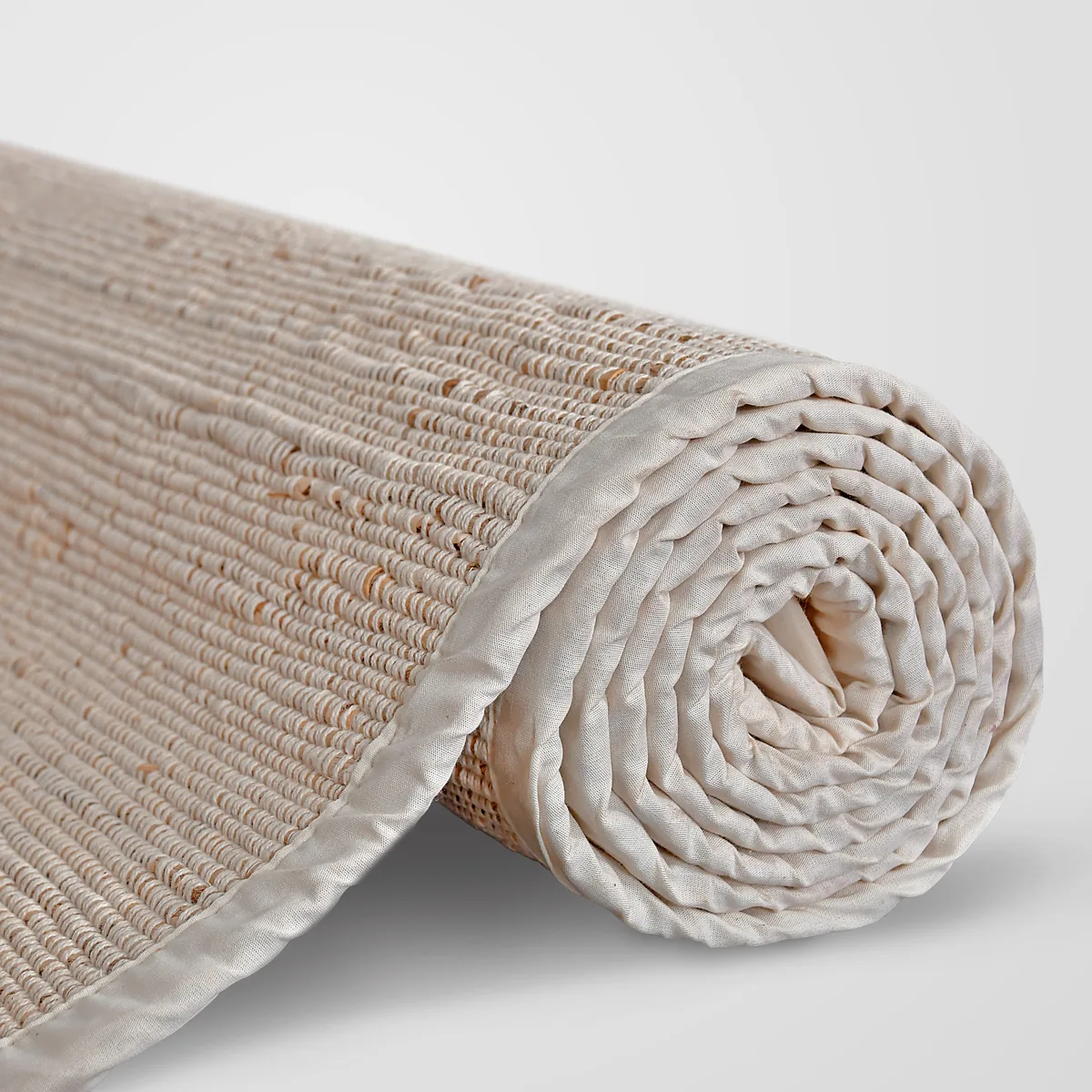
A banana fibre yoga mat is woven from fibre taken from the banana plant's pseudo-stem, the thick trunk-like stalk that is cut down after the fruit is harvested and would otherwise be left as field waste. The fibre is firm, dry and slightly glossy, and our mat uses it undyed, bound with cotton, at 3 mm thick and about a kilo. It suits seated practice, hot weather and anyone who wants a plant-fibre mat, with the honest limits that it is not cushioned and must never be soaked.

Where the fibre comes from
A banana plant is not a tree. What looks like a trunk is a pseudo-stem: a tight bundle of leaf sheaths that grows up from the ground, carries one bunch of fruit, and is cut back after harvest so the next shoot can take over. Research published by the Indian Council of Agricultural Research describes the scale of what is left behind: after the fruit is harvested, 60 to 80 tonnes of residue per hectare remain in the field as pseudo-stem, leaves and suckers.
The fibre sits inside those sheaths. A study in the Journal of Horticultural Sciences, published by the ICAR–Indian Institute of Horticultural Research, explains that it is extracted by stripping the sheath, either by hand or with a raspador machine, and that the fibre is roughly 60 per cent cellulose and about 20 per cent lignin. The lignin is why it feels stiffer and glossier than cotton: it is closer to a leaf fibre than to a seed fibre.
So nothing is cut down for the fibre; the stem has already done its work. We like that about this mat, and we are careful not to inflate it into a bigger environmental claim than it is.
From sheath to mat
The material reaches our workshop as dried strips of outer bark and longer inner fibre, and both go into the mat: the bark gives the broad, flat texture of the surface, the fibre gives strength. The strips are sorted, kept dry and woven on the handloom, with cotton binding the ends.
We do not dye it. Banana fibre dried in shade comes out in its own range of creams and pale tans, and we leave it there. That means every Banana Fibre mat is a slightly different colour, and the colour will mellow further with light and use. It is the fibre's own colour, not a finish, so there is nothing to fade unevenly.
Once woven, a thin layer of natural tree latex is brushed onto the underside by hand. It is what holds a one-kilo mat on tile, marble or wood. After many wipe-downs it can soften, and a thin fresh coat of natural latex brings it back. If you are allergic to natural latex, choose with care and write to us first.
What it feels like
Firm. There is no give in it; at 3 mm it is a surface, not a cushion. The texture is a dry, slightly waxy smoothness with the ridges of the weave under the palm. It warms little under the body and feels dry after a sweaty session, because there is no foam to hold moisture against you.
A little fibre fuzz lifting from the surface in the first weeks is normal, and it settles. Natural fibre also varies from strip to strip, so the weave is never perfectly even.
What it is good for
- Seated practice. Meditation and pranayama want a firm, cool, quiet surface, and this is one. Put a cushion on top to lift the hips. We compare it with grass and cotton in best meditation mat.
- Hot weather. Like our grass mats, it feels dry and stays flat in the heat.
- An undyed mat. If you would rather have no dye at all, this is the choice.
What it is not good for
- Cushioning. Kneeling and floor work on a 3 mm banana mat need a folded blanket. If you want padding, you want our 7 mm Diamond weave or a 5 mm cotton rug.
- Washing. It cannot be soaked or machine washed. Shake, wipe, air. The full routine is in how to clean a banana fibre mat.
- Flowing practice. The latex holds it down, but the surface is harder on the hands than cotton and does not steady as it dampens the way cotton does.
Banana fibre, sambhu grass and cotton
| Banana Fibre | Sambhu grass mats | Cotton rugs | |
|---|---|---|---|
| Fibre | Banana bark and fibre, cotton-bound | River grass woven with organic cotton | GOTS-certified organic cotton |
| Thickness | 3 mm | 3 mm | 5–7 mm |
| Weight | About 1 kg | About 1 kg | About 1.4–1.8 kg |
| Washing | Wipe only | Wipe only | Hand wash cold |
| Best for | Seated practice, hot weather | Hot yoga, seated practice | Standing and flowing practice |
At the time of writing the Banana Fibre mat is ₹2,000, in the same band as our sambhu grass mats; the product page has the current price.
Frequently asked questions
What is a banana fibre yoga mat made of?
It is woven from the bark and inner fibre of the banana plant's pseudo-stem, the stalk that is cut down after the fruit is harvested. Ours is undyed, bound at the ends with cotton, 3 mm thick, 183 × 68.5 cm and about 1 kg, with a thin layer of natural tree latex brushed onto the underside for grip.
Is banana fibre taken from the fruit or the plant?
From the plant, not the fruit. After a banana plant has fruited, the pseudo-stem is cut back and would otherwise be left as field residue; the fibre is stripped from the leaf sheaths inside it, by hand or with a raspador machine. No plant is cut down for the fibre alone.
Is a banana fibre mat soft?
No. It is a firm, 3 mm surface with a dry, slightly waxy texture and no cushioning. It suits seated practice and hot weather well, but for kneeling work you will want a folded blanket, and for padding a thicker cotton weave is the better choice.
Can I wash a banana fibre mat?
Not by soaking. Shake it out, wipe it with a damp cloth and air it in the shade. Never soak it, machine wash it or dry it in direct sun. A little fibre fuzz in the first weeks is normal and settles with use.
If a firm, undyed, plant-fibre surface sounds right, the Banana Fibre mat page has the current price and photos, and it sits in the banana fibre collection.