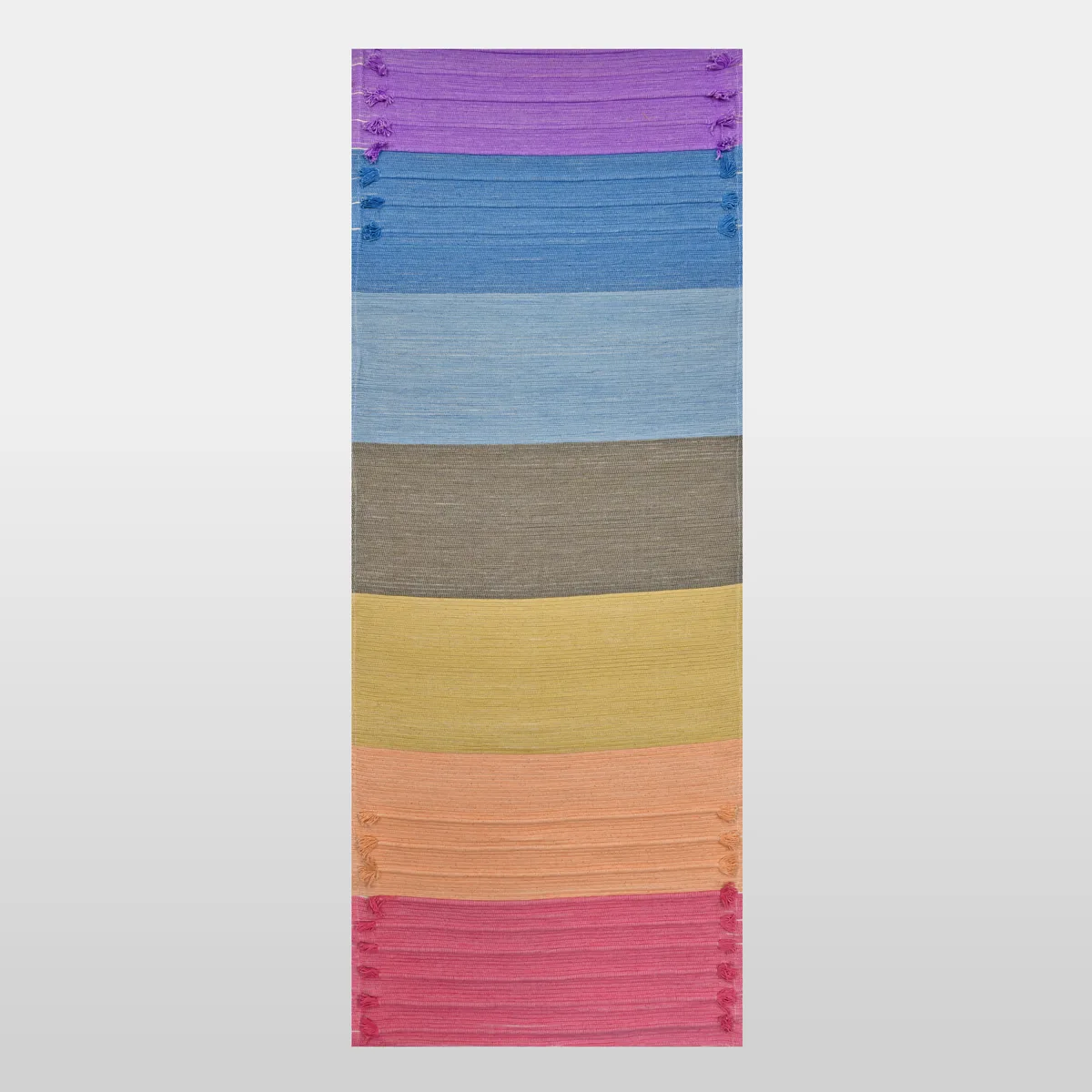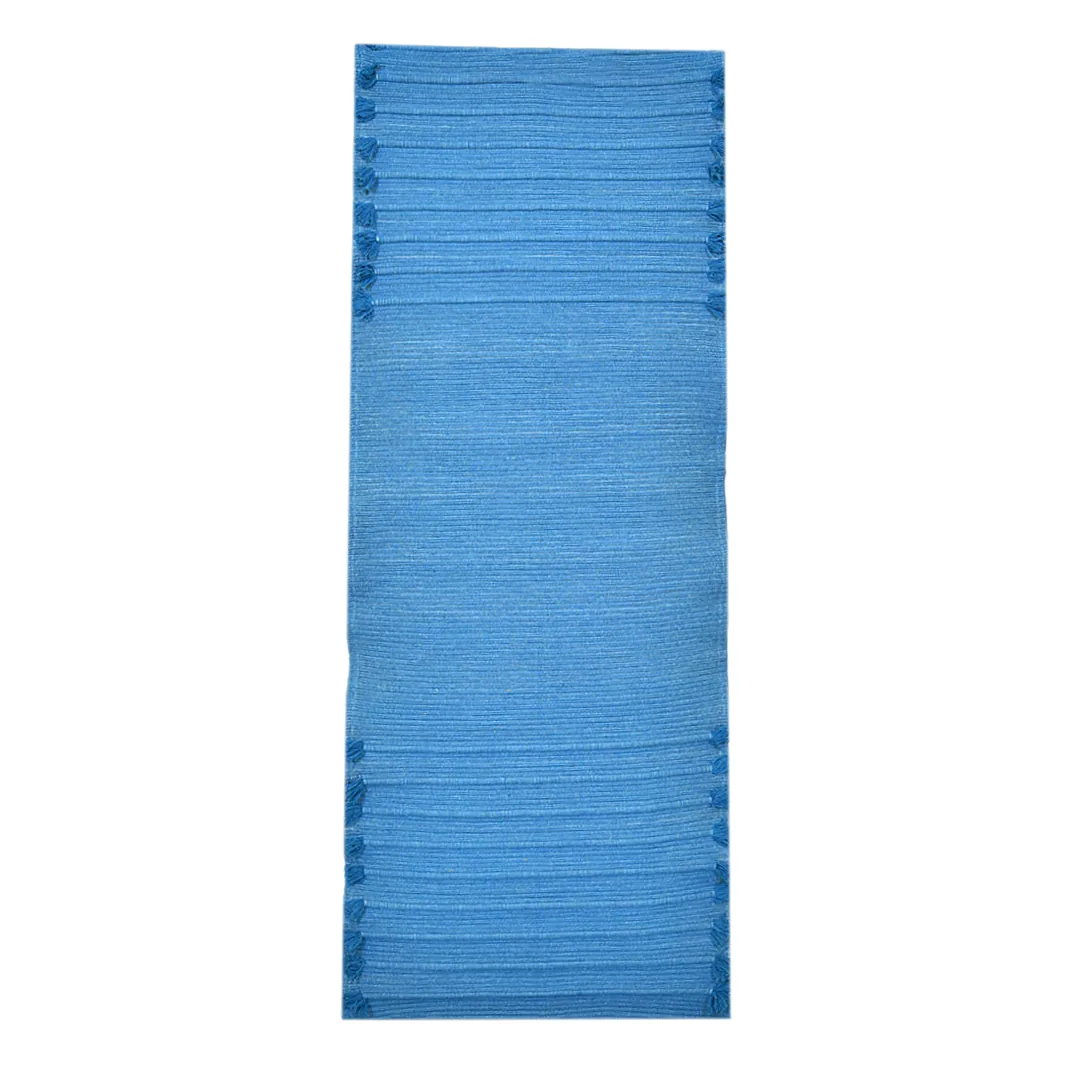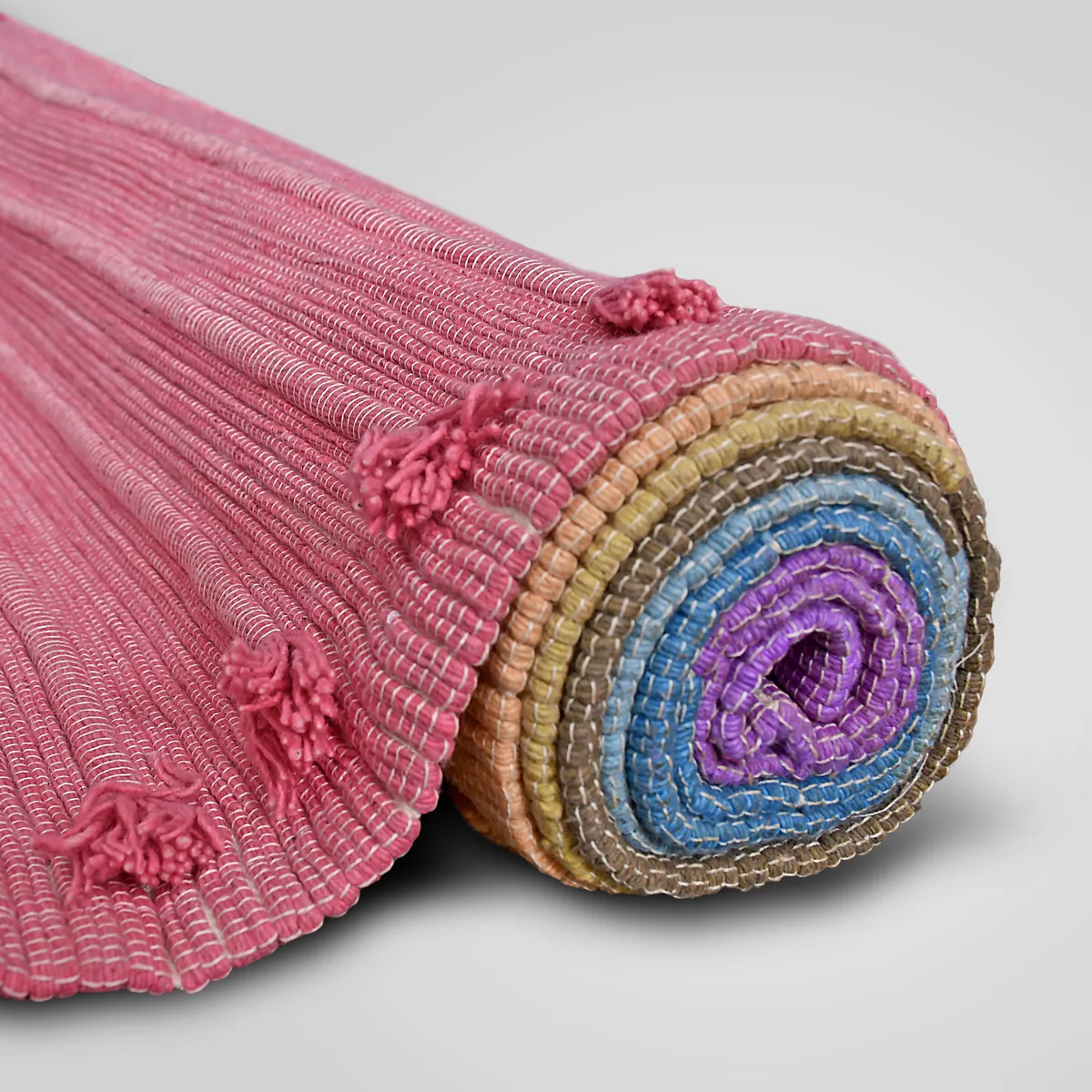
Laying a cotton rug over a rubber mat helps in three situations: you sweat enough that a rubber surface turns slippery, you practise on a shared studio mat and want your own washable layer against it, or you want a little more under the knees. If none of those applies, a rug such as the Indico works on its own on tile, marble or wood, and the second layer is only more to carry.
Why the stack exists
Rubber and foam mats grip well when they are dry. Once sweat sits on the surface, hands and feet begin to slide, and the usual answer is a towel laid on top. A woven cotton rug does the same job more thoroughly: it takes the moisture into the fibre, lies flat under its own weight and does not bunch the way a thin towel does. This is the habit behind the rug-over-mat stack you see in Ashtanga rooms, where the rubber mat supplies cushion and the rug supplies the surface. Our guide to yoga mats and yoga rugs covers the definitions; this article is about using both at once.
When layering helps
You sweat heavily
A cotton rug is at its best damp. If your rubber mat needs a towel by the fourth Surya Namaskar, a rug on top replaces the towel and stays put. The Indico, 5 mm of dense ribbed cotton, is the one we would reach for: it absorbs, grips better as it dampens, and comes home to a cold hand wash when it needs one.
You use studio mats
Many studios lend rubber mats. A rug of your own laid over the studio mat gives you a washable surface that is yours alone, while the mat underneath still cushions and holds the floor. The rug goes home in your bag; the studio mat stays. We make no hygiene claims beyond the obvious: you can wash cotton, and most foam mats can only be wiped.
You want more cushion
A 5 mm six-ply rug such as the Prana Shakti on top of a rubber mat gives the knees and the sitting bones noticeably more than either alone. The trade is that balance postures feel softer underfoot, because each layer gives a little. If you mostly stand, keep the stack thin.
The floor is cold
In winter, in a flat with marble or tile, a rubber mat takes the chill of the floor. Cotton on top is warmer to lie on in savasana, and for some people that alone is reason enough.
When it is unnecessary
- You practise at home on a hard floor. Our cotton mats have a thin layer of natural tree latex brushed onto the underside by hand, and it holds on tile, marble and wood. The rug does not need a rubber mat to stay put. If you are allergic to natural latex, choose with care and write to us first.
- Your practice is slow and dry. Cotton can slip when bone dry, but the fix is damp palms and a few minutes of warming up, not a second mat. Our article on stopping a cotton mat slipping sets out the two kinds of slip and what cures each.
- You travel to class. Two mats are heavy. A 1.4 kg Indico plus a rubber mat is a real weight on a scooter or a bus; take one or the other.
How to layer so nothing moves
- Lay the rubber mat down first and smooth it.
- Unroll the rug on top, latex side down. The latex underside sits on the rubber and the two hold each other.
- Line up the ends and step onto the rug once or twice so it settles.
- After class, separate them straight away. Air the rug flat in shade; wipe the rubber mat. A rug left rolled inside a damp rubber mat is how smell starts.
Wash the rug when it needs it: cold water, a mild natural detergent, by hand, separately for the first few washes, dried flat away from sun. Machine washing can fade the plant dyes.
| Rug alone on a hard floor | Rug over a rubber mat | |
|---|---|---|
| Grip to the floor | Natural latex underside | Rubber mat holds the floor; rug holds the mat |
| Grip for the hands | Improves as it dampens | Same |
| Cushion | 5 mm dense cotton | Rug plus mat |
| Balance postures | Firm | Softer |
| To carry | ≈1.4–1.5 kg | Both mats |
| Best for | Home practice, hot rooms | Studio mats, sweaty practice, bony knees |
Frequently asked questions
Can you put a cotton rug on top of a yoga mat?
Yes. Lay the rubber mat down first, then the rug on top with its latex underside against the rubber. The mat holds the floor, the rug holds the mat, and your hands get a cotton surface that grips better as it dampens. Separate and air both after class.
Is a cotton rug better than a yoga towel on a rubber mat?
For sweat, a woven rug does what a towel does and does it more steadily: it is heavier, so it lies flat, and it absorbs more. A towel is lighter to carry and cheaper. If you already own a rubber mat and sweat a lot, the rug is the more lasting fix.
Do I need a rubber mat under a cotton rug?
Not on tile, marble or wood. Our rugs have a thin coat of natural tree latex brushed onto the underside that holds on hard floors. A mat underneath is for shared studio mats, for extra cushion, or for carpet.
Will the rug slide on the rubber mat?
Very little. The latex underside and the rubber surface hold each other well. If the rug creeps during jump-throughs, check that the rubber mat is clean and dry and that the rug is latex side down.
If you sweat heavily, start with the Indico over the mat you already own; if your knees want more, the six-ply Prana Shakti.