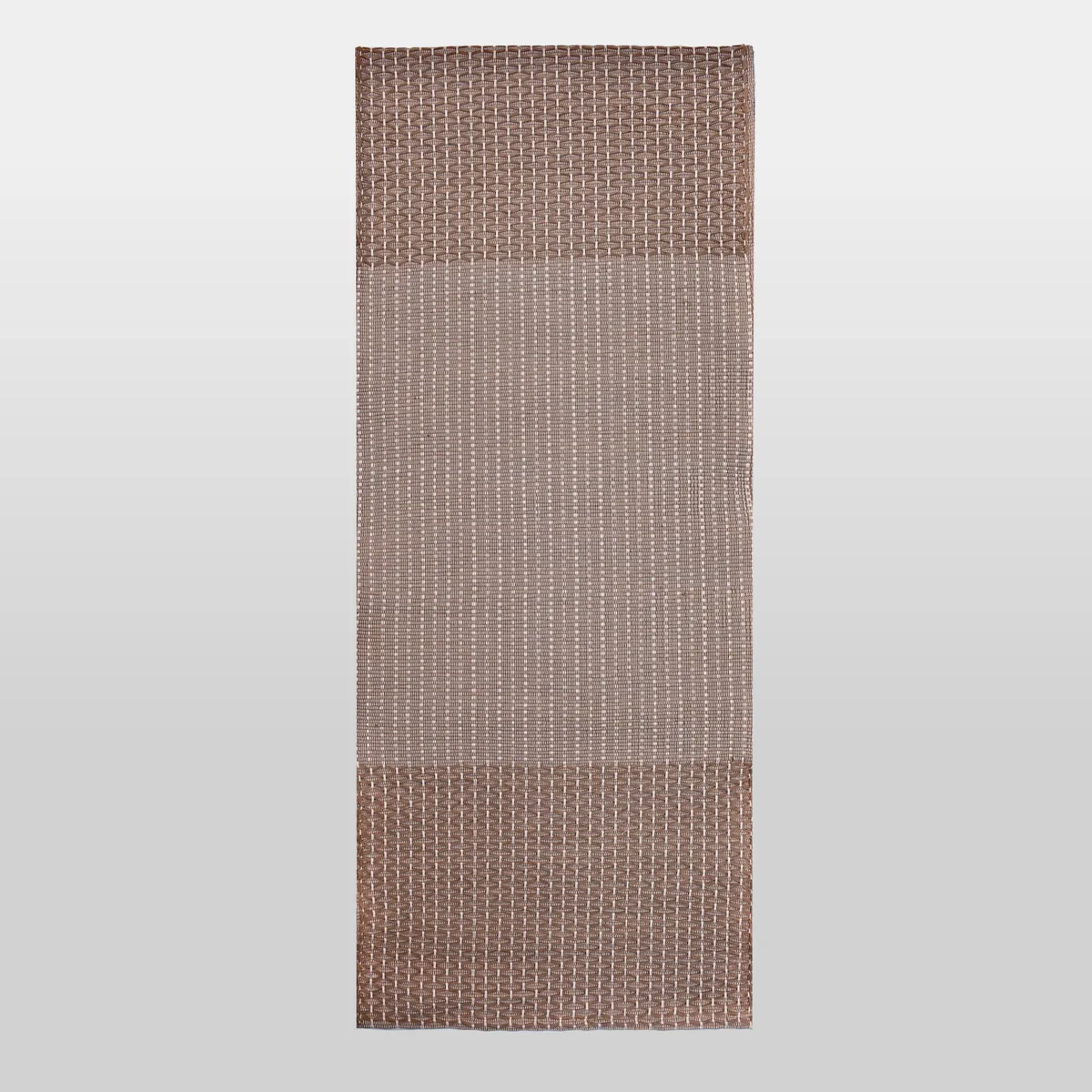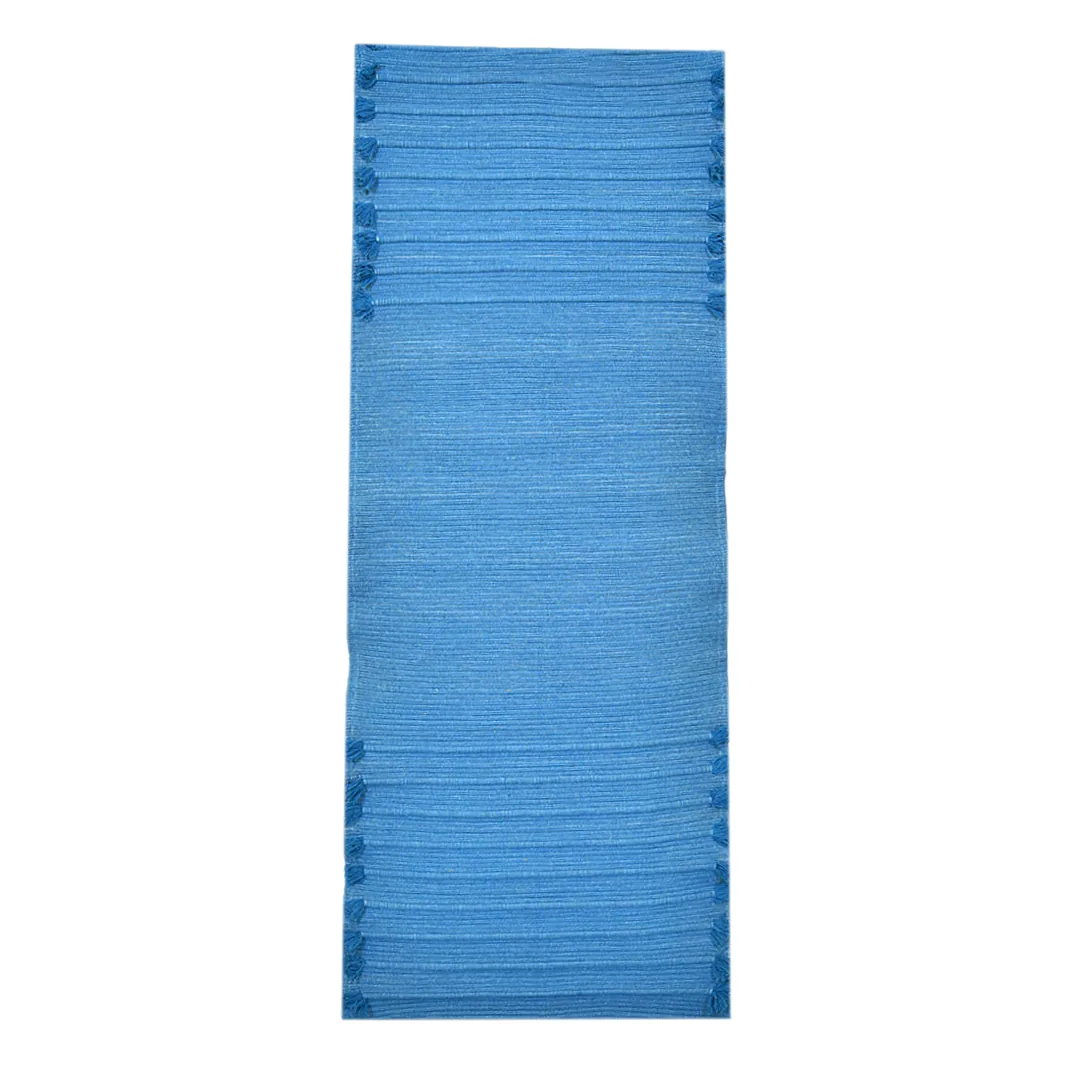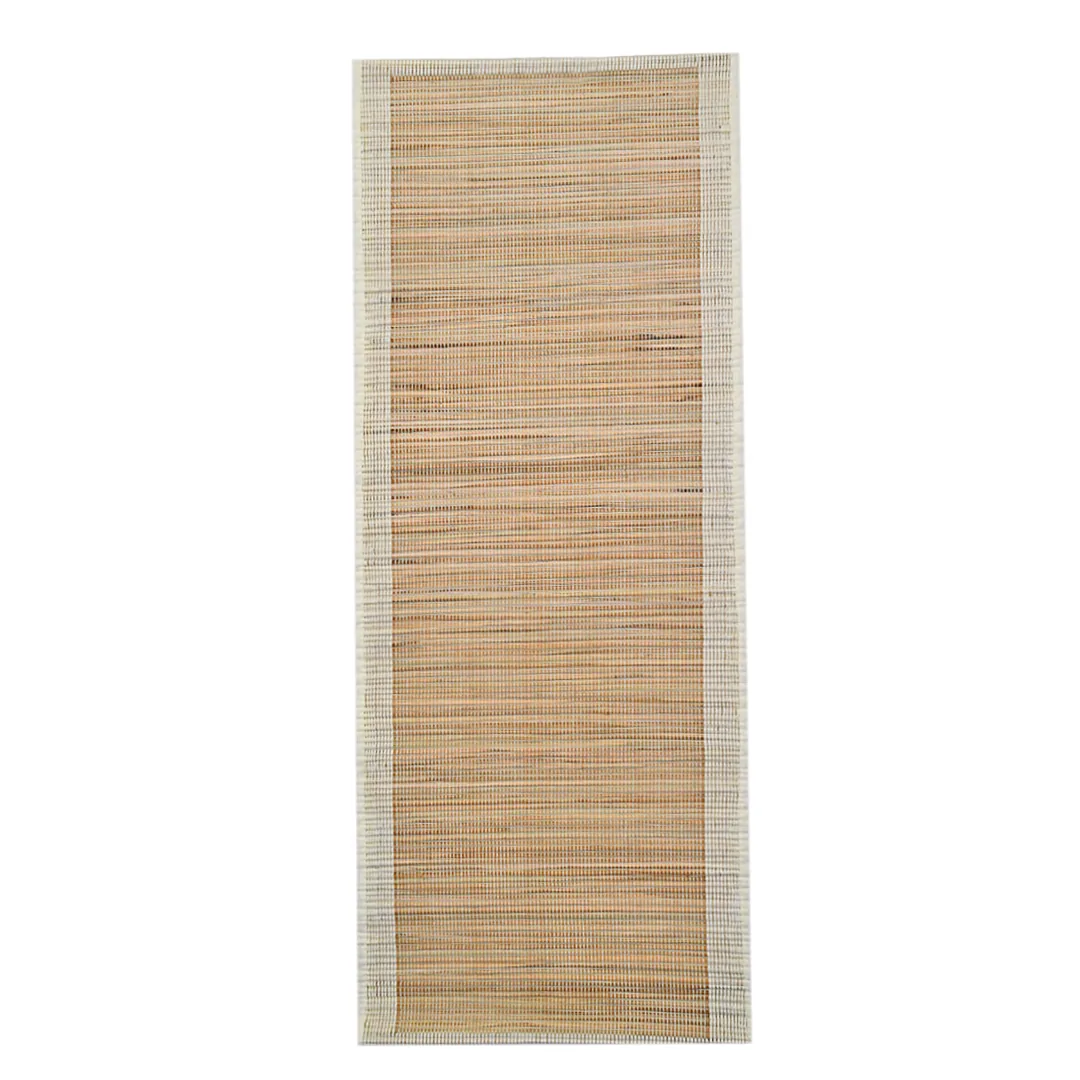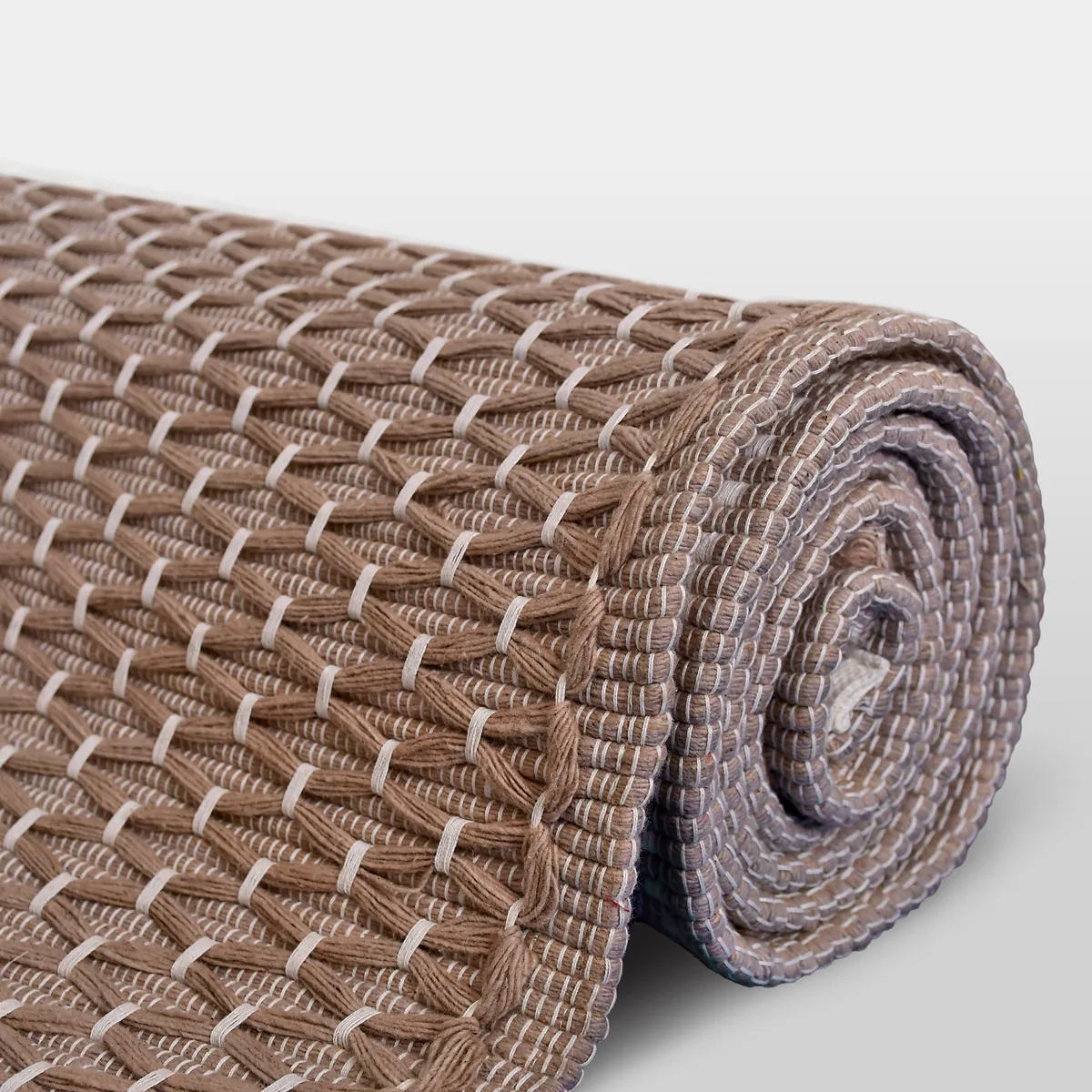
On tile, marble or wooden floors the best yoga mat has a grippy underside and a top surface that does not rely on suction: a cotton or grass mat with a thin layer of natural latex brushed onto the back. The latex holds the mat to polished tile, marble and wood by friction, while the woven surface handles your hands and feet. The most common reason any mat slides on tile is dust, so sweep before you unroll. From our range we would point you to the Diamond Clay for floor work on hard tile, the Indico for an all-round cotton rug, and the Sambu Frame for a cool, light grass mat.

The floors most of us practise on
Few Indian homes have carpet. We practise on vitrified tile, marble, granite, polished cement or wooden boards: smooth, hard, cool surfaces that collect a film of dust between sweeps. A mat for them must not creep when you step back into a lunge, must put something between the knees and the stone, and should not feel clammy in January or sticky in May. How it behaves is decided almost entirely by its underside, so that is where we start.
How a mat stays put on a smooth floor
Our cotton mats, sambhu grass mats and banana fibre mat all have a thin layer of natural tree latex brushed onto the underside by hand. It is a thin coat, not a slab of rubber, and it works by friction rather than suction: on clean tile, marble or wood the mat stays where you put it.
Two things defeat it. The first is dust: a film of grit between latex and tile acts like tiny ball bearings, and no underside grips through it. The second is time. After many washes the latex can soften and the grip can fade; a thin fresh coat of natural latex restores it, and we explain how in The natural latex grip layer: what it is, how it ages, and allergy notes.
If you are allergic to natural latex, choose with care and write to us first. Our Darbha mat is cloth-backed with no latex, and sits well under a seated practice.
Three mats for hard floors
Diamond Clay: 7 mm for knees on tile
The Diamond Clay is the thickest mat we weave. Seven millimetres of handwoven GOTS-certified organic cotton puts a dense layer between you and the stone for kneeling and anything on the back, and the raised diamond lattice gives hands and feet a texture to press into. At about 1.8 kg it lies flat as soon as it is unrolled; it is 183 × 68 cm (72 × 27 in). The clay colour comes from alkanet root. It can be machine washed on a delicate 30 °C cycle in a laundry bag and dried flat away from the sun. At the time of writing it is ₹4,450.
Indico: the all-round cotton rug
The Indico is 5 mm of GOTS-certified organic cotton in a ribbed weave, dyed in natural indigo, with hand-knotted tassels. On tile it warms under you, absorbs sweat and grips a damp palm; the ribs give dry hands traction and the latex underside keeps it on the floor. It is 183 × 68 cm (72 × 27 in) and about 1.4 kg. Hand wash cold with a mild natural detergent, separately for the first washes, and dry flat in shade. At the time of writing it is ₹4,499.
Sambu Frame: cool grass for summer tile
The Sambu Frame is sambhu grass woven with GOTS-certified organic cotton in the pattern our weavers call the TV weave: a warm tan field framed by a paler border. Grass stays cool to the touch, which is a real comfort on tile in the hot months when a rubber mat would be clammy. It is 3 mm, 183 × 68.5 cm (72 × 27 in) and about 1 kg, with a natural latex underside. Being thin and firm it suits standing and flowing practice better than long kneeling. Shake it out, wipe with a damp cloth, never soak. At the time of writing it is ₹1,799.
Which one for you
| Diamond Clay | Indico | Sambu Frame | |
|---|---|---|---|
| Fibre | GOTS-certified organic cotton | GOTS-certified organic cotton | sambhu grass with GOTS-certified organic cotton |
| Thickness | 7 mm | 5 mm | 3 mm |
| Weight | ≈1.8 kg | ≈1.4 kg | ≈1 kg |
| Underside | natural latex | natural latex | natural latex |
| On cold tile in winter | warmest | warm | cool |
| On hot tile in summer | fine | fine | coolest |
| Kneeling comfort | best | good | firm |
| Washing | machine, delicate 30 °C, laundry bag | hand wash cold | wipe only |
| Price at the time of writing | ₹4,450 | ₹4,499 | ₹1,799 |
If you kneel a lot or your floor is hard stone, the Diamond Clay. If you want one cotton rug for everything, the Indico. If your room is hot and you mostly stand and flow, the Sambu Frame.
Before you practise on tile
Sweep or dry-mop the patch of floor you use; this does more for grip than any mat feature. Let a wet-mopped floor dry completely, because a damp floor under latex is as slippery as a dusty one. Give a new mat a few hours unrolled so the ends settle, and dampen dry palms before the first downward dog. On a newly polished or waxed wooden floor, test a corner first, as with any mat. More in How to stop a cotton yoga mat slipping.
Honest limits
Cotton can slip under completely dry hands for the first few minutes. Grass mats are firm and not cushioned. The latex layer softens after many washes and will eventually want a fresh coat. And no underside grips on a dusty floor, ours included.
Frequently asked questions
Will a cotton yoga mat slip on marble or tiles?
Not if the floor is clean and the mat has a grippy underside. Our cotton mats have a thin layer of natural tree latex brushed onto the back, which holds on tile, marble and wood by friction. Dust is the usual cause of a mat creeping on a smooth floor, so sweep before you unroll. If you are allergic to natural latex, choose with care and write to us first.
Which thickness is best for a tile floor?
For kneeling, lunges and work on the back, 7 mm of dense cotton is the most comfortable on stone; our Diamond Clay is woven to that thickness. For standing and flowing practice 5 mm is plenty, and 3 mm grass is fine for people who do not kneel for long. Dense woven cotton feels firmer than foam of the same thickness, so do not compare the numbers directly.
Does the latex underside mark or damage floors?
The latex is natural tree latex brushed on thinly and fully dried before the mat leaves us, and it is meant to sit on tile, marble and wood. As with any mat on a newly polished or waxed floor, we would test a corner first and check the floor after practice. Keep the floor clean, because grit trapped under any mat is what scratches.
Is a grass mat good on a tile floor?
Yes, especially in hot weather. Sambhu grass stays cool to the touch where rubber turns clammy, and our grass mats have the same natural latex underside as the cotton ones. They are firm and 3 mm thick, so they suit standing and flowing practice better than long kneeling, and they are wiped clean rather than washed.
If your practice is on tile and your knees know it, start with the Diamond Clay, or compare all our mats in the collection.