A handloom mat is woven by a weaver working a loom by hand and foot, with no motor; a power loom mat is woven by a machine with the weaver mostly supervising. You can usually tell them apart by the selvedge, the slight irregularities in the weave, the density of the cloth and the way the ends are finished. The difference matters for the feel of the mat, for how long it lasts, and for who earns a living from it.

What each loom actually does
A loom holds the long warp threads under tension while the weaver passes the weft across, then beats it into place. On a handloom every one of those actions is made by a person: the shuttle is thrown by hand, the shed is changed with foot treadles, and the beater is pulled by arm. The weaver sets the rhythm and can adjust tension and beat as the cloth grows.
A power loom does the same sequence with an electric motor. It is faster and produces very even cloth, and that is exactly what it is for. Much of the cotton cloth in the world is made this way, and there is nothing wrong with it. But it changes the product in ways you can see and feel, and it changes who does the work.
All of our mats are handwoven by our own weavers in Komarapalayam, with no electricity used in the weaving itself. We describe the process step by step in How a handloom yoga mat is woven.
How to tell a handloom mat from a power loom mat
No single sign is proof on its own, but together they are hard to fake.
| What to look at | Handloom | Power loom |
|---|---|---|
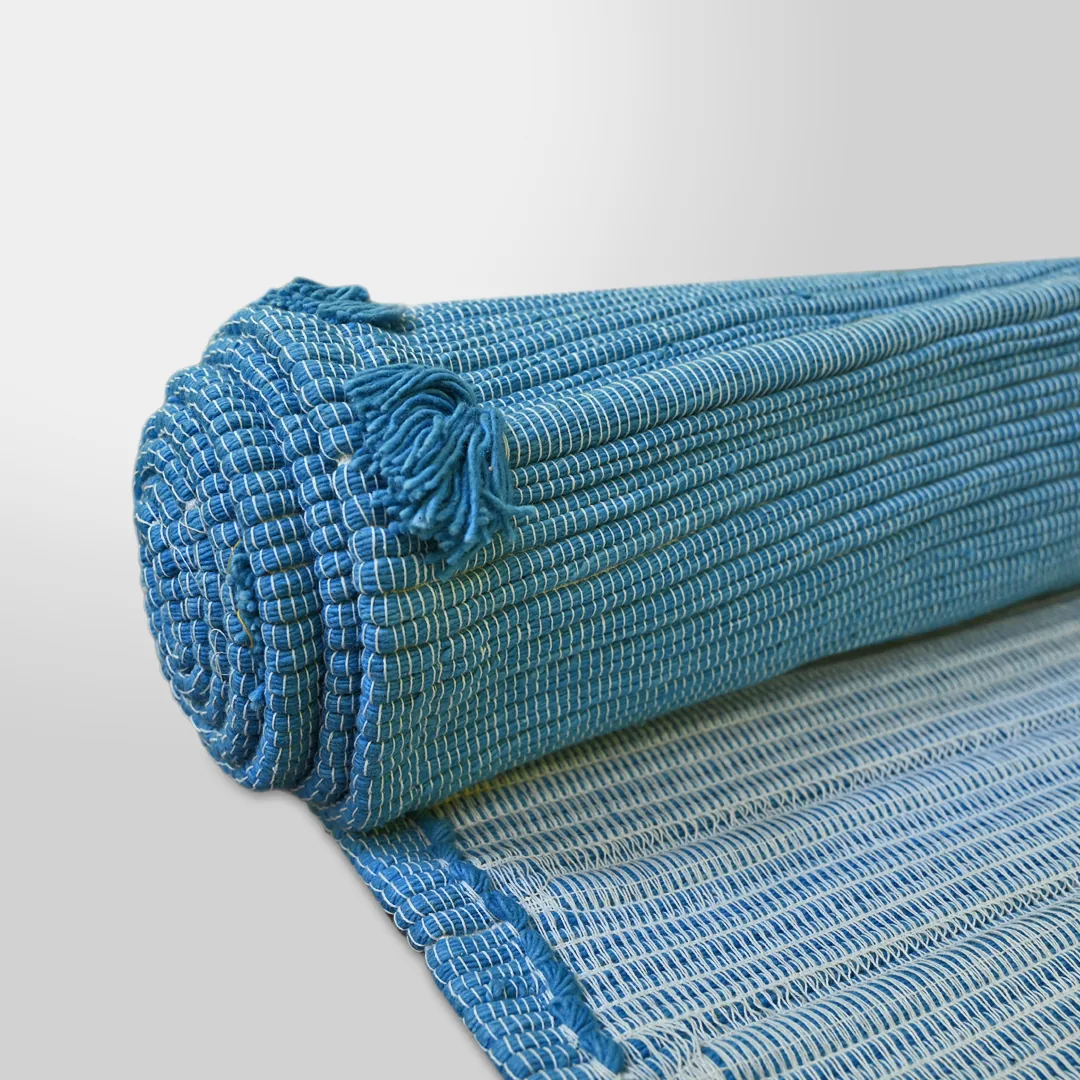
| Selvedge (the long edges) | Slightly uneven, often firmer and thicker than the body, because the weaver turns the weft by hand | Very straight and uniform, sometimes with a fringe of cut threads or a stitched edge |
| Weave regularity | Small variations in the beat: a rib a little closer or wider here and there | Mathematically even from end to end |
| Density | Often heavier and denser for the thickness, because the weaver beats thick yarn in firmly | Can be dense too, but tends to be lighter for the same look |
| Ends | Hand-knotted tassels or a hand-finished hem | Machine-stitched hem, or warp ends simply cut |
| Pattern joins | Colour bands meet with a slight softness at the boundary | Crisp, identical boundaries |
| Between two mats of the same design | Shade and width vary a little | Near identical |
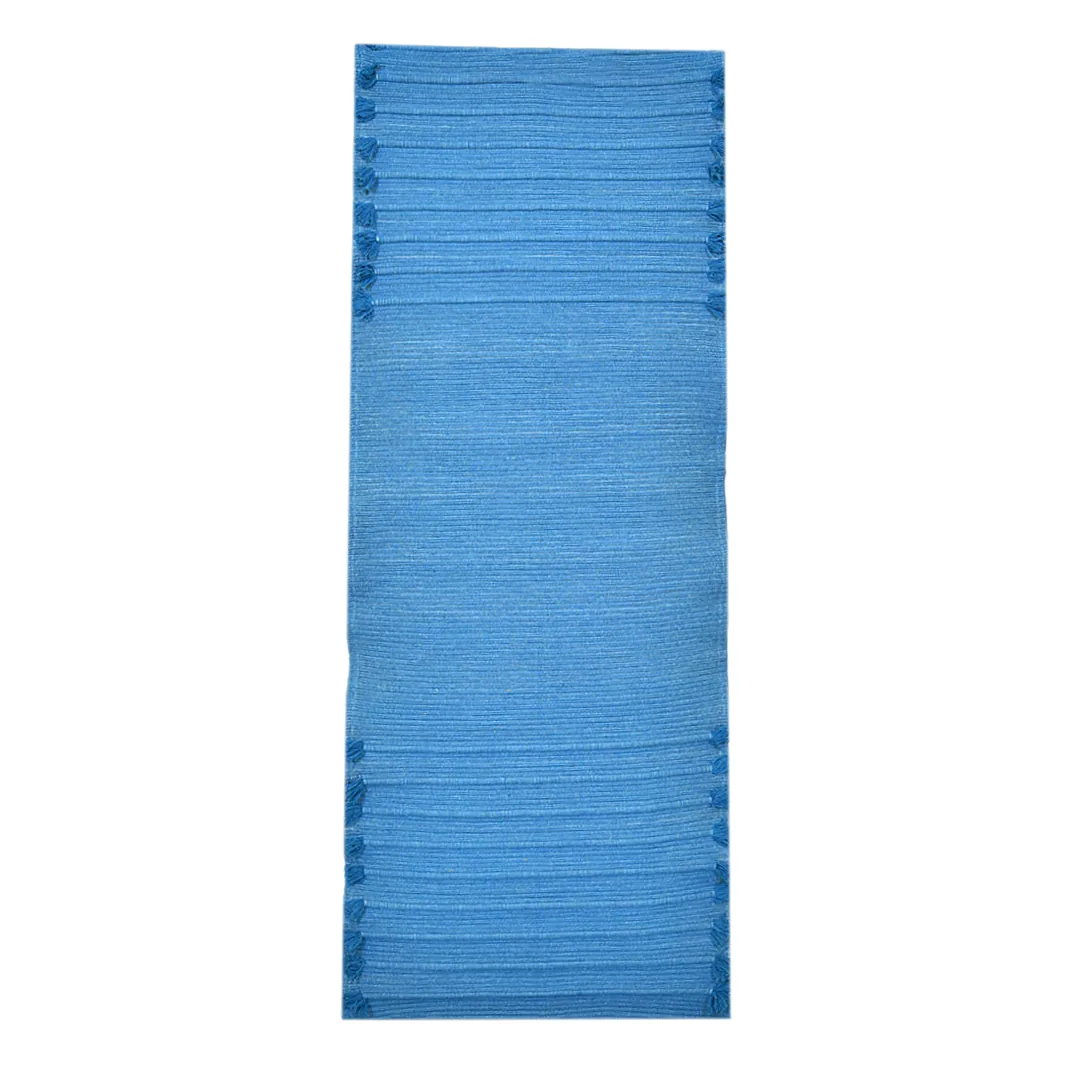
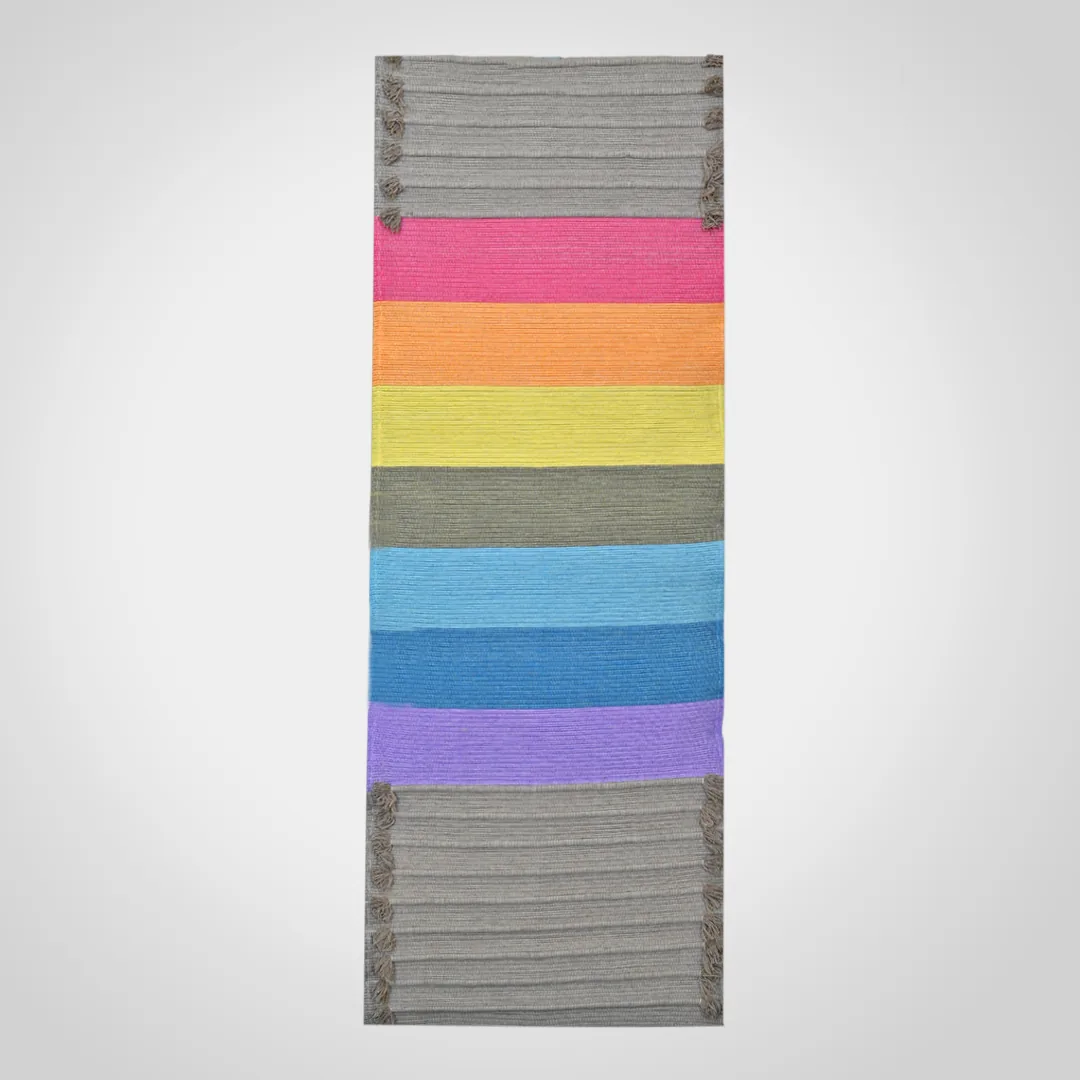
Pick up our Indico and turn it over. The ribbed weave shows the beat of the loom, the tassels are knotted by hand, and the two long edges are not perfectly matched. On the Prithvi, the earth-toned ground and the seven colour bands show the same character. We go deeper into the practical checks in How to spot a genuine handloom product.
Irregularities are not defects
A slight slub in the yarn, a rib that sits a touch closer to its neighbour, a width that differs by a few millimetres from the mat beside it on the shelf: these are what hand-weaving looks like, and we do not grade them as faults. What we do count as a fault is a broken warp thread, a hole, a loose tassel or dye that transfers heavily after the first washes. If something like that reaches you, the Returns page explains what to do.
Why the difference matters
For the mat
The firm hand beat on a six-ply or ribbed cotton rug gives a dense cloth that holds its shape, and dense cotton grips better and wears longer than loose cotton. Hand-knotted tassels and a sound selvedge are the two places a rug usually fails first, and when they are made by hand they can be repaired by hand.
For the people
Hand-weaving is slow. One weaver produces a small number of mats in a day, and that time is the main cost of a handloom rug. When you buy one you are paying for hours at the loom in a weaving town rather than for machine time. We weave in our own workshop with our own weavers, with no middlemen, and we think that is the honest way to make the case: not that machine cloth is bad, but that handloom cloth keeps a skill and a livelihood going.
For the price
A handloom cotton mat will cost more than a machine-woven one of similar weight. Our cotton rugs sit between about ₹3,500 and ₹4,500 at the time of writing. If a "handloom" mat is priced like a power loom one, it is reasonable to ask how.
The Handloom Mark
The Government of India runs a scheme that gives buyers a way to check. The Handloom Mark Scheme was launched in 2006, with the Textiles Committee of the Ministry of Textiles as its implementing agency. Its purpose is to assure the buyer that a labelled product is genuinely hand-woven; registered producers and sellers attach its label to their products.
We should be clear: we do not currently hold Handloom Mark registration, and we will say so plainly rather than imply otherwise. When you shop elsewhere, the Mark is a useful thing to look for, and we explain how it works as a buyer's tool in The Handloom Mark and what it means. For our own mats, the evidence is the weave itself, the tassels, the selvedge and the fact that you can ask us directly how and where a mat was made.
What we do not claim
Handloom does not automatically mean organic, plant-dyed or better made; those are separate choices. Our cotton is GOTS-certified organic cotton and our dyes are plant-based, but those facts stand on their own. Nor does handloom mean flawless: handwoven goods vary slightly, and we would rather you knew that before ordering than be surprised after.
Frequently asked questions
What is the difference between handloom and power loom?
A handloom is worked entirely by a person, who throws the shuttle, changes the shed with foot treadles and beats the weft in by hand, with no motor. A power loom does the same sequence with an electric motor, faster and with very even results. Handloom cloth shows small variations in the weave and selvedge; power loom cloth is uniform from end to end.
How can I tell if a yoga mat is handwoven?
Look at the long edges, which on a handloom mat are slightly uneven and often firmer than the body; at the weave, where the beat varies a little; and at the ends, which are usually hand-knotted or hand-hemmed. Two handwoven mats of the same design will differ slightly in shade and width. Where a seller is registered, a Handloom Mark label is another check.
Is a handloom yoga mat better than a power loom one?
It depends what you value. A firmly hand-beaten cotton rug is dense, grips well and can be repaired, and buying it supports a weaver's livelihood directly. A power loom mat is cheaper and perfectly uniform. Neither is automatically better made; ask about the fibre, the dye and the backing as well as the loom.
What is the Handloom Mark?
The Handloom Mark is a Government of India scheme, launched in 2006 and implemented by the Textiles Committee. Its label is meant to assure buyers that a product is genuinely hand-woven, and registered producers and sellers attach it to their products. TwinsPoles does not currently hold this registration.
Why do handwoven mats cost more?
Because they take longer. One weaver produces a small number of mats in a day on a handloom, and that time is the main cost. A machine-woven mat spreads the same cloth across minutes of motor time. You pay for hours at the loom and for a product that can be repaired by hand.
If you would like to see the signs for yourself, the Indico is the plainest mat we weave and shows the hand beat most clearly; the Prithvi shows how colour bands meet on a handloom. All of our handwoven mats are in the collection.