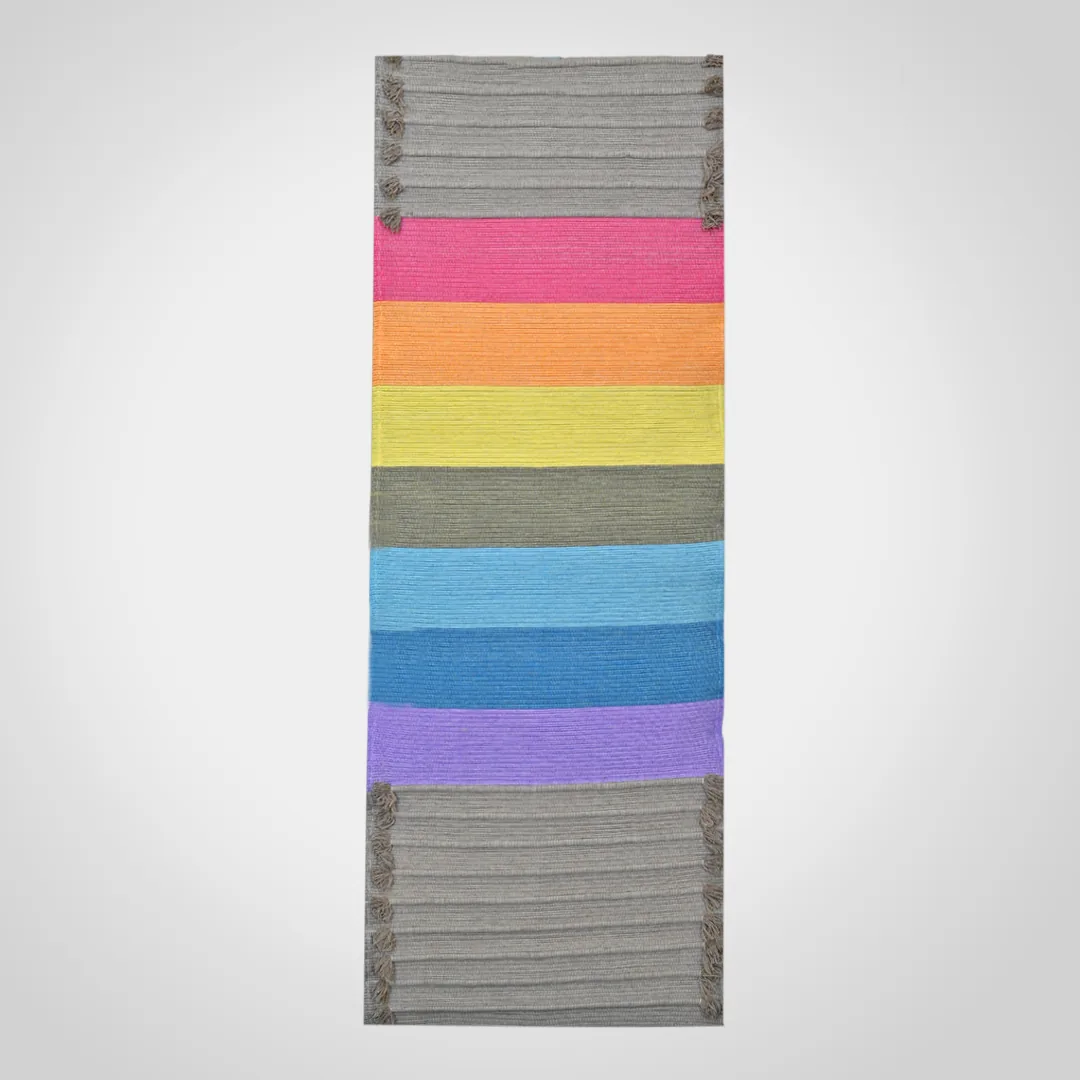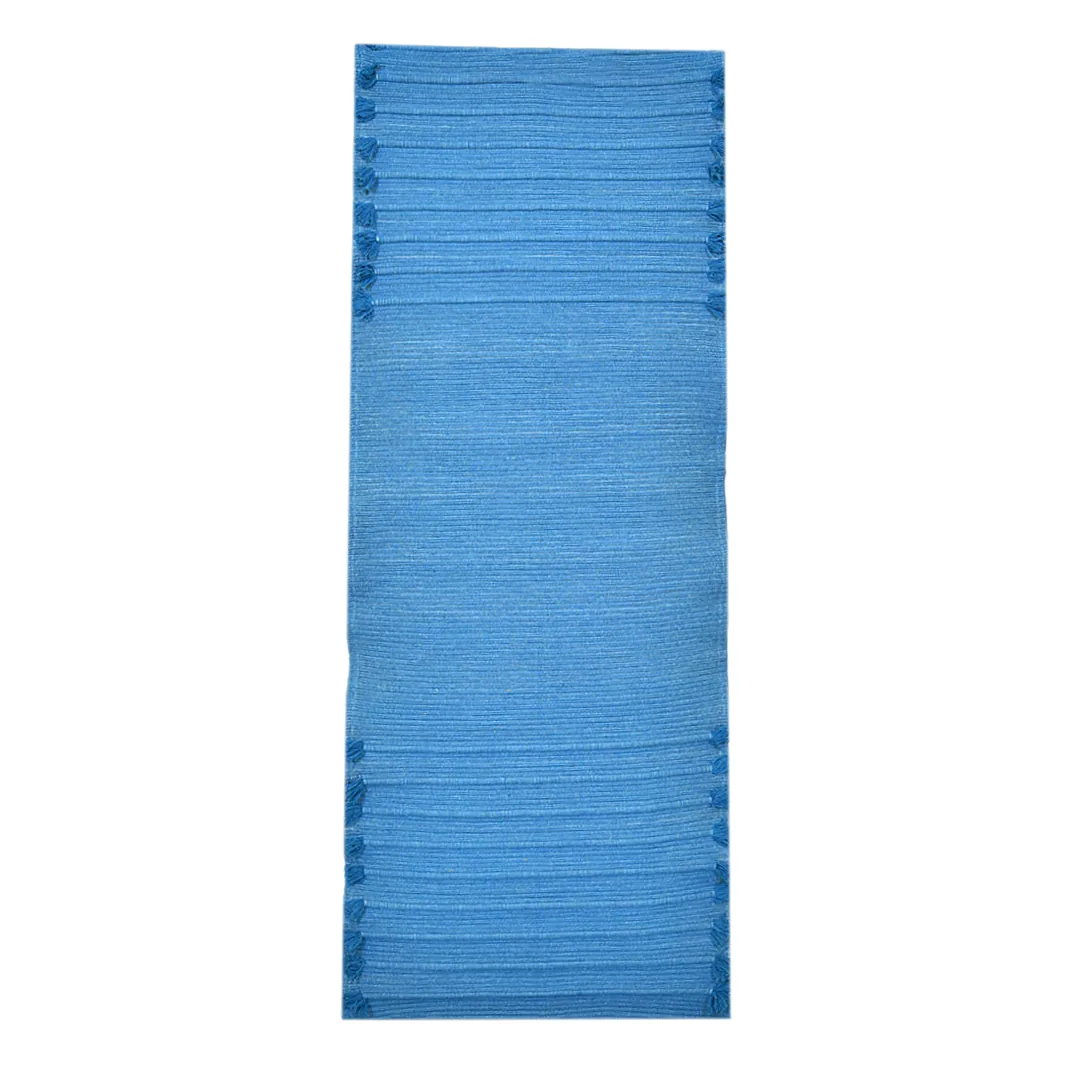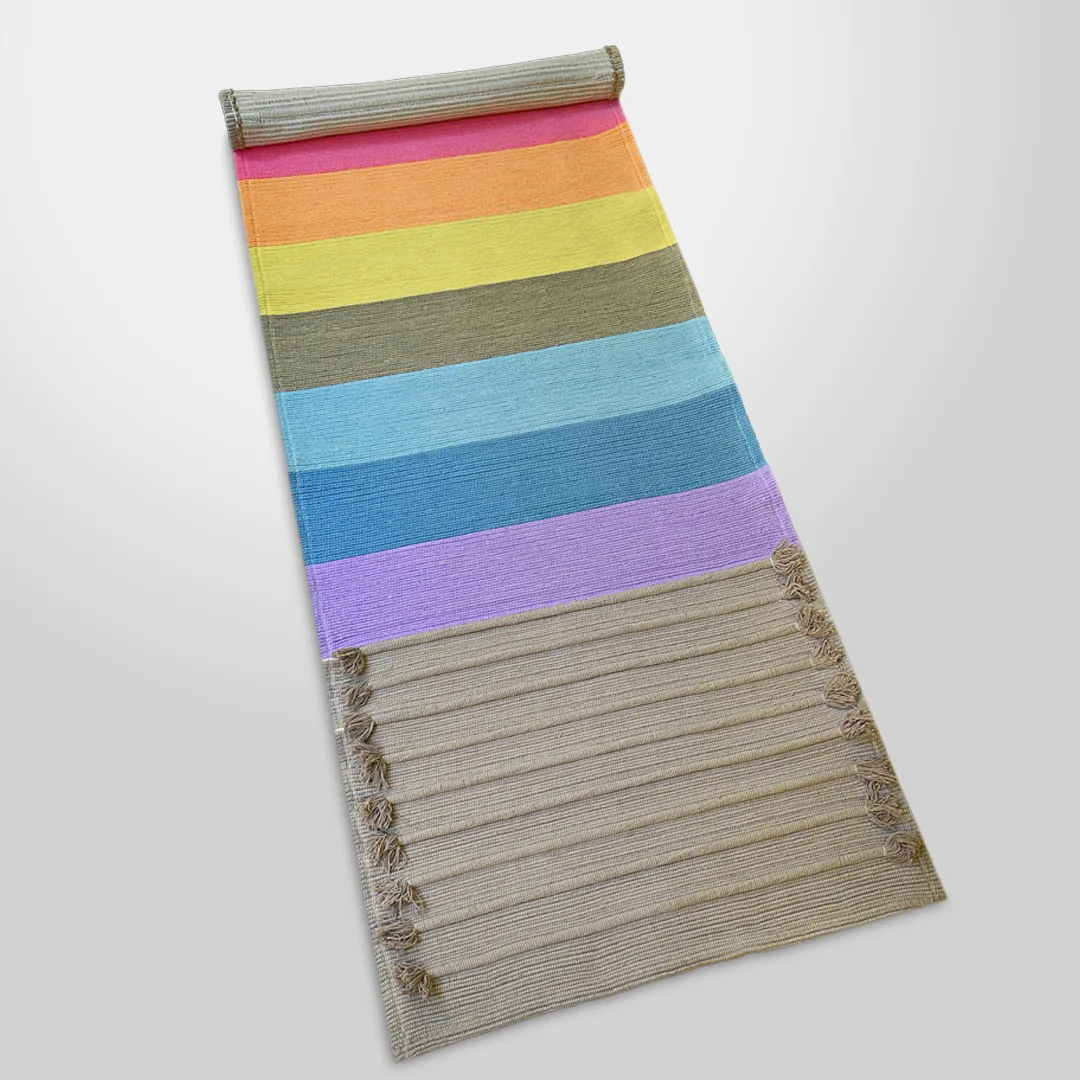
A handloom yoga mat begins as hanks of plant-dyed cotton yarn and ends, days later, as a dense rug with a brushed latex underside and hand-knotted tassels. Between the two come the steps every handloom weaver knows: measuring out the warp, dressing the loom, passing the weft and beating it down, keeping the selvedge true, and finishing. This is the way we work in our own workshop in Komarapalayam, on looms that no electricity drives.

The yarn arrives dyed
For the cotton mats we start with GOTS-certified organic cotton yarn, dyed in our own dye shed before it reaches a loom. The Indico takes its blue from indigo leaves; the chakra rugs such as the Prithvi draw on a palette of more than twenty herbs, turmeric, neem and tulsi among them. Because the yarn is dyed before weaving, the colour is woven in rather than printed on, and it runs right through the cloth. How the colour gets into the fibre is a story of its own, told in a day in the dye shed. Once dry, the yarn is wound onto bobbins and sorted by colour for the loom.
Warping: measuring the length
Every woven cloth has two sets of threads. "The vertical warp yarns are held stationary in tension on a loom (frame) while the horizontal weft (also called the woof) is drawn through (inserted over and under) the warp thread" (Wikipedia). Warping is the job of measuring out all the lengthwise threads to the same length and in the right order, and it is slow, careful work done before any weaving can begin. On a handloom it is usual to warp for more than one piece at a time, so the loom is dressed once for a short run of mats. The warp decides the width of the mat and, with the reed, how closely the threads sit.
Dressing the loom
The measured warp is wound onto the back beam of the loom, and each thread is drawn by hand through the heddles, which lift the threads, and then through the reed, the comb that spaces them and beats the weft down. The ends are tied to the front beam and the whole warp is brought up to an even tension. A thread out of place here shows as a flaw along the whole length of the mat, so this stage is checked and checked again. Our looms are wooden and worked with the hands and feet; there is no motor.
The weft and the beat
Now the weaving proper. The weaver presses a treadle, which lifts one set of warp threads and opens a gap called the shed. The shuttle carrying the weft is thrown through the shed, the treadle is changed so the other set of threads lifts, and the reed is pulled firmly forward to beat the new weft against the cloth. Then again, and again, for the whole length of the mat.
Two things in this rhythm make a yoga rug what it is. The first is the yarn: the chakra rugs are woven with six-ply cotton, six strands twisted together, which is why 5 mm of Prithvi feels denser than 5 mm of foam. The second is the beat. A firm, even beat packs the weft tightly, and that density gives the mat its weight and its stay-put feel. The ribbed texture of the Indico comes from the weave itself, the way the weft packs between the warp threads, not from anything added.
Where a band of colour runs across a chakra rug, it is a change of weft: the weaver finishes one colour, changes the shuttle and begins the next, so the seven bands are woven in, not printed. Keeping each band the same width from one rug to the next is done by eye and by measure.
The selvedge
At each side the weft turns and goes back, and this turning edge is the selvedge. On a handloom the weaver controls it every pass, keeping it neither so loose that it waves nor so tight that it draws the cloth in. A handwoven selvedge is woven, not cut and overlocked, and it is never perfectly even; a slight irregularity is one of the honest signs of the hand. What to read in those edges, and in the tassels, is in tassels, selvedge and slubs.
Cutting off and finishing
When the run is done the cloth is cut from the loom with a length of bare warp left at each end. On the Prithvi and the Indico those warp ends are gathered and knotted by hand into tassels, which is why no two tassels are quite the same. The mat is checked across its whole surface in good light, loose ends are trimmed, and anything we would not want to unroll ourselves goes back for mending.
The latex coat
The finished cloth is laid face down and a thin layer of natural tree latex is brushed onto the underside by hand. This is the grip layer: it holds on tile, marble and wood without adding noticeable thickness or weight. It is left to dry in shade. After many washes the coat can soften, and a thin fresh coat of natural latex restores it. If you are allergic to natural latex, choose with care and write to us first. Our Darbha mat is the exception: it is backed in cotton cloth and has no latex layer.
Drying, rolling, packing
Once the latex is dry the mat is rolled and packed without plastic for the journey to you. The time from warping to packing is measured in days, not hours; the warping and dressing are shared across a run of mats, the weaving itself is one rug at a time.
| Stage | What happens | What you see on the mat |
|---|---|---|
| Dyeing | Yarn dyed with plants in our shed | Colour through the cloth; gentle variation between batches |
| Warping | Lengthwise threads measured and ordered | Even width; straight edges |
| Dressing | Threads drawn through heddles and reed | No long flaws; even spacing |
| Weaving | Weft thrown and beaten, pass by pass | Density; ribs; colour bands |
| Selvedge | Edges turned by hand each pass | Woven edge, slightly uneven |
| Finishing | Cut off, warp ends knotted | Hand-knotted tassels |
| Latex | Brushed onto the underside | Grip on hard floors |
What to look for when it arrives
A handloom mat carries the marks of all this: a selvedge that wanders a hair, a slub where the yarn thickened, tassels of slightly different lengths, a shade a little different from the photograph. None of these is a fault. How to tell a handloom piece from a power-loom one, and why it matters to the people who weave, is in handloom vs power loom mats.
Frequently asked questions
How are yoga rugs made on a handloom?
Dyed cotton yarn is measured into a warp, threaded through the loom, and woven by passing a weft thread through the raised warp and beating it down, pass after pass, by hand and foot. The cloth is cut off, the warp ends are knotted into tassels, and a thin coat of natural latex is brushed onto the underside.
What is the difference between warp and weft?
The warp is the set of threads held under tension along the length of the loom; the weft is the thread carried across them by the shuttle. On a yoga rug the warp runs the length of the mat and the weft runs across it.
Why does a handwoven mat vary from the photograph?
Because the hands, the beat and the dye bath vary a little every time. Plant colour differs between batches and softens with years, and the selvedge and tassels carry the marks of being made by a person. We treat these as the nature of the thing, not as defects.
How is the grip layer put on?
By hand, with a brush. A thin layer of natural tree latex goes onto the underside of the finished cloth and dries in shade. It holds on tile, marble and wood, and it can be refreshed with a thin new coat when it softens after many washes. The Darbha mat is cloth-backed instead.
Is the weaving really done by hand?
Yes. Every mat is woven on a handloom worked by hand and foot, without electricity, by our own weavers. We dye the yarn ourselves and brush the latex on by hand. Handwoven goods are not identical, and that is the point.
If you would like to see the result of all this, the Prithvi shows the six-ply weave and the hand-knotted tassels most clearly, and the Indico the ribbed weave in a single indigo.