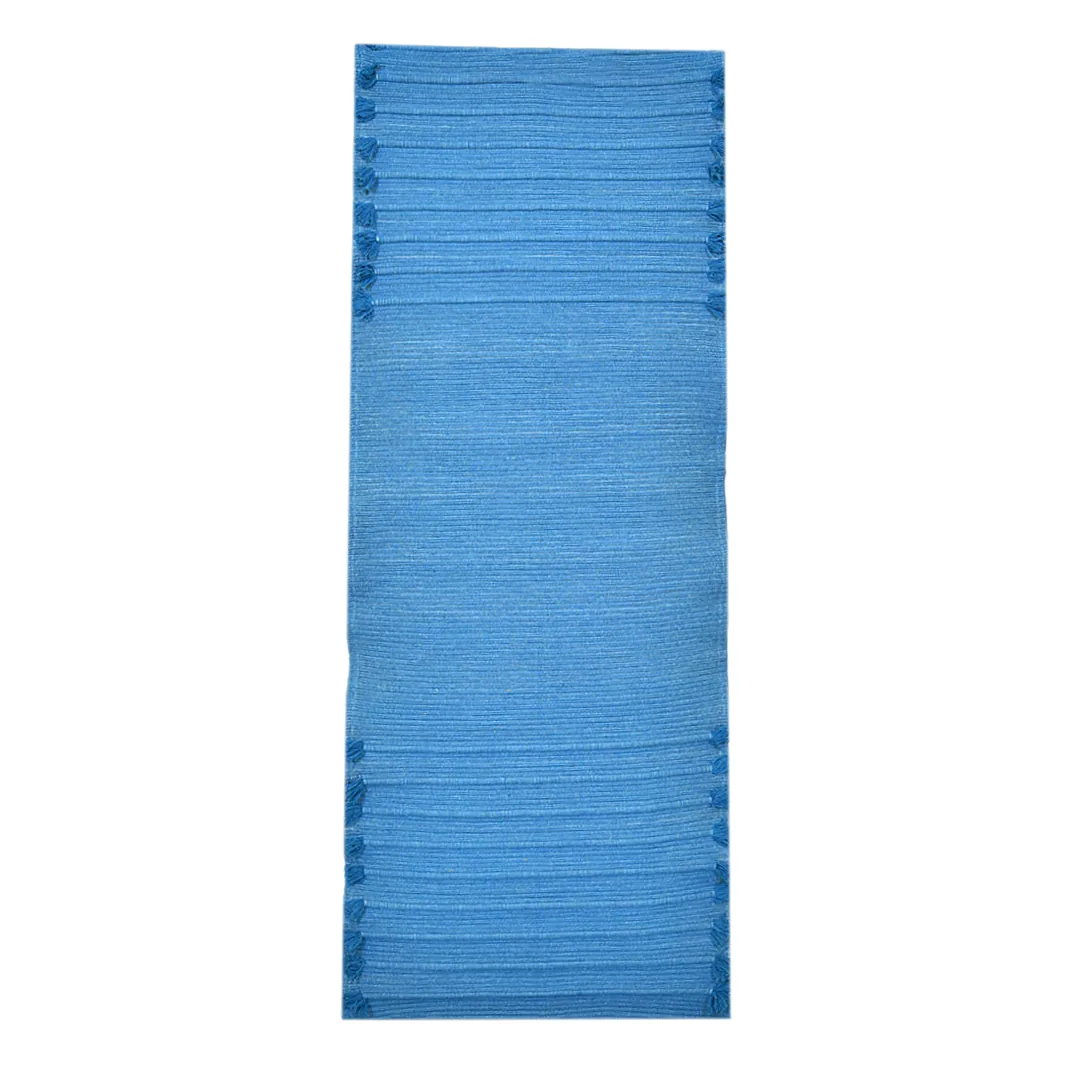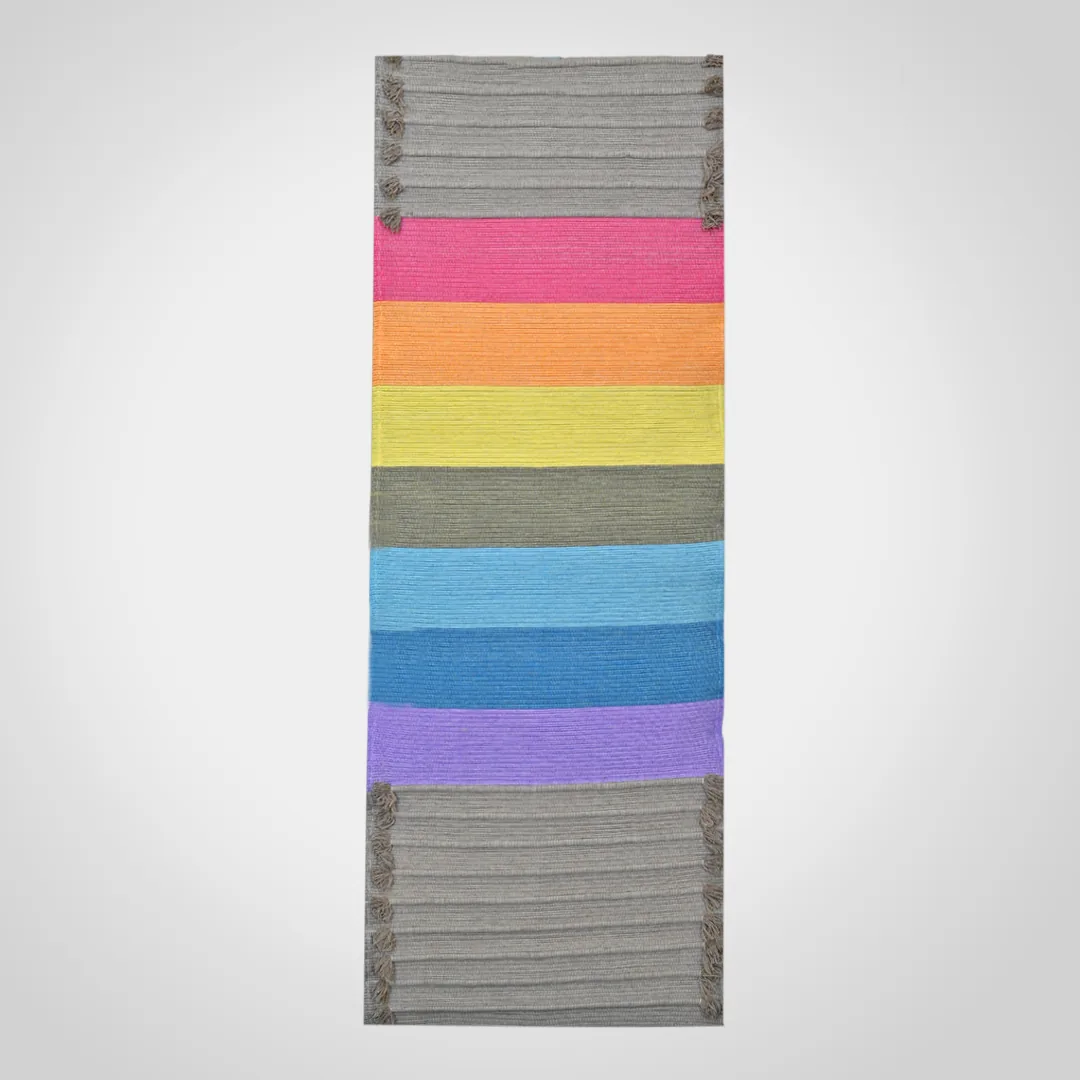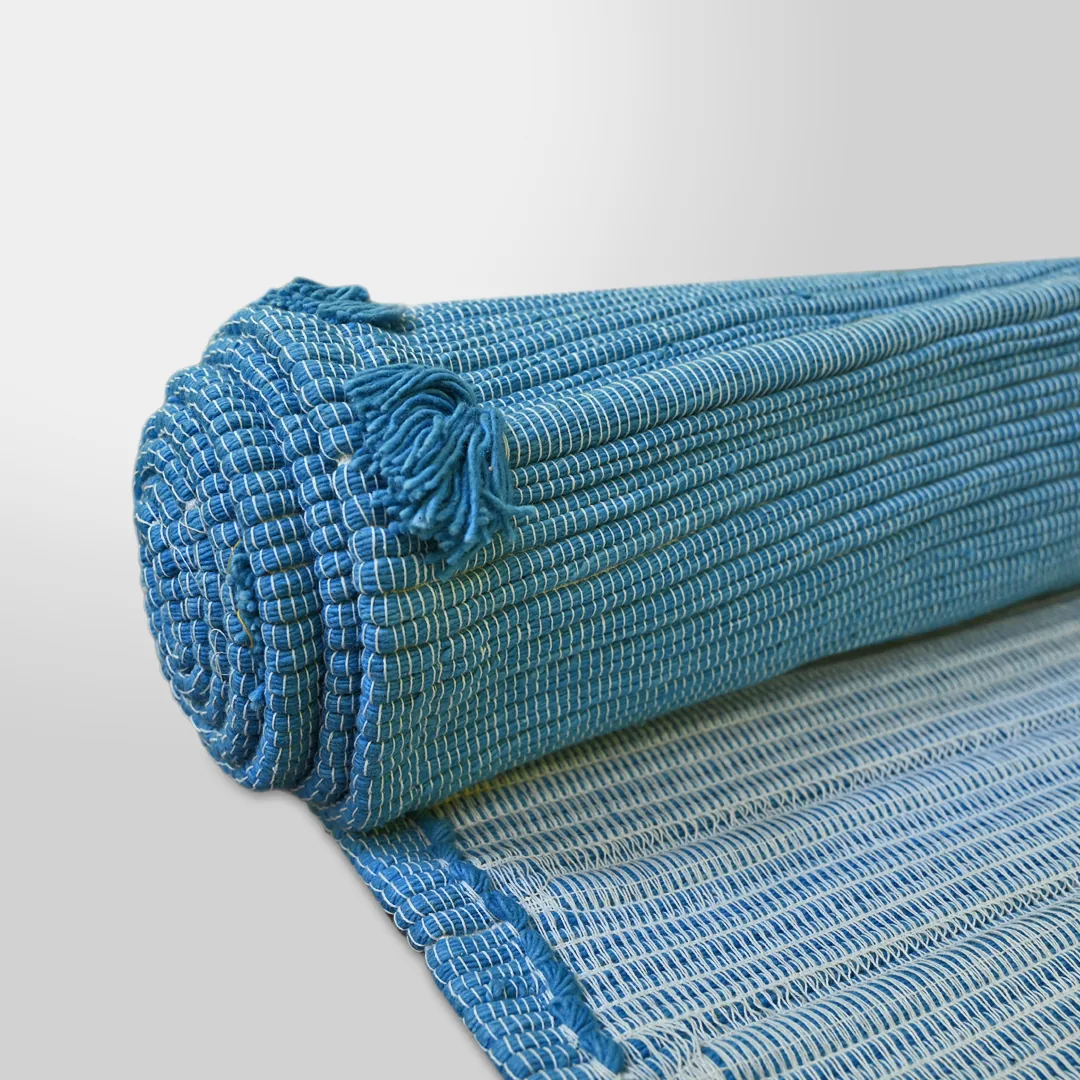
On a handwoven mat, three small details tell you most of what you need to know: the tassels at the ends, the selvedge along the long edges and the slubs in the yarn. Tassels show how the warp was finished and whether it can be repaired; the selvedge shows how the weft was turned at the edge; slubs show that the yarn and the beat carry a human irregularity, which is normal. Here is how to read each one, and what each means for care.

Tassels: how the warp was finished
When a length of cloth comes off the loom, the long warp threads are left hanging at each end. Something has to stop the weft from working loose, and there are two honest ways to do it: knot the warp ends into tassels, or turn and stitch a hem. On the Indico and the Prithvi, the ends are hand-knotted into tassels.
What to look for: a knot that sits tight against the last weft, groups of threads of roughly but not perfectly equal size, and a little variation in tassel length from one to the next. Those are the signs of a hand. A machine-stitched hem is not a fault, but it is a different construction, and warp ends simply cut and left is a sign of hurry.
What it means for care: tassels are the first place a rug shows wear, and hand-knotted ones can be re-knotted by hand. Wash cotton rugs cold and dry them flat so the tassels are not dragged, and if a knot loosens, retie it rather than cutting it off.
Selvedge: how the weft was turned
The selvedge is the self-finished edge of a piece of fabric, formed where the weft thread loops back at the end of each row along the edges parallel to the warp; it keeps the cloth from unravelling and fraying without any further finishing (Wikipedia: Selvage). On a handloom the weaver turns the weft by hand at every pass, and a handloom selvedge generally matches the thickness of the rest of the cloth. Some shuttleless power looms instead cut the weft at the edge and leave a fringe, or tuck or heat-seal it, which gives a quite different-looking edge (Wikipedia: Selvage).
What to look for: run your thumb along the long edge of the Indico. It should be continuous, with no cut ends, and slightly uneven in a way that follows the beat. The two long edges of a handwoven mat will not be perfectly matched.
What it means for care: a sound selvedge is why a handwoven cotton rug can be washed without the edges fraying. If an edge ever starts to loosen, a few stitches by hand will hold it; there is no binding tape to replace.
Slubs and the beat: what the yarn tells you
A slub is a short thicker place in a spun yarn. In cotton that has been spun and woven with some irregularity, slubs appear now and then as small raised flecks in the cloth. Alongside them you may see the beat vary: a rib a touch closer to its neighbour, a weft line that wanders by a hair. On a plant-dyed rug, a slub often takes the dye a little differently too, so it shows as a tiny point of deeper or paler colour.
What to look for: slubs scattered, not clustered; a beat that varies gently rather than leaving gaps you can see light through. A broken warp thread, a hole, or a loose, open patch is a different matter and we treat it as a fault. The line between variation and defect is drawn in Why no two handwoven mats are identical, and the broader handloom signs are in Handloom vs power loom yoga mats.
What it means for care: nothing special. Slubs do not weaken the cloth or catch in the wash. They are part of the surface and will soften with use.
Turn it over
The underside of our cotton and grass mats carries a thin layer of natural tree latex brushed on by hand, which is what holds the mat on tile, marble and wood. Look for an even matt film that follows the texture of the weave; after many washes it can soften, and a thin fresh coat of natural latex restores it. If you are allergic to natural latex, choose with care and write to us first. The Darbha grass mat is the exception: it is backed in cotton cloth and has no latex layer.
A quick reading guide
| Detail | What it tells you | Care note |
|---|---|---|
| Hand-knotted tassels | Warp finished by hand; repairable | Dry flat; retie a loose knot |
| Continuous, slightly uneven selvedge | Weft turned by hand on a shuttle loom | Hand-stitch if it ever loosens |
| Scattered slubs, gently varying beat | Natural character in the yarn and a hand beat | None needed |
| Even latex film underneath | Grip layer applied by hand | Re-coat thinly when it softens; latex allergy note applies |
Frequently asked questions
What is the selvedge on a handwoven mat?
The selvedge is the self-finished long edge of a woven cloth, formed where the weft loops back at the end of each row, which keeps the fabric from unravelling without a hem. On a handloom the weaver turns the weft by hand at every pass, so the edge is continuous and slightly uneven, and generally the same thickness as the body of the cloth.
Are slubs in a handwoven rug a defect?
No. A slub is a short thicker place in the spun yarn, and scattered slubs are a normal feature of handwoven cotton; on plant-dyed cloth they often show as tiny points of deeper or paler colour. What we do count as a fault is a broken warp thread, a hole or a loose open patch, and the Returns page explains what to do if one reaches you.
Why do handwoven mats have tassels instead of a hem?
Because knotting the warp ends is the traditional way to finish a handloom rug and it can be done, and redone, by hand. Hand-knotted tassels sit tight against the last weft and vary a little in size and length; a machine-stitched hem is a different, factory construction. Tassels wear first on any rug, so dry the mat flat and retie a knot rather than cutting it.
How should I care for tassels and edges?
Wash cotton rugs cold by hand, do not wring them, and dry them flat in shade so the tassels and selvedge are not pulled out of line. If a tassel knot loosens, retie it; if a selvedge thread lifts, a few hand stitches will hold it. Never tumble dry, which is the quickest way to tangle tassels.
Pick up the Indico or the Prithvi and read the ends, the edges and the surface for yourself; the Mat care page covers the washing routine for each.