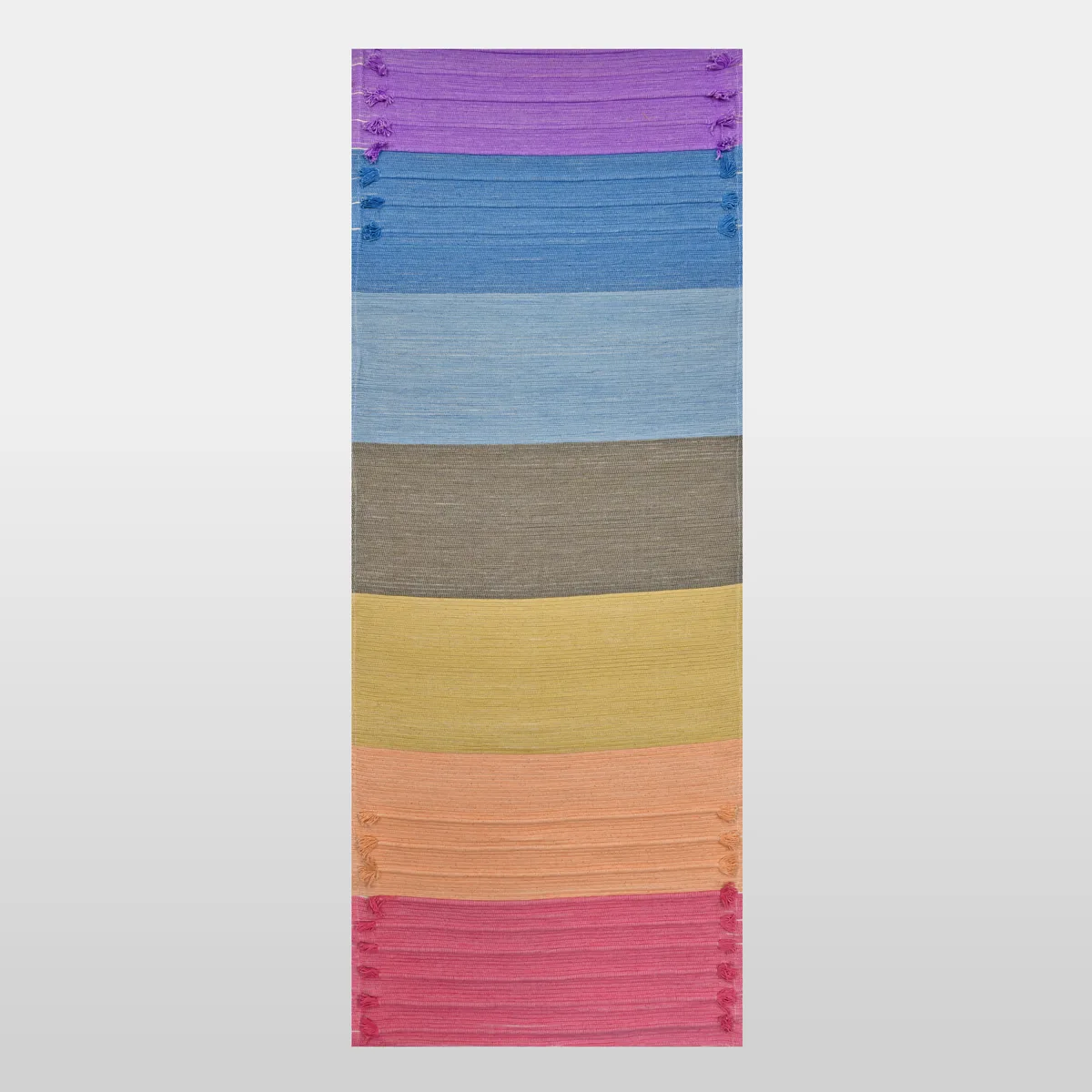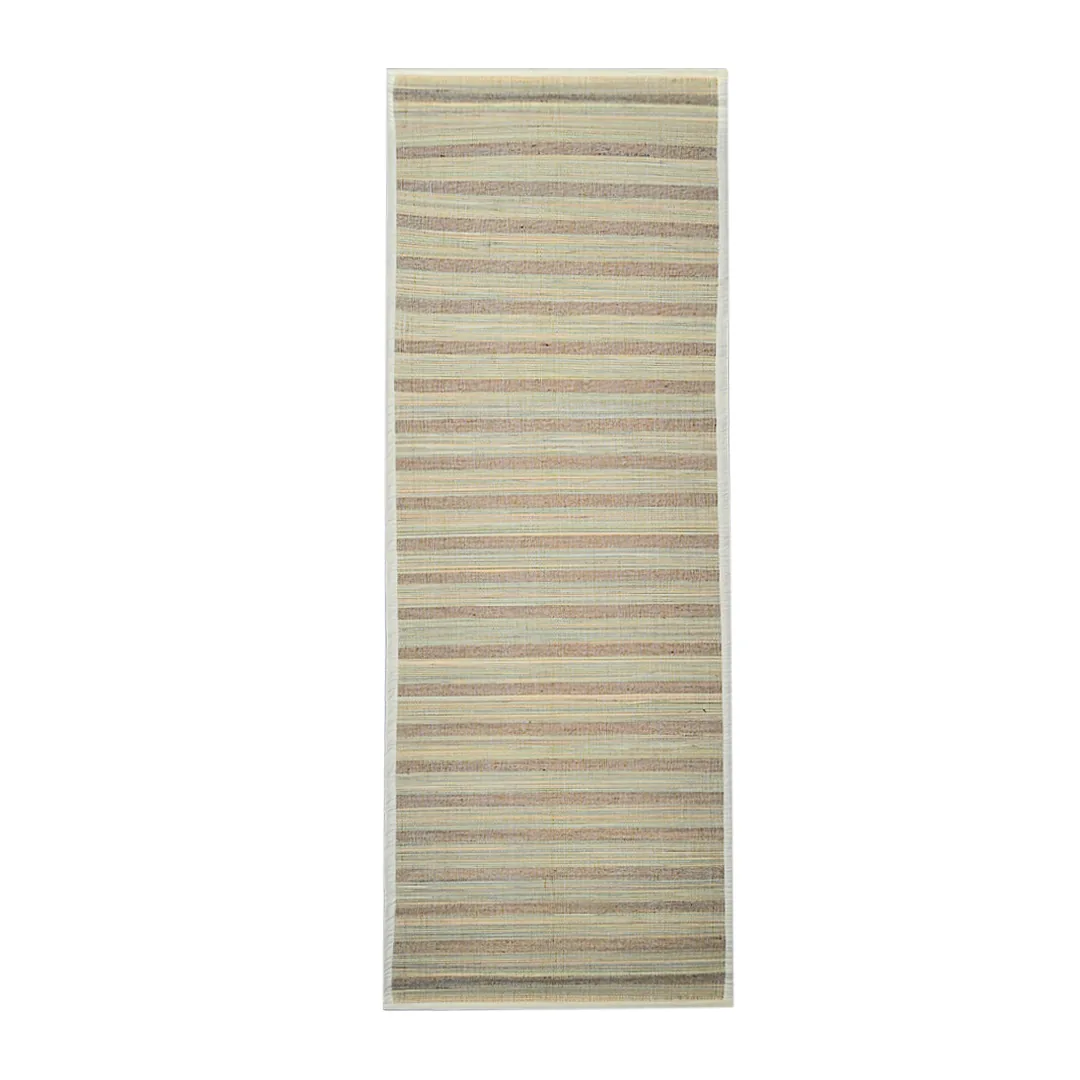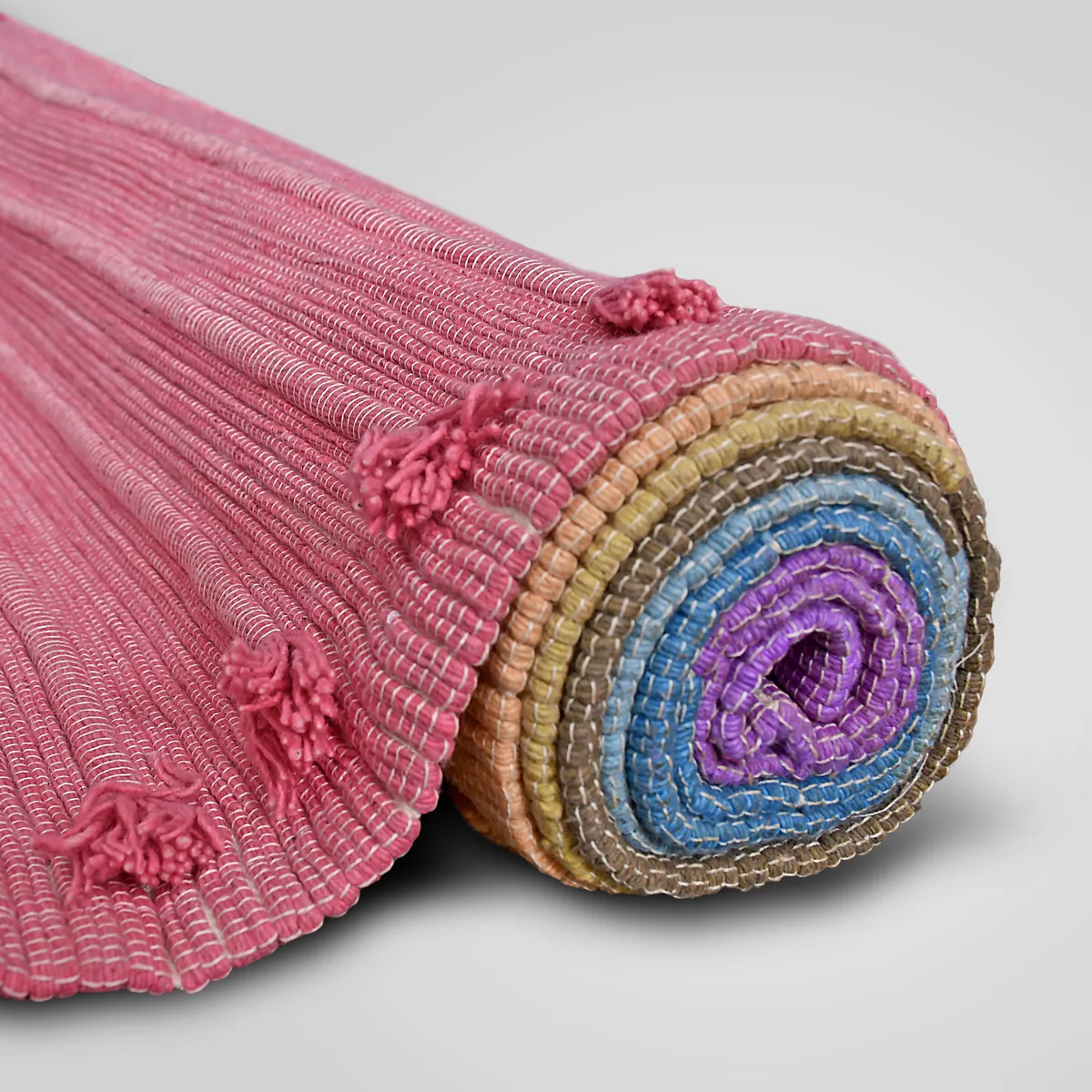
No two handwoven mats are identical because each one is woven by a person, on a loom worked by hand and foot, from natural yarn and grass, dyed in small batches. Small differences in shade, width, weave density and tassel length are the normal character of handloom work, not faults. A hole, a broken warp thread, a loose binding or a mat that is clearly the wrong size is a defect, and we treat it as one.

Where the variation comes from
On a handloom the weaver throws the shuttle, changes the shed with treadles and beats each pass of weft into place by arm. Every movement is a little different from the last, and the cloth records it: a rib sits a touch closer to its neighbour, the beat tightens as the weaver settles into rhythm, and the long edges, turned by hand, are never perfectly matched.
The materials add their own variation. Handloom cotton yarn has slubs, the slightly thicker places where fibre bunched during spinning. Sambhu grass is a plant, so its stems differ in thickness and in the shade they dry to. And our dyes are plant extracts, so one dye bath is never quite the same as the next. The rose ground of one Prana Shakti may sit a shade warmer or cooler than the one photographed, and both are right.
What is normal
| You may notice | Why | What to do |
|---|---|---|
| Shade differs from the photo or a friend's mat | Plant dyes vary by batch and soften over years | Nothing; it is the nature of plant colour |
| Width differs by a few millimetres | Hand-turned selvedge, hand-beaten weft | Nothing; it does not affect practice |
| Small slubs or a thicker thread | Natural texture of the yarn | Leave them; they are not weak points |
| One colour band a touch wider than another | Bands are counted by the weaver | Normal on the chakra rugs |
| Tassels of uneven length | Hand-knotted | Trim gently, or leave them |
| Grass stems of mixed shade or thickness | Sorted by hand, not graded by machine | Normal on the Sambu Jute and its siblings |
| A little colour in the first rinse | Loose surface dye releasing | Wash separately for the first washes |
We explain how to read these details in Tassels, selvedge and slubs: reading a handwoven mat.
What we do count as a defect
Honesty about variation is only fair if we are equally clear about faults. We consider a mat defective if it has a hole, a cut or a broken warp thread; a selvedge or cotton binding that is unravelling; a tassel group that pulls free with light handling; dye that transfers heavily after the first few washes, rather than a faint tint in the first rinse; a size that is centimetres, not millimetres, away from the product page; or damage from transit.
If any of those reach you, write to us through the Contact page with a photograph, and read the Returns page for how an exchange or refund works. The process, including what "unused condition" means for a mat, is in Returns and exchanges for handwoven goods.
Why we do not weave the variation out
We could make our mats more uniform on power looms with synthetic dyes. We choose not to, because the small irregularities are the evidence of the two things we care about: a person at the loom in Komarapalayam, and colour that comes from plants. A mat with no variation at all is usually a mat made by a machine. That is a legitimate way to make cloth, but it is not what we do, and we would rather you knew before ordering.
Frequently asked questions
Is slight colour variation on a handwoven mat a defect?
No. Our colours come from plant dyes, and no two dye baths are identical, so a mat may be a shade warmer or cooler than the photograph, and the colour softens gently over years. Heavy dye transfer after the first few washes is different, and we treat that as a defect.
How much can the size of a handwoven mat vary?
A few millimetres in width, along the length or between two mats of the same design, is normal, because the edges are turned by hand and the weft is beaten in by arm. A difference of centimetres from what the product page states is not normal; tell us and we will put it right.
What are the small bumps in the cotton?
They are slubs: places where the fibre bunched slightly as the yarn was spun. They are a normal feature of handloom cotton, they are not weak points, and there is no need to cut or pull them.
Will my mat look exactly like the photo?
It will be the same design, woven by the same people in the same plant colours, but not an exact copy: expect a slightly different shade, slightly uneven band widths on the chakra rugs and tassels of uneven length. If what arrives is clearly different from what you ordered, the Returns page covers it.
To see what hand-weaving looks like close up, the Prana Shakti shows how seven colour bands meet on a handloom and the Sambu Jute shows the natural mix of shades in sambhu grass; all of our mats are in the collection.