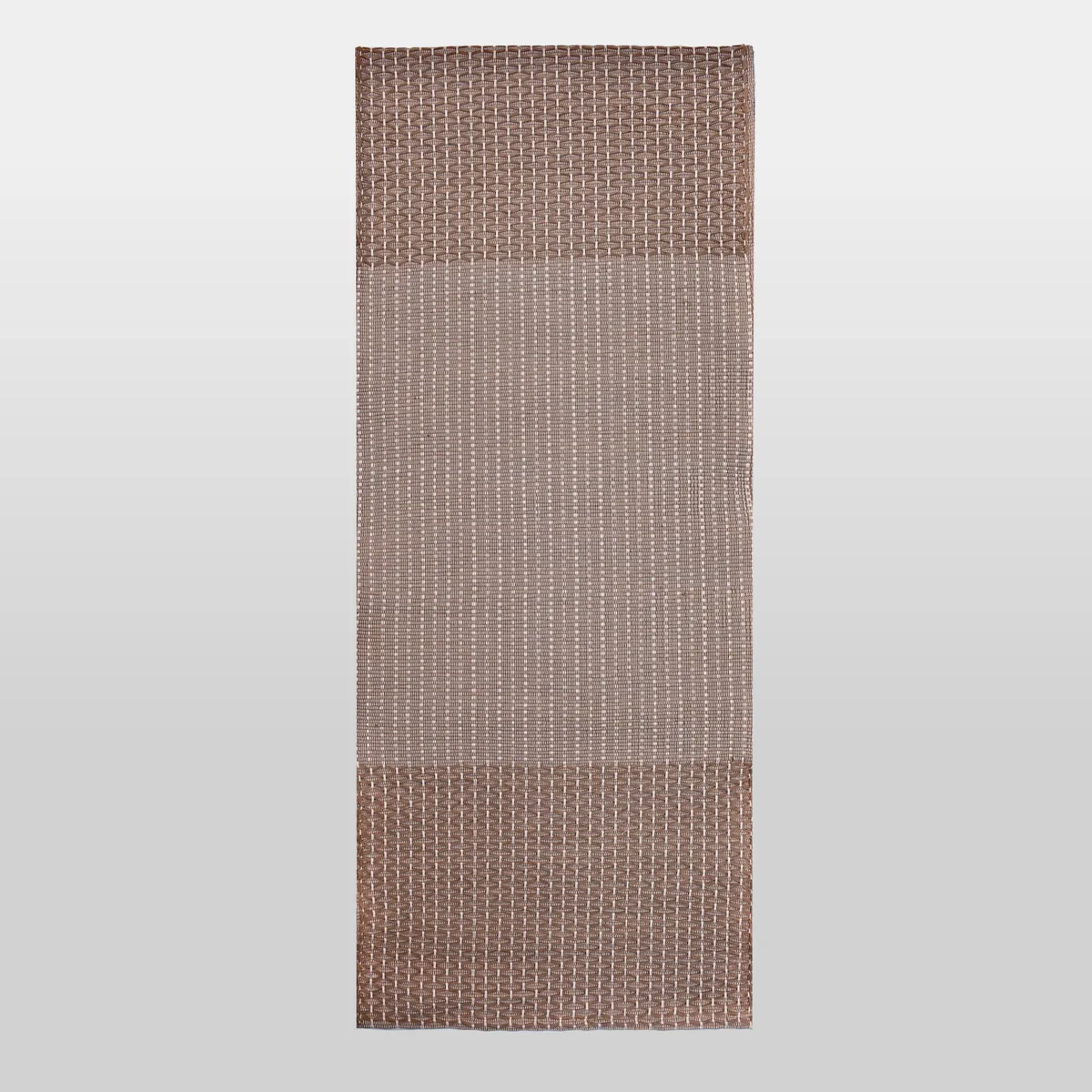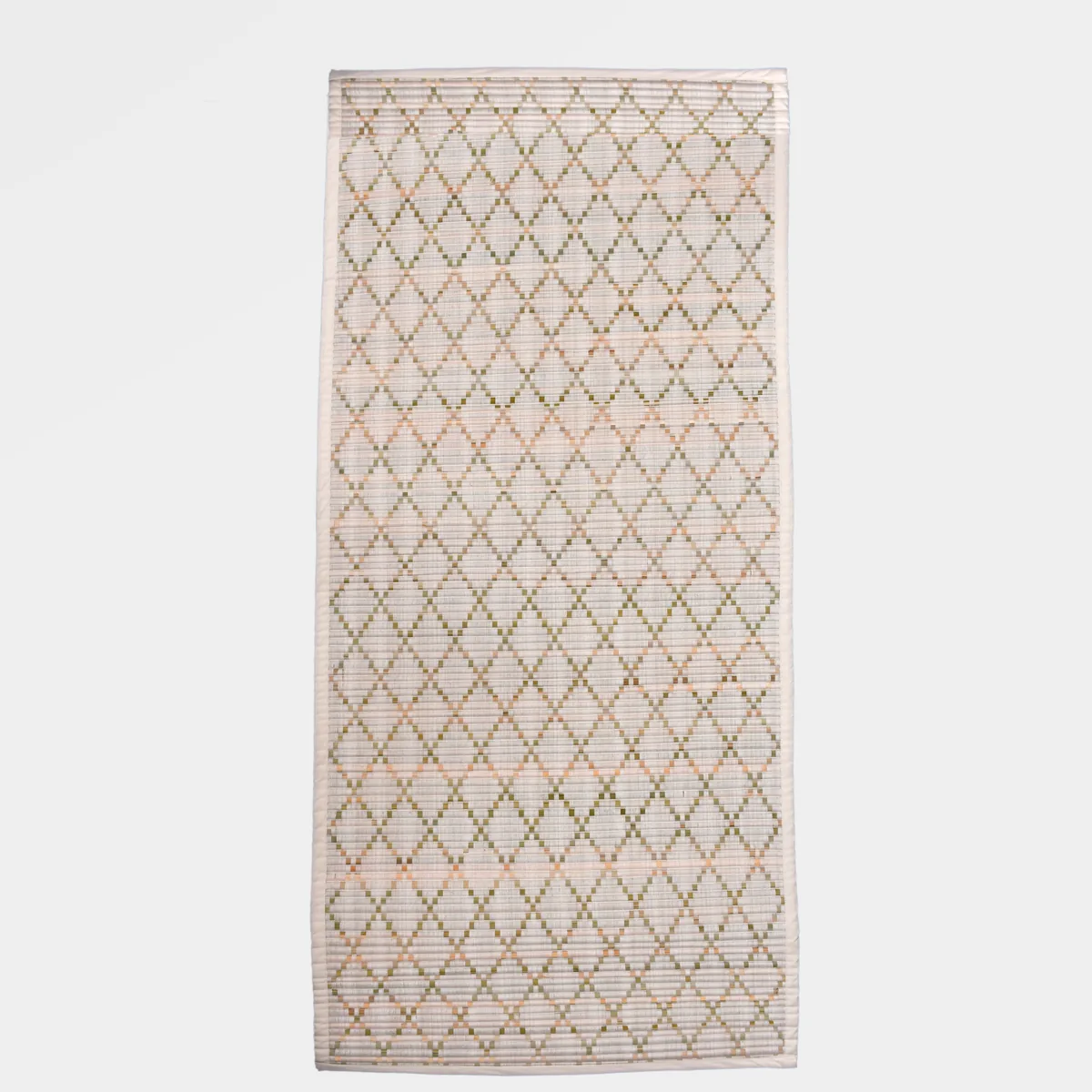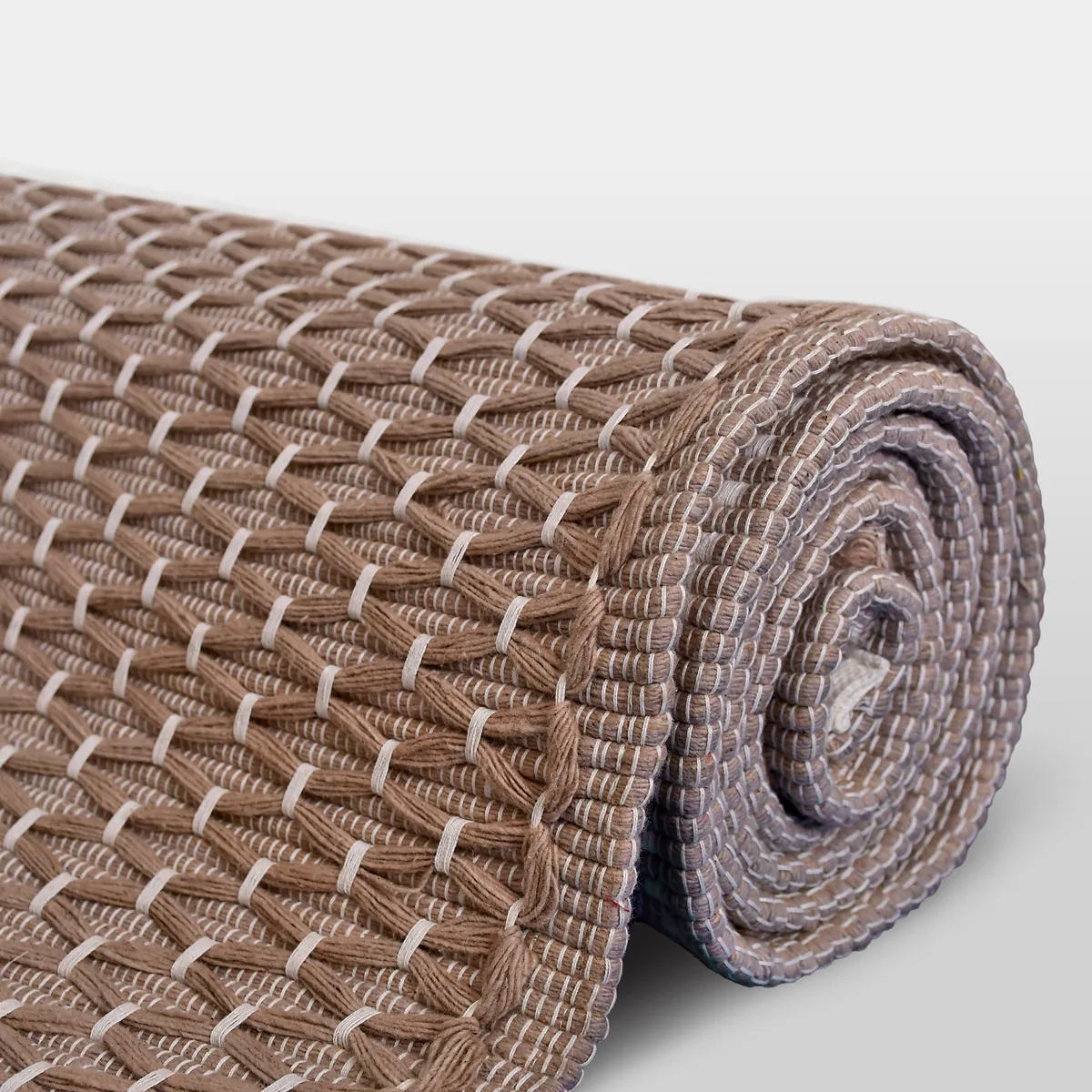
A yoga mat spec sheet should tell you eight things: thickness, density, weight, size, material, backing, certification and care. Thickness and size are the easiest to read, but weight and material tell you more about how the mat will feel and last. If a listing leaves out the material or the backing, ask before you buy.
Thickness
Thickness is given in millimetres. Most mats fall between about 3 mm and 7 mm. A thicker mat cushions knees and spine more on hard floors; a thinner one feels steadier in standing balances and is lighter to carry. Thickness alone can mislead: 5 mm of soft foam compresses more than 5 mm of tightly woven cotton. Our thickness guide goes into the choice in detail.
Density
Few sellers state density, but it matters as much as thickness: a dense mat feels firmer, a loose one squashes flat under a knee. You can estimate it by dividing the weight by the area. Our Diamond Clay is about 1.8 kg over roughly 1.24 square metres, so around 1.45 kg per square metre. Our Sambu Diamond is about 1 kg over a similar area, so around 0.8 kg per square metre.
Weight
Weight tells you how easy a mat is to carry and how much material is in it. Heavier mats tend to stay put on the floor and cushion more; lighter ones are easier to take to class. Treat listed weights as approximate; ours are too, because handwoven mats vary slightly.
Size
Size is length by width, often in both centimetres and inches. A common length is about 183 cm (72 in) and a common width about 61–68 cm. If you are tall, or practise wide stances, a few centimetres matter. Check whether the length includes tassels or fringe. Our size guide explains how to choose a length for your height.
Material
Read this line most carefully. Look for a named material: PVC, TPE, natural rubber, cork, jute, cotton, grass. Many "natural" mats are a natural top layer bonded to foam or rubber, so a full material line names the top surface, the core and the underside.
Backing
The underside decides whether the mat stays still on your floor. Foam and rubber grip by themselves; woven mats need something added. Our cotton, sambhu grass and banana fibre mats have a thin layer of natural tree latex brushed onto the underside by hand, which holds them on tile, marble and wood. If you are allergic to natural latex, choose with care and write to us first. Our Darbha mat is backed in cotton cloth instead and has no latex layer.
Certifications
A certification is only useful if you know what it covers. The GOTS standard, for example, applies to textiles made with certified organic fibres and requires every company involved in production to be certified. That is a statement about the fibre and how it is processed. On our mats it applies to the cotton: the Diamond Clay is woven from GOTS-certified organic cotton, while the grass in the Sambu Diamond is not covered by that certificate. Ask any seller which fibre or product a logo refers to and who issued it.
Care
Care instructions tell you whether a mat can be washed, how, and how it should dry. The Diamond Clay can go in the machine on a delicate 30 °C cycle in a laundry bag, or be hand washed, then dried flat away from sun. The Sambu Diamond, like all grass mats, should be shaken out and wiped with a damp cloth, never soaked or machine washed. Our Mat care page covers every mat.

Red flags on a spec sheet
- No material named, only words such as "eco", "natural" or "premium".
- A thickness with no weight. You cannot judge density or carrying weight.
- A certification logo with no explanation of what fibre or product it covers.
- "Handmade" or "handloom" at a machine-made price. See how to spot a genuine handloom product.
- No care instructions, or "wipe clean only" on a mat sold for sweaty practice.
- Health claims such as "antibacterial" or "therapeutic" with no evidence given.
- A backing that is not described. You will not know how it grips or what it is made of.
Frequently asked questions
What is the most important specification on a yoga mat?
Material, because it shapes everything else: grip, cushioning, weight, washing and how the mat ages. Once you know the material, thickness and weight tell you how cushioned and portable it will be. A material line naming the top, core and underside is a good sign.
How can I tell a yoga mat's density if it is not listed?
Divide the weight by the area. A mat of about 1.8 kg measuring 183 × 68 cm works out to roughly 1.45 kg per square metre. Higher figures usually mean a firmer, more substantial mat. It is a rough guide, since materials differ, but it helps you compare two mats of the same type.
What does GOTS certification mean on a yoga mat?
GOTS is a standard for textiles made with certified organic fibres, and it requires each company in the production chain to be certified. It describes the fibre and its processing, not every part of the mat. On our mats it applies to the cotton only; our grass and banana fibre are not covered by that certificate.
Is a thicker yoga mat always better?
No. Thicker mats cushion more on hard floors but can feel less steady in balances and weigh more. Density matters as much as thickness: a dense 5 mm cotton rug compresses less than soft 5 mm foam. Choose thickness for your practice and floor, then check weight to see how much material is really there.
If you want to compare two very different spec sheets side by side, open the Diamond Clay and the Sambu Diamond and read them line by line.