A 3 mm mat suits standing poses, balances and travel because you feel the floor through it; a 5 mm mat is the all-round choice for most home practice; a 7 mm mat is for anyone who spends a lot of time kneeling or on the floor. But thickness is only half the story. A dense woven cotton mat at 5 mm compresses far less than 5 mm of foam, so two mats with the same number can feel completely different. This guide explains both halves and ends with a decision table.

Thickness is only half the number
When you kneel on a mat, what you feel is how much it compresses and then how much it pushes back. That depends on thickness and density together.
Foam is mostly air. It compresses a long way under a knee, then stops abruptly at the floor. Woven cotton is tight fibre with little air in it; it compresses a little and then holds. Grass is firmer still. So a 7 mm foam mat may bottom out under a knee while a 7 mm cotton mat does not, and a 5 mm six-ply cotton rug can feel more supportive than thicker foam.
The practical test is weight for size. A heavier mat of the same dimensions is denser. Our 3 mm Sambu Diamond weighs about 1 kg, our 5 mm Prana Shakti about 1.5 kg and our 7 mm Diamond Clay about 1.8 kg. We explain the weave side of this in six-ply weave explained.
3 mm: firm, light, close to the floor
A 3 mm mat gives you the floor. Balances are steadier because your foot is not sinking into anything, standing poses feel rooted, and the mat weighs about a kilo and rolls small enough for a bag.
What it will not do is cushion. Long kneeling on a 3 mm mat over tiles is uncomfortable for most people without a folded towel under the joint.
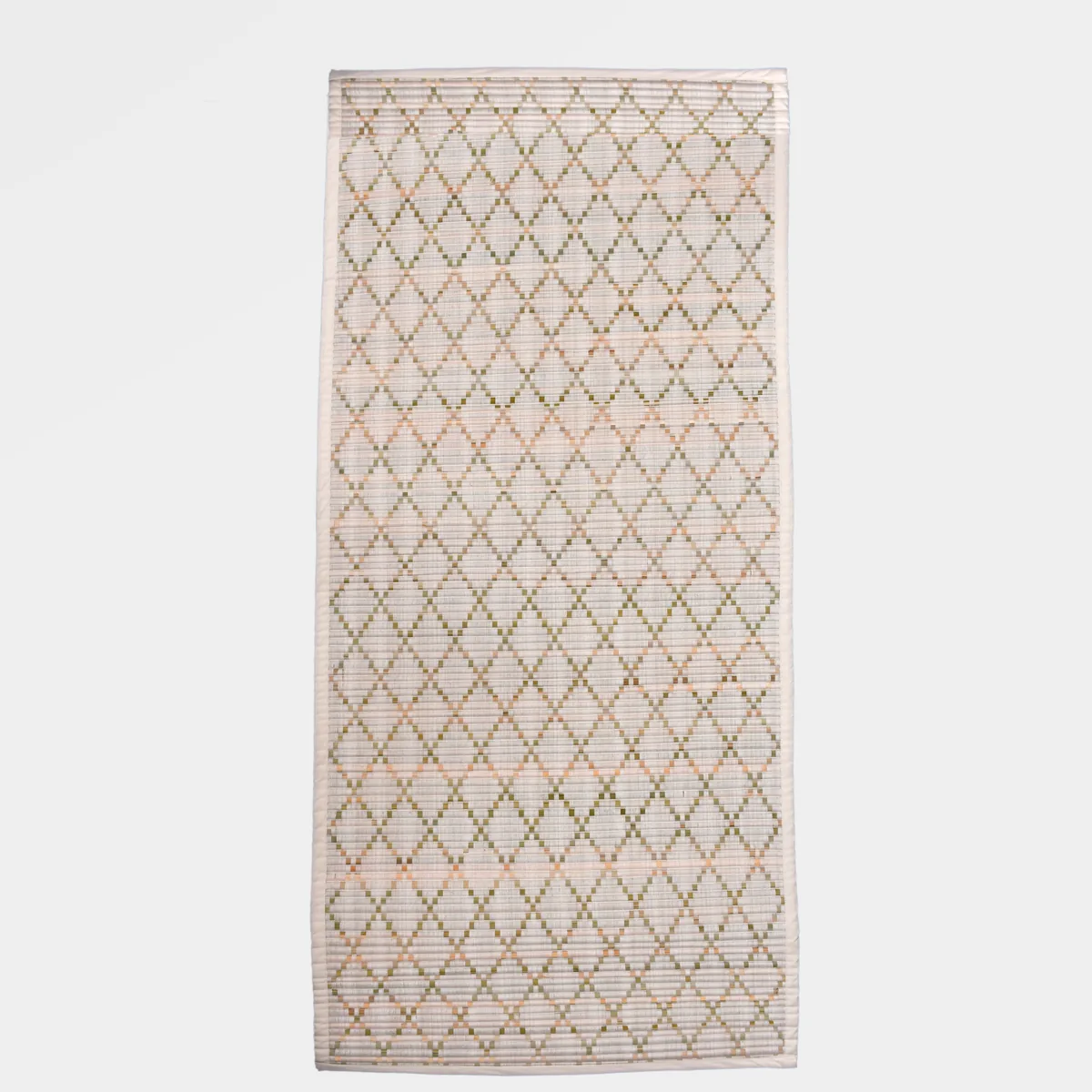
Choose 3 mm if your practice is mostly standing and seated, if you travel with your mat, or if you practise over a carpet or another mat. Our 3 mm mats are the sambhu grass and banana fibre ones; Sambu Diamond is sambhu grass woven with organic cotton, 183 × 68.5 cm, cool against the skin, with a plant-dyed green and peach lattice.
5 mm: the all-rounder
Five millimetres is where most people should start. There is enough between you and the floor for kneeling and seated poses without losing the ground in balances, and a 5 mm cotton rug is still light enough, about 1.4 to 1.5 kg, to carry to class.
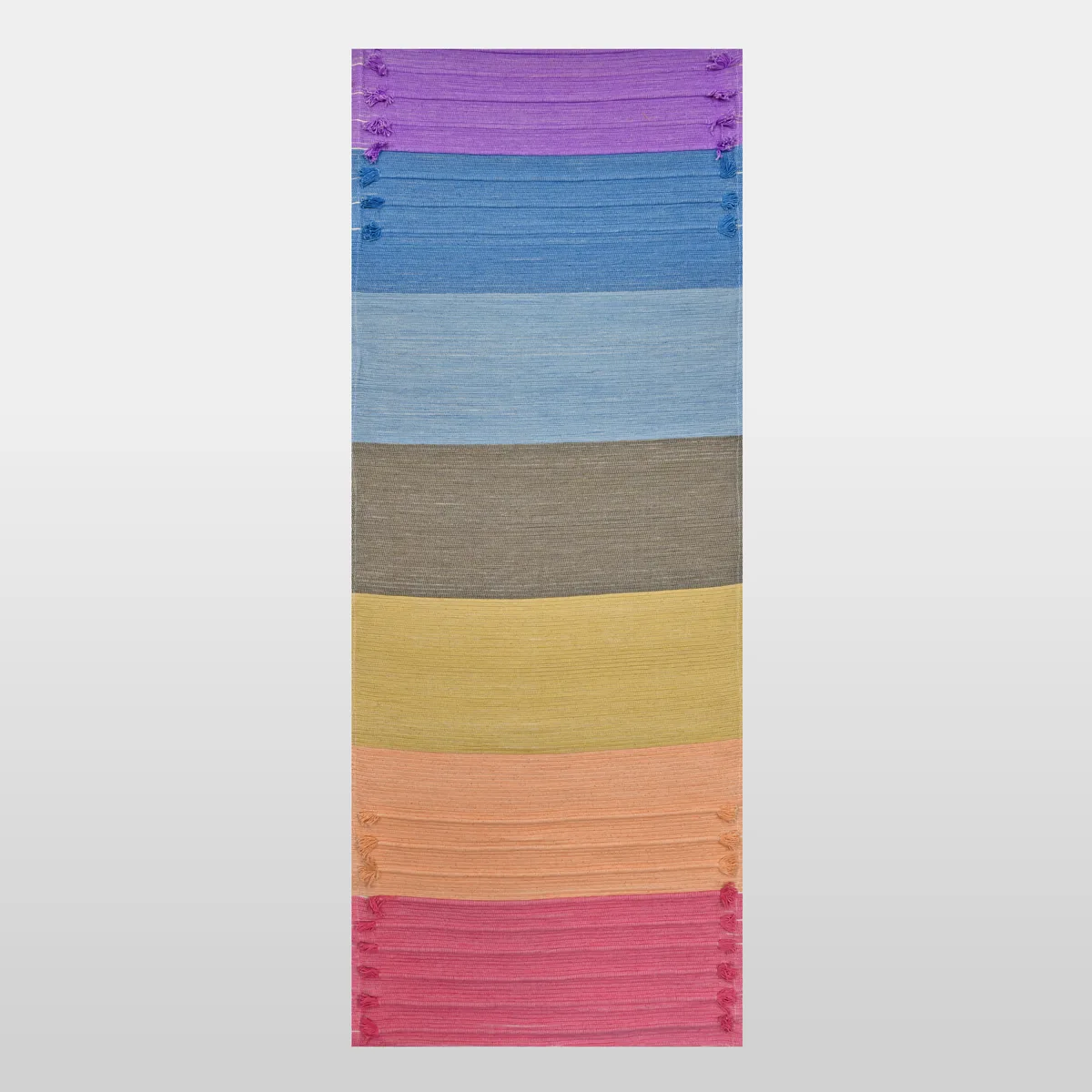
In cotton, 5 mm in a six-ply weave is dense enough that the mat does not bunch under a lunging foot and does not bottom out under a knee. Prana Shakti is our six-ply 5 mm rug: GOTS-certified organic cotton, 188 × 69 cm, seven chakra colour bands on a rose ground, all plant-dyed, and about 1.5 kg.
7 mm: cushioning for knees and floor work
Seven millimetres is for the floor. If your practice is heavy on kneeling, tabletop, lying twists and seated work, or if you simply want more between a bony knee and a tiled floor, the extra 2 mm is worth having.
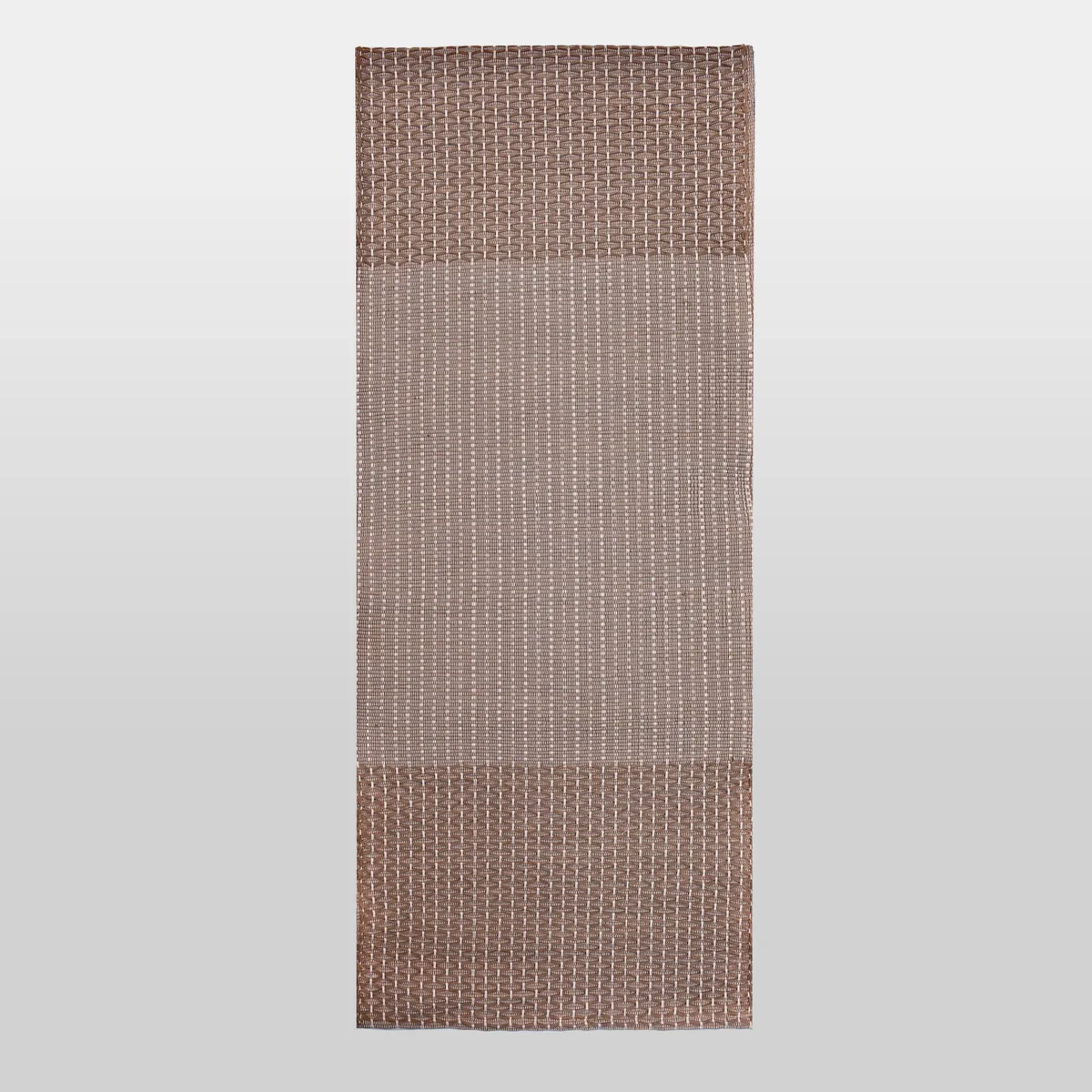
The cost is a little less ground feel in balances and more weight. Diamond Clay is, with Diamond Orange, the thickest mat we weave: 7 mm of GOTS-certified organic cotton, 183 × 68 cm, about 1.8 kg, with a raised diamond lattice that grips and doubles as an alignment grid, in a clay colour from alkanet root. Like Diamond Orange, it is also a cotton mat we are happy to see machine washed, on a delicate 30 °C cycle in a laundry bag.
If knees are the whole question, the best yoga mat for bad knees goes into folding the mat, props and what helps beyond padding.
Decision table
| Your practice or situation | Thickness to start with | Why |
|---|---|---|
| Mostly standing poses and balances | 3 mm | Maximum ground feel and stability |
| Travel, or over a carpet or another mat | 3 mm | Light, rolls small, firmness suits soft surfaces |
| Seated practice, pranayama, meditation | 3 mm (add a cushion) | Firm, cool seat; cushion for height |
| General home practice on tile or wood | 5 mm | Enough cushion for knees, still grounded |
| Flowing practice with jump-throughs | 5 mm cotton | Dense weave does not bunch; absorbs sweat |
| Lots of kneeling, tabletop and floor work | 7 mm | Most cushion without bottoming out |
| Hot room or warm climate | 3 mm grass or 5 mm cotton | Grass stays cool; cotton grips better damp |
| You are taller than about 180 cm | Check length first, then thickness | Our 188 cm mats are the 5 mm chakra rugs |
Weight and portability
Thickness and weight travel together. For our own mats: 3 mm grass or banana fibre, about 1 kg; 5 mm cotton, about 1.4 to 1.5 kg; 7 mm cotton, about 1.8 kg. If you carry your mat to a studio every day, the kilo matters more than the millimetre. If it lives on your floor at home, choose for your knees and ignore the weight.
What thickness will not fix
- Slipping. Grip comes from the surface and the backing, not the depth. Our cotton, grass and banana mats hold on tile, marble and wood through a thin layer of natural tree latex brushed onto the underside; the Darbha is cloth-backed instead. If you are allergic to natural latex, choose with care and write to us first.
- Wobble in balances. More thickness makes balances harder, not easier.
- A cold floor. Warmth comes from the material; cotton is warm underfoot at any thickness.
- Cushioning for one joint. Folding the end of a 5 mm mat under the knee gives you 10 mm exactly where you need it.
Frequently asked questions
Which yoga mat thickness is best, 3 mm, 5 mm or 7 mm?
For most people 5 mm is the best starting point: enough cushioning for kneeling and seated poses without losing stability in balances. Choose 3 mm if your practice is mostly standing, you travel with the mat or you practise over carpet, and 7 mm if you spend most of your time kneeling or on the floor. Density matters as much as the number, so a 5 mm dense cotton rug can feel more supportive than thicker foam.
Is a 3 mm yoga mat too thin?
Not for standing, balancing or seated practice, where the firmness helps; it is too thin for long kneeling on a hard floor unless you fold a towel under the joint. A 3 mm mat is also the lightest to carry, at about 1 kg for our grass mats.
Is 7 mm too thick for yoga?
Seven millimetres suits floor-heavy and kneeling practice well and is not too thick for general use, though balances feel slightly less grounded than on 3 or 5 mm. In dense woven cotton, 7 mm supports the knee without bottoming out; in soft foam, very thick mats can feel unstable.
Does a thicker yoga mat help with knee pain?
Extra thickness can make kneeling more comfortable, and folding the mat under the knee adds cushioning exactly where it is needed, but a mat is not a treatment; if kneeling hurts, ask your teacher about alternatives and see a doctor if the pain persists. Choose density as well as thickness, since dense cotton compresses less than foam of the same depth.
How thick should a beginner's yoga mat be?
A 5 mm mat is the simplest choice for a beginner because it works for the mixed standing, seated and kneeling practice most classes involve. If you already know your practice will be mostly standing or mostly on the floor, pick 3 mm or 7 mm accordingly.
When you have a thickness in mind, the full collection can be filtered by practice, or go straight to Prana Shakti if 5 mm sounds like you.