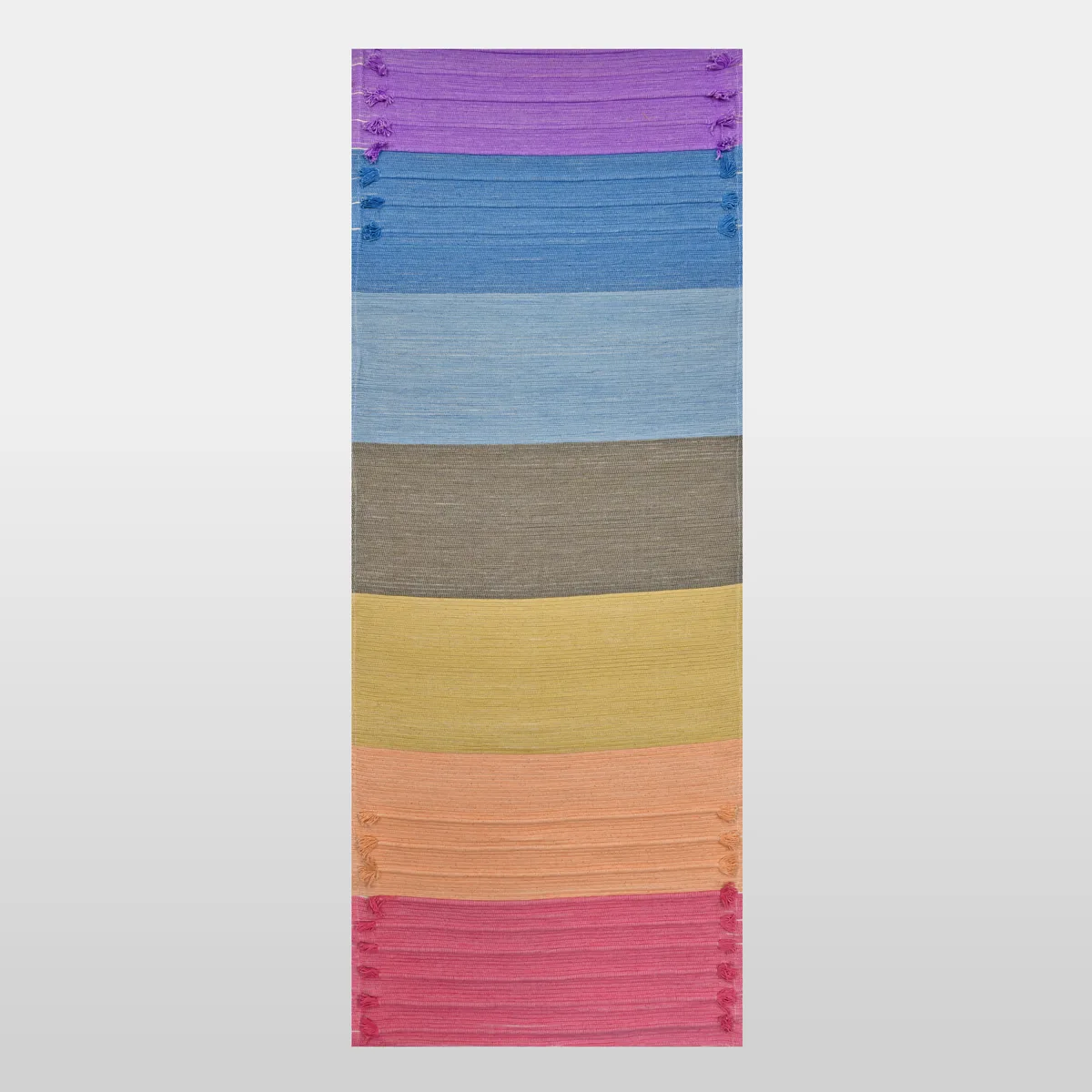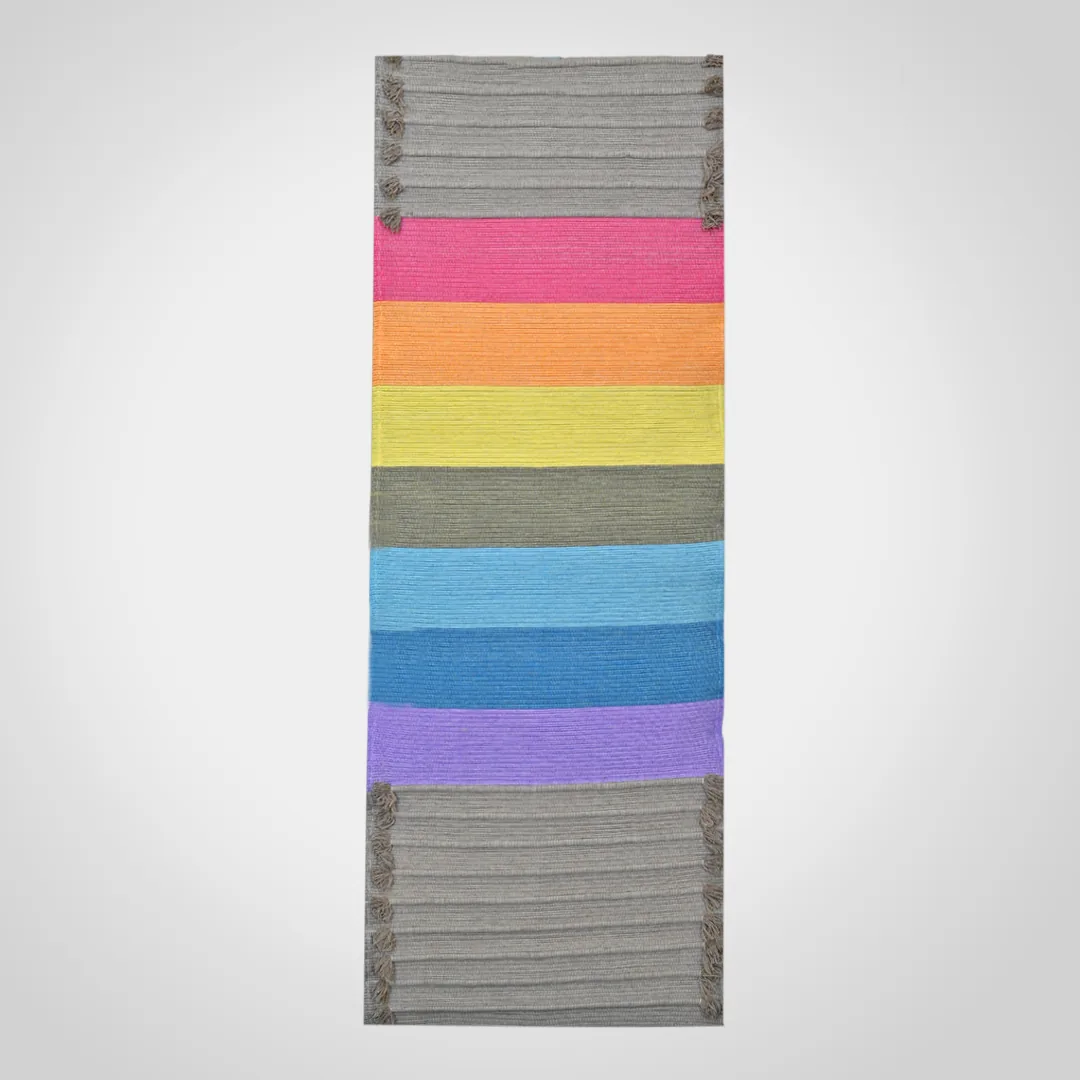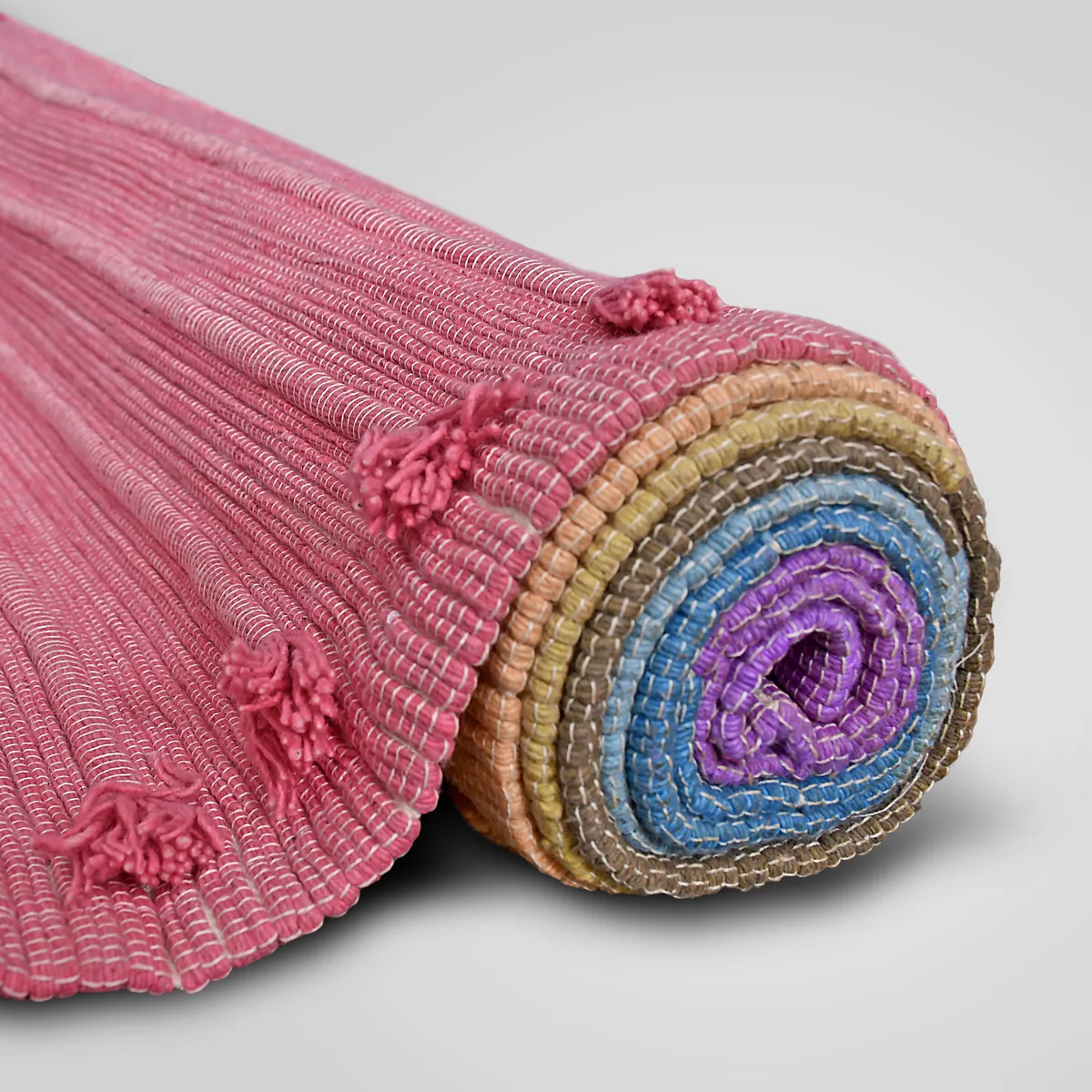
A six-ply yoga rug is woven from yarn made by twisting six strands of cotton together, which gives a dense, firm 5 mm surface rather than a soft one. Five millimetres of foam is mostly trapped air and compresses under a knee; five millimetres of six-ply cotton is almost all fibre and barely moves. That is why a 5 mm cotton rug feels more like a firm floor covering and a 5 mm foam mat feels like a cushion.

What "ply" means
Ply is the number of single strands twisted together to make one yarn. A two-ply yarn is two strands; a six-ply yarn is six. More plies make a thicker, rounder, stronger yarn, and when that yarn is woven tightly the cloth it makes is heavier and denser than cloth woven from thinner yarn at the same thickness.
For the Prana Shakti and Prithvi rugs we weave with six-ply GOTS-certified organic cotton. On the loom the thick weft yarn is beaten in firmly, so the finished rug comes out at about 5 mm and weighs roughly 1.5 kg for a 188 × 69 cm mat. Compare that with our 3 mm sambhu grass mats at about 1 kg, and you can feel where the weight is going: into cotton, not air.
Thickness is not the same as cushioning
People shop by millimetres, and we understand why; it is the one number on every spec sheet. But two mats of equal thickness can behave very differently depending on what is inside them.
| 5 mm six-ply cotton rug | 5 mm foam mat (typical) | |
|---|---|---|
| What fills the 5 mm | Twisted cotton yarn, tightly woven | Foamed polymer with air cells |
| Under a knee | Compresses very little; firm, even support | Compresses noticeably; soft |
| In a balance pose | Stable; little sinking or wobble | Can feel springy under the standing foot |
| When wet with sweat | Absorbs moisture and grips better damp | Surface can become slippery |
| Washing | Hand wash cold, dry flat in shade | Usually wipe only |
| Weight | About 1.5 kg | Varies; often lighter |
| Ageing | Cotton softens; plant colour mellows | Foam can harden or flake with time |
We are not saying foam is wrong. If you want a soft landing for the knees, foam or a thick rubber mat gives more give than cotton, and the fairest guide to that trade-off is our thickness guide. What six-ply cotton gives you instead is a firm, stable surface with some insulation from the floor, which many people prefer for standing work, seated practice and anything where you want to feel the ground.
How six-ply compresses under the knee
Press a thumb into a six-ply rug and it gives a little, then stops. The yarn flattens slightly and the fibres pack closer, but there are no air cells to collapse. Under a kneeling pose, that means the rug spreads the load across the whole contact area rather than letting the kneecap sink to the floor through a soft layer.
For people who want more padding under the knee than 5 mm of cotton gives, the simplest answer is to fold the end of the rug double for kneeling work, or to put a folded blanket under the knee. Our 7 mm Diamond mats are the thicker cotton option, and we go through the choices for sore knees in Best yoga mat for bad knees.
What the ribs do for grip
Because the weft yarn is thick, a six-ply rug has a ribbed surface rather than a flat one. The ribs run across the width of the rug, and they do two things.
First, they give the skin something to press against. A flat, smooth surface relies entirely on friction; a ribbed surface adds a slight mechanical hold, especially under the heel of the hand in downward-facing poses.
Second, the texture breaks up moisture. Cotton grips better as it dampens, and on a ribbed weave sweat spreads into the fibres rather than pooling on top. This is why cotton rugs have long been used for sweaty practice.
We are honest that cotton can slip when bone dry on a dusty floor, particularly in the first few sessions before the surface has softened. Dampening the palms, or practising for ten minutes until you have warmed up, usually solves it.
The grip layer underneath
The topside grip comes from the weave; the underside grip comes from a thin layer of natural tree latex that our weavers brush onto the back of each rug by hand. It holds on tile, marble and wood. After many washes it can soften, and a thin fresh coat of natural latex restores it. If you are allergic to natural latex, choose with care and write to us first.
Caring for a six-ply rug
The thick yarn holds dye well and dries more slowly than a thin cloth, so the care is simple but needs patience: hand wash cold with a mild natural detergent, wash separately for the first few washes, and dry flat in shade. Machine washing can fade the plant dyes on the chakra bands. Roll the rug for storage rather than folding it; six-ply cotton does not like a hard crease. Full details are on the Mat care page.
Frequently asked questions
What does six-ply mean on a yoga rug?
Six-ply means the yarn used to weave the rug is made by twisting six single strands of cotton together. The thicker yarn, beaten in tightly on the loom, produces a rug about 5 mm thick that is dense and firm rather than soft, and heavier than a thinner-yarn rug of the same size.
Is a 5 mm cotton rug as cushioned as a 5 mm foam mat?
No. Foam is mostly air cells that compress under weight, so it feels soft. Six-ply cotton is almost all fibre and compresses very little, so it feels firm and stable. If you want softness under the knees, foam or thick rubber gives more; if you want a stable surface that grips better when damp, cotton does.
Does a six-ply rug slip on the floor?
The underside has a thin layer of natural tree latex brushed on by hand, which holds on tile, marble and wood. It can soften after many washes and is restored with a thin fresh coat of natural latex. If you are allergic to natural latex, choose with care and write to us first.
Can I machine wash a six-ply chakra rug?
We recommend hand washing in cold water with a mild natural detergent, separately for the first few washes, then drying flat in shade. Machine washing can fade the plant dyes on the colour bands. The 7 mm Diamond mats are the only cotton mats we suggest for a delicate machine cycle.
If you would like to feel the difference, the Prana Shakti and the Prithvi are both woven in six-ply cotton at 188 × 69 cm, priced at the time of writing between about ₹3,500 and ₹4,400. Both are in our cotton collection.