Our mats are woven by our own weavers, in our own workshop in Kattur, Komarapalayam, on handlooms worked by hand and foot. There are no middlemen, no contract looms in other villages and no bought-in stock: the people who weave a TwinsPoles mat work under the same roof as the people who dye the yarn and pack the parcel. We will not give you invented names or headcounts, but we can tell you how a weaving day runs.

Our own weavers, our own workshop
A lot of handloom goods pass through several hands before they are sold: a trader commissions a master weaver, who gives yarn out to households, who return cloth that is finished somewhere else and sold under a name none of them chose. We do not work that way. Our weaving and our dyeing happen in one place, the weavers are ours, and what we sell is what they made. When you ask us how a mat was woven, the person answering can walk across the room and check.
We say "our weavers" rather than naming them for a simple reason: we have not asked each of them whether they want to appear on a website, and we would rather be vague than presumptuous. If that changes, this page will too.
How a weaving day runs
What follows is the way we work, not a report on one particular day.
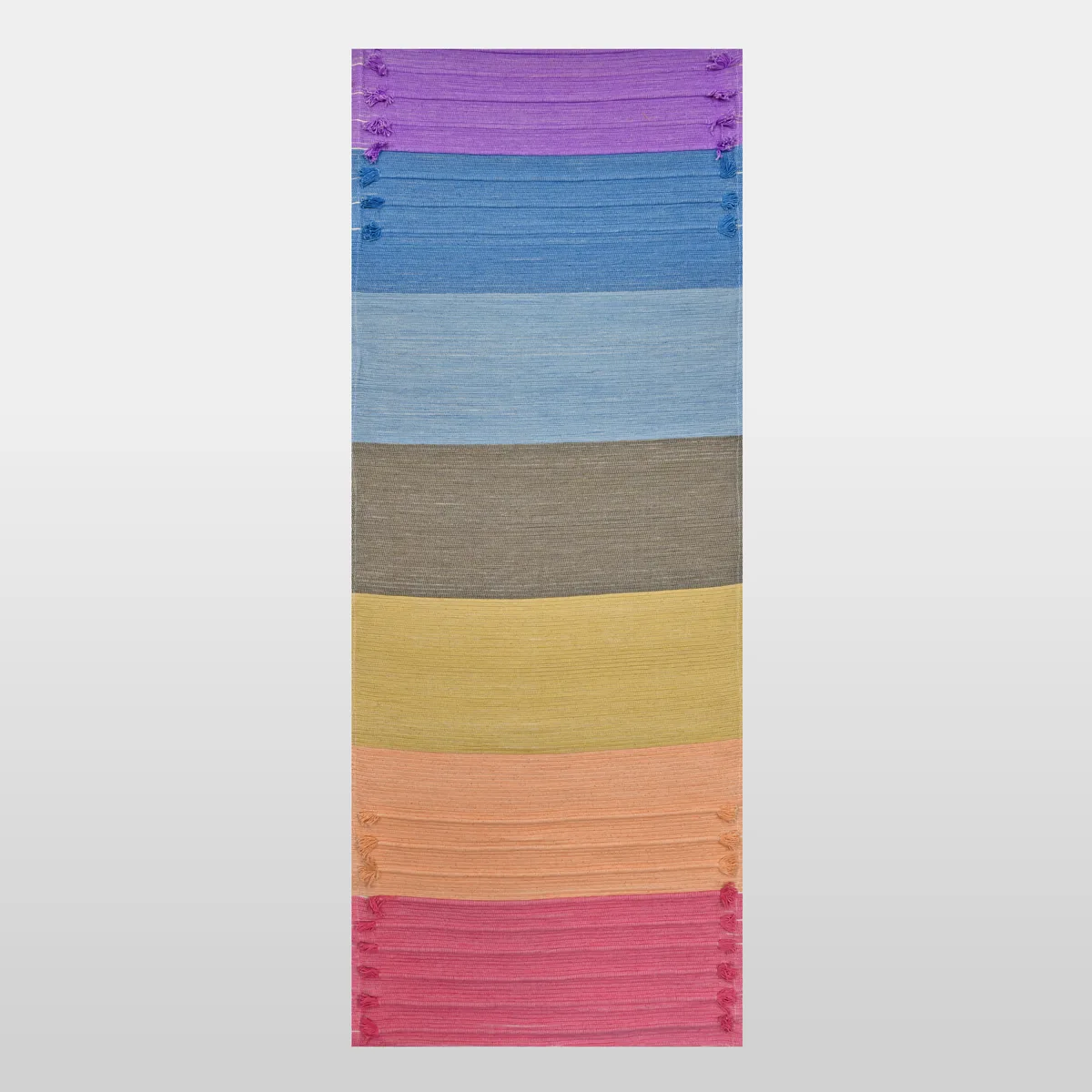
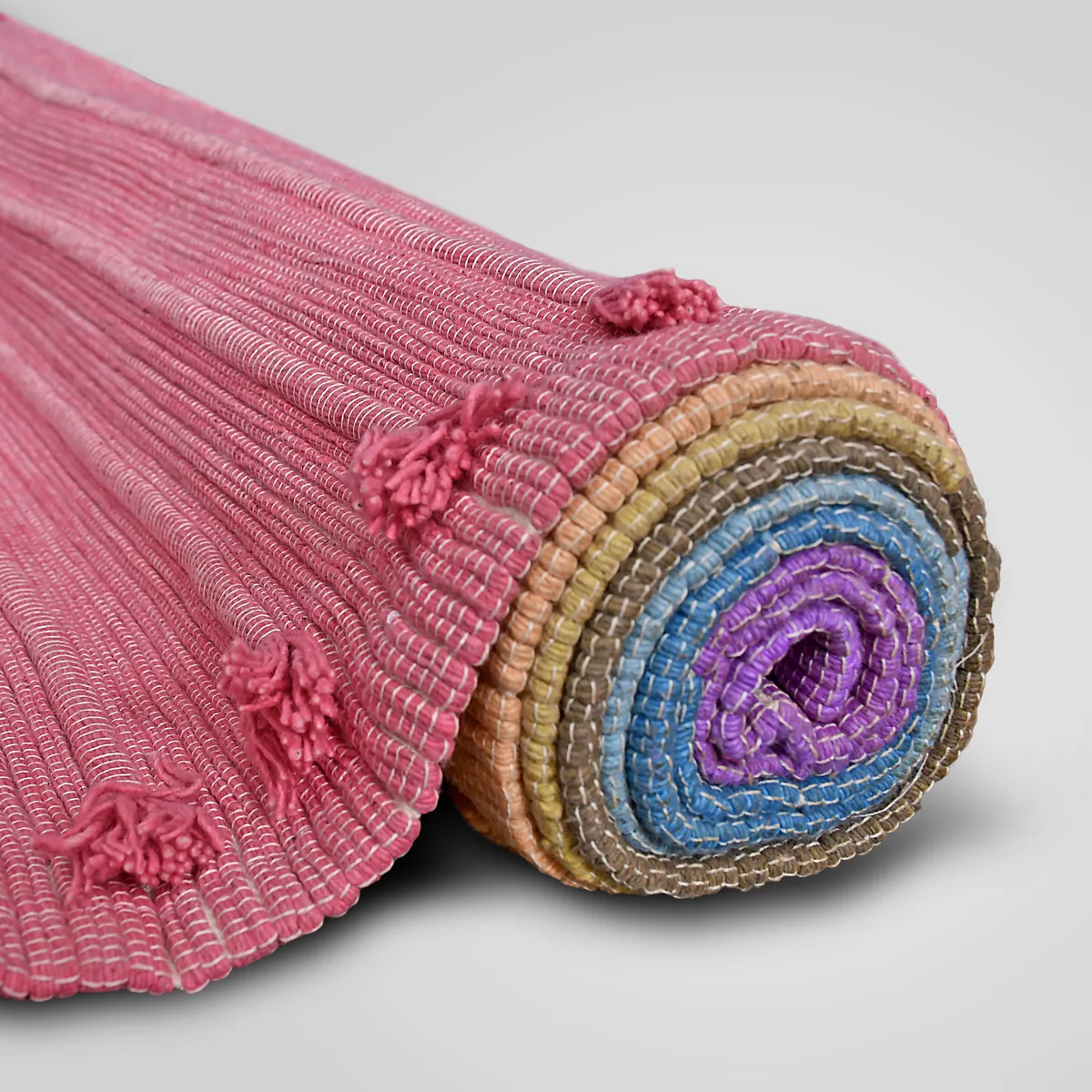
A day starts with the warp. The long threads are already on the loom, under tension, and the first job is to look along them for anything that broke or slackened overnight, and to tie in or re-tension where needed. On a cotton rug like the Prana Shakti, the warp carries the ground colour, and the seven chakra bands arrive in the weft, so the weaver also checks that the right colours of weft yarn are wound and ready in the order the design needs.
Then the rhythm begins: open the shed with the treadles, throw the shuttle, beat the weft home, change the shed, throw again. On a thick six-ply rug the beat has to be firm and even, and that is where the day's strength goes. It is not fast work. We do not publish how many mats a weaver finishes in a day because the honest answer is "it depends on the mat, the yarn and the weaver", and a single number would mislead.
There are pauses to wind bobbins, to move the finished cloth forward on the beam, and to eat. The light matters more than the clock: colour bands are joined by eye, and nobody wants to judge a boundary between two plant-dyed yarns at dusk.
What a weaver decides
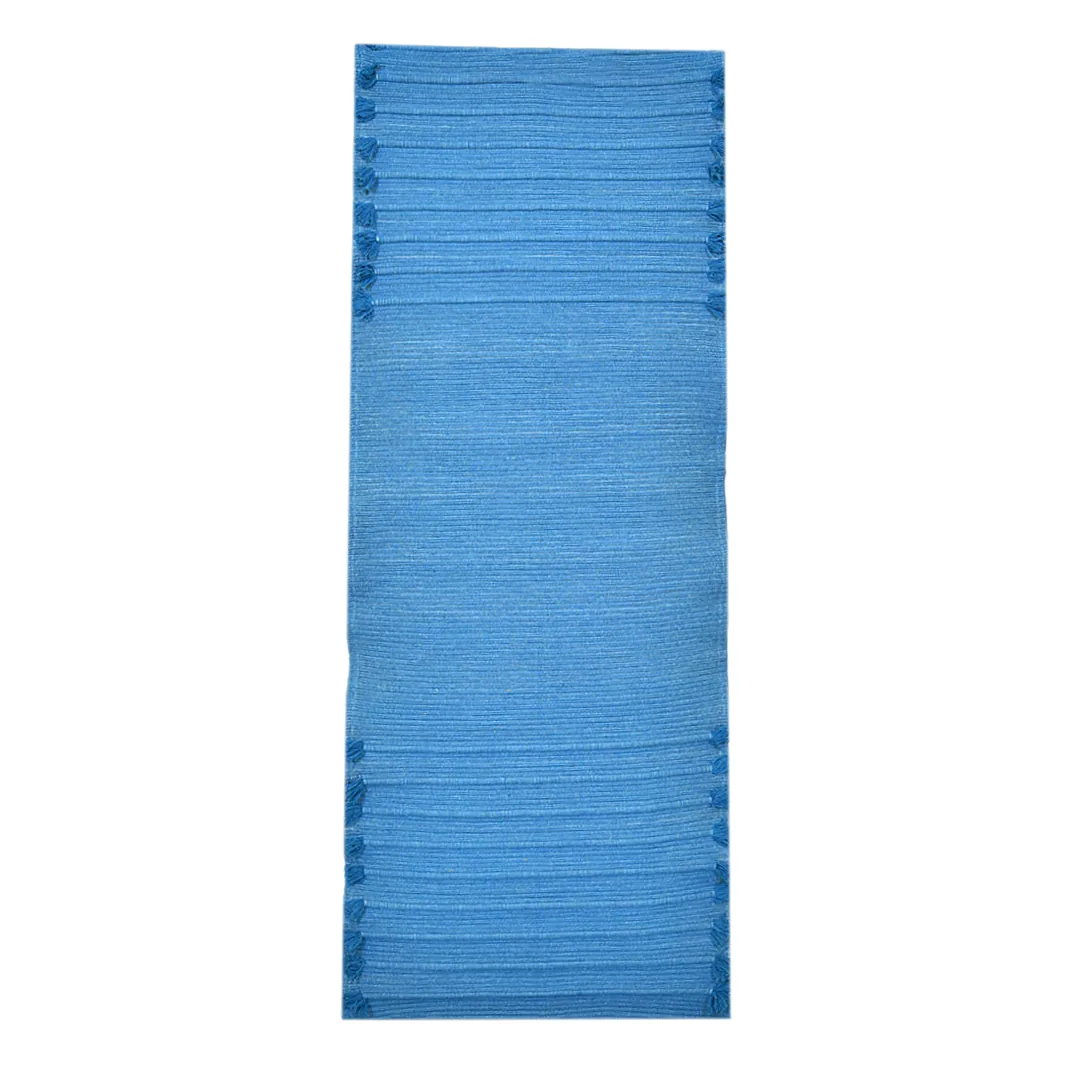
A handloom gives the weaver decisions that a machine takes away. How hard to beat, which changes the density of the cloth. How to tension a warp thread that is running a little thin. Where exactly one colour ends and the next begins. On the Indico, which is one colour from end to end, the only thing on show is the beat itself, in the ribbed texture of the weave, and it is the plainest record of a weaver's hand that we make.
These decisions are why two mats of the same design are never quite identical, and why we describe slight variation as part of the product rather than a defect. The full sequence, from warping to the finished mat, is in How a handloom yoga mat is woven.
After the loom
When a length comes off the loom, the warp ends on the Prithvi and the Indico are knotted into tassels by hand rather than stitched over. Then a thin layer of natural tree latex is brushed onto the underside, also by hand, so the mat holds on tile, marble and wood, and the mat is left to dry. If you are allergic to natural latex, choose with care and write to us first.
The Darbha grass mat is the exception in our range: it is bound and backed in cotton cloth and has no latex layer.
Why "no middlemen" matters to the weaver
Every extra hand between loom and customer takes a share and adds distance. Keeping weaving, dyeing and selling together means the person who beat the weft is not an anonymous supplier at the bottom of a chain, and it means that when something goes wrong with a mat we can trace it to a loom and fix the cause. We will not claim more than that: we hold GOTS certification for our organic cotton, and that is a statement about the cotton, not a social audit of our workshop. Our account of ourselves is the workshop itself, and the town it sits in, which we describe in Komarapalayam: the weaving town our mats come from.
Frequently asked questions
Who makes TwinsPoles yoga mats?
Our own weavers, in our own workshop in Kattur, Komarapalayam, Namakkal district, Tamil Nadu. Weaving and dyeing both happen there, on handlooms worked by hand and foot with no electricity used in the weaving. We do not use contract looms elsewhere, buy in finished mats or resell stock made by anyone else.
Are the mats made by machine at any stage?
The weaving is entirely by hand on a handloom. After the loom, tassels on the Prithvi and the Indico are knotted by hand and the natural latex grip layer is brushed on by hand. If you are allergic to natural latex, choose with care and write to us first. The Darbha mat has no latex layer; it is backed in cotton cloth.
How long does it take to weave one mat?
Longer than a machine takes, and we would rather not give a figure, because it depends on the mat, the thickness of the yarn and the weaver, and a single number would mislead. A six-ply chakra rug with seven colour bands is slower than a plain ribbed mat. The time at the loom is the main cost of a handloom mat.
Can I visit the workshop or speak to a weaver?
Please write to us first through the Contact page and we will tell you what is possible. We do not publish weavers' names or photographs without asking them, so the answer may be a conversation with us rather than an introduction.
If you want to see a weaver's hand in the cloth, the Indico shows the beat most clearly, and the Prana Shakti shows how seven colour bands are joined by eye. Every mat in the collection was woven the same way.