Ashtanga practitioners use cotton rugs for three plain reasons. The practice is sweaty, and a rug soaks up sweat where rubber goes slick. The vinyasa between postures involves jumping the feet back and through, which a cotton surface allows and a sticky one resists. And a rug can be washed like cloth after a practice that leaves most mats damp. The method was taught in Mysore, and the rug travelled with it.
Where the practice comes from, briefly
Ashtanga vinyasa yoga is a twentieth-century form of hatha yoga popularised by K. Pattabhi Jois, who "established his Ashtanga Yoga Research Institute in Mysore, Karnataka, in 1948" (Wikipedia). In the Mysore style of teaching, students practise a set sequence "at their own pace, and are instructed individually by the teacher", rather than following a led class. The word vinyasa describes the "flowing sequences of movements that connect each asana to the next".
We are weavers, not historians, and we will not claim more than that. What we can speak to is what the method asks of the surface you practise on, because that is what people ask us.
What the practice asks of a mat
It is sweaty
A Mysore-style practice is often well over an hour of continuous movement, in a warm room full of other people doing the same. Sweat is not a side effect; it is expected. On a rubber or foam mat, sweat sits on the surface and the hands and feet begin to slide, which is why so many practitioners lay a towel on top. A woven cotton rug takes the moisture into the fibre instead, and the grip improves as the practice goes on. Our fuller comparison is in cotton yoga mat vs rubber yoga mat.
It involves jumping through
Between seated postures the practitioner lifts, swings the legs back or through the arms and lands in the next position. On a tacky surface the toes catch and drag. On cotton the feet slide the last few centimetres and the movement finishes cleanly, which is one reason rugs are favoured for learning jump-throughs. Ask your teacher before attempting them; they are learnt gradually, once the hands and shoulders are ready for the weight.
It is frequent
Many Ashtanga practitioners practise most days of the week. A mat that cannot be washed will, after a few months of daily sweat, start to smell and feel unpleasant. A cotton rug is washed cold, dried flat in shade, and comes back clean. For the chakra rugs and the Indico that means a hand wash with a mild natural detergent, washed separately for the first few times because plant dyes release a little colour at first. The Mat care page has the details.
Rug alone, or rug over a mat?
Both are common, and the choice depends on the floor and your knees.
| Rug alone | Rug over a rubber mat | |
|---|---|---|
| Cushioning | Firm; 5 mm of dense cotton | Softer; rubber underneath |
| Grip to floor | Natural latex layer holds on clean tile, marble, wood | Rubber holds the floor; rug rests on rubber |
| Sweat | Absorbed by the rug | Absorbed by the rug; the rubber stays dry |
| Weight to carry | ≈1.4–1.5 kg | Both items |
| Washing | Rug washed | Rug washed, mat wiped |
| Suits | Home practice, warm rooms, travel | Studios with hard floors, shared mats, sensitive knees |
In many Ashtanga rooms the rug goes over a rubber mat: the mat is a base and the rug is the working surface, and the rug keeps sweat off the shared or expensive mat beneath. At home on a clean tiled floor a rug on its own works well. Our cotton rugs have a thin layer of natural tree latex brushed by hand onto the underside, which holds them to the floor; after many washes that layer can soften, and a thin fresh coat of natural latex restores it. If you are allergic to natural latex, choose with care and write to us first.
Our note on layering a cotton rug over a rubber mat goes into the when and why.
Which rug for Ashtanga
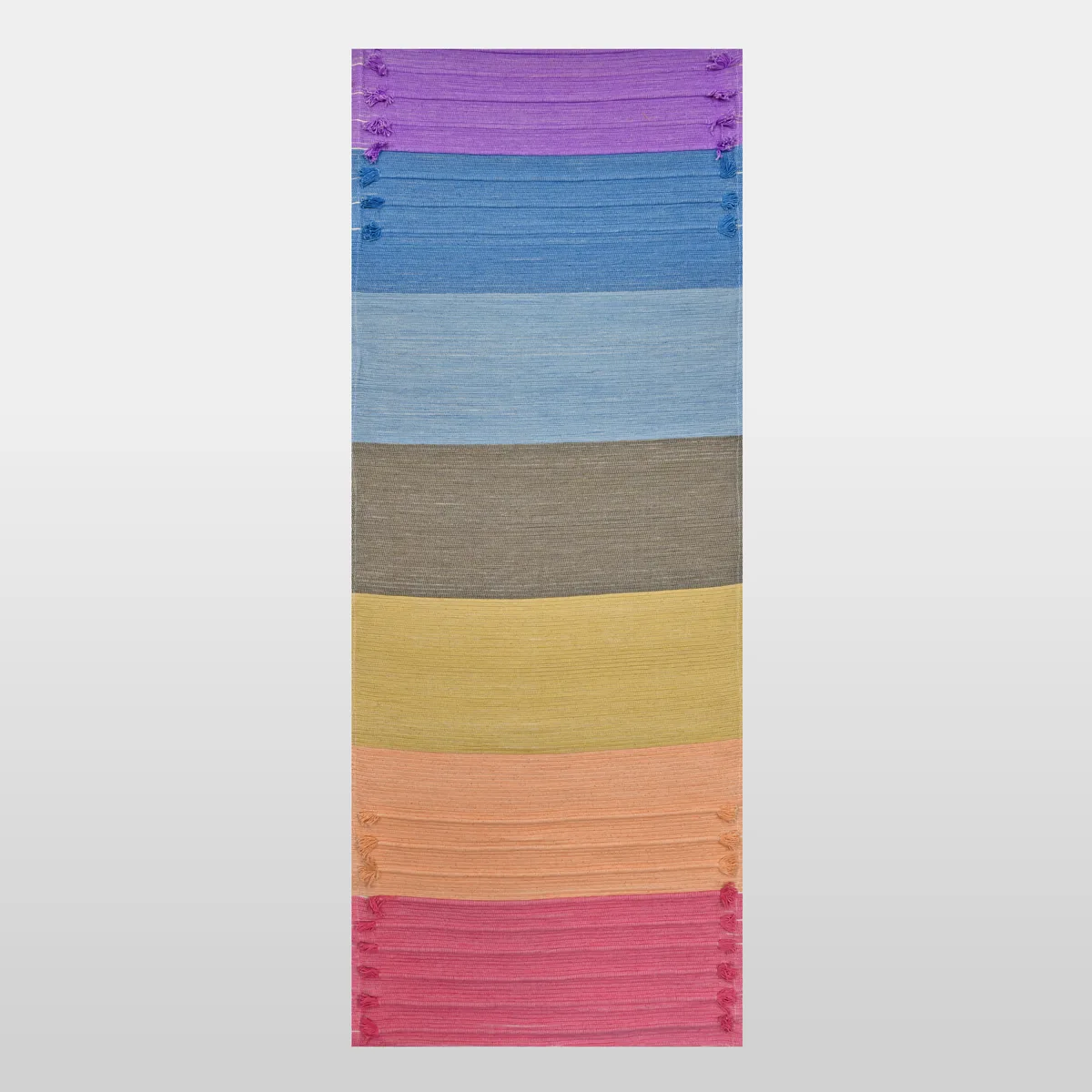
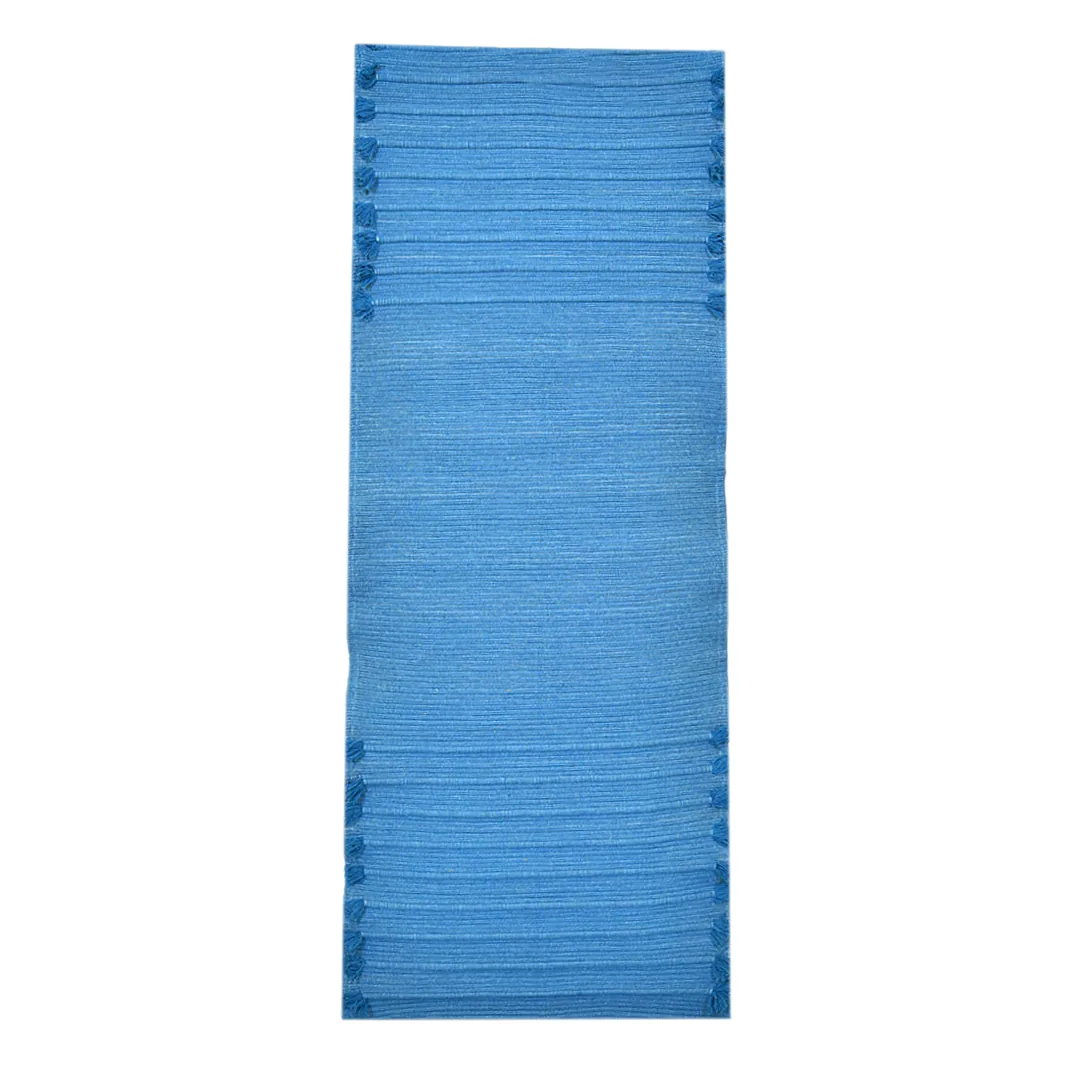
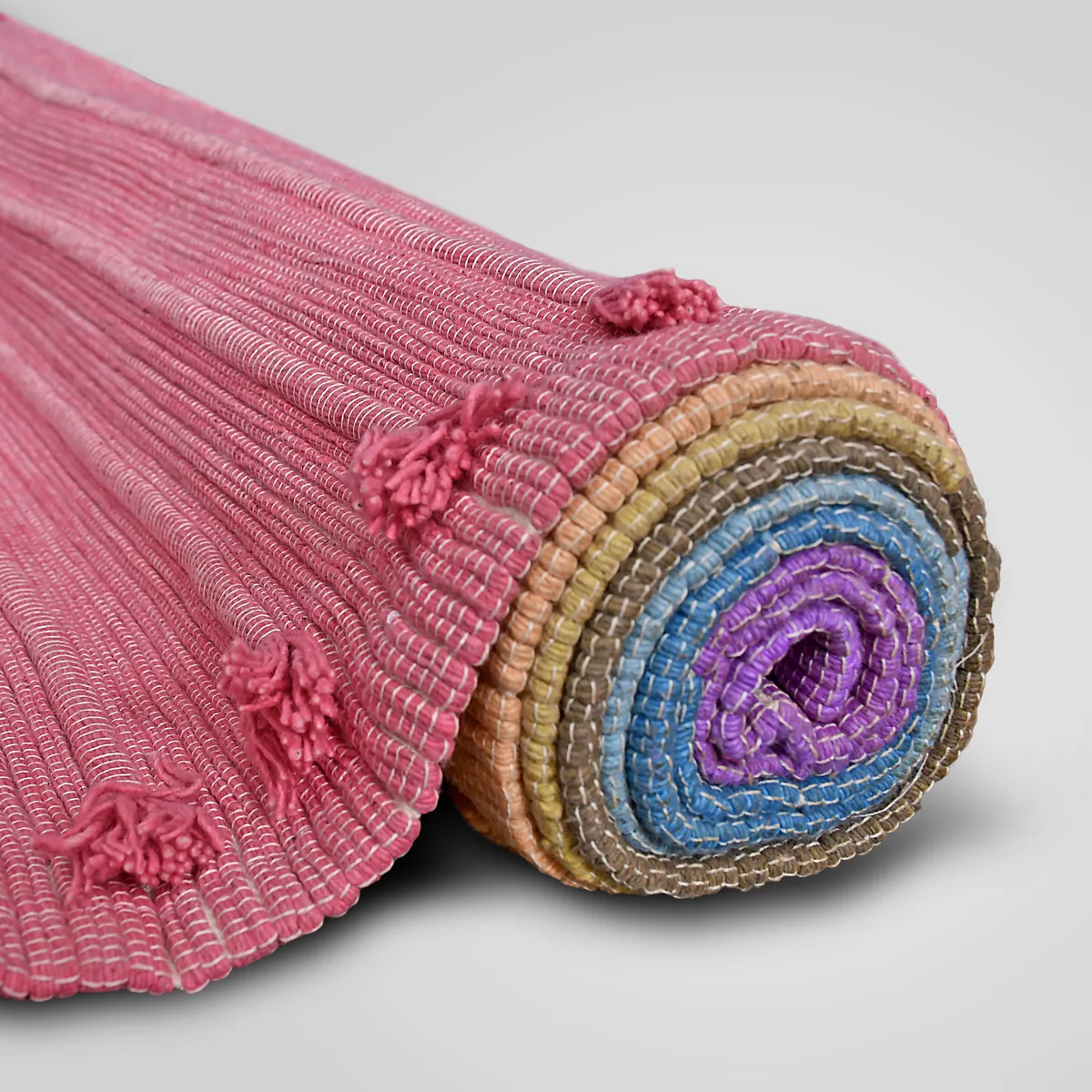
The Prana Shakti is a six-ply rug in GOTS-certified organic cotton, 5 mm thick and 188 × 69 cm, so a little longer than most mats, which matters when you stretch out in the finishing postures. Its seven colour bands are dyed with plants, turmeric, neem and tulsi among them. The Indico is plainer: one colour from indigo, 5 mm and 183 × 68 cm, with a ribbed weave the fingers can hold and hand-knotted tassels at the ends. Both weigh around one and a half kilos and both wash the same way. For a longer look at the choice, read best mat for Ashtanga and Mysore-style practice, and for the rug's longer story, what is a yoga rug?

Frequently asked questions
Why do Ashtanga practitioners use a rug instead of a mat?
Because the practice is sweaty, fast and frequent. A cotton rug absorbs sweat and grips better as it dampens, where rubber goes slippery; its surface lets the feet slide through in the jump-throughs between postures; and it can be washed properly after practice. Many practitioners lay a rug over a rubber mat so the rubber gives cushioning and the rug does the work on top.
What is a Mysore rug?
A Mysore rug is the informal name for the woven cotton rug used in Ashtanga rooms, after the city of Mysore in Karnataka where K. Pattabhi Jois taught the method. It is a flat, dense cotton weave, usually around 5 mm thick, used alone or laid over a rubber mat. Ours are handwoven in Komarapalayam, Tamil Nadu, from GOTS-certified organic cotton.
Does a cotton rug slip during Ashtanga?
A new rug can slip a little while your hands are bone dry, which in Ashtanga lasts about as long as the first few Surya Namaskars. Once you begin to sweat the cotton grips well. Underneath, a thin natural latex layer holds the rug to a clean floor, or you can lay it over a rubber mat. If you are allergic to natural latex, choose with care and write to us first.
How do I wash a rug after a sweaty practice?
Hang it to air after every practice, and wash it when it needs it: cold water, a mild natural detergent, by hand, washed separately for the first few washes, and dried flat in shade. No bleach, no softener, no tumble dryer and no direct sun, which fades plant dyes.
If you are building a Mysore-style practice, the Prana Shakti is the rug we would hand you first; the Indico if you prefer one colour and a ribbed surface.