A yoga rug is a flat-woven cotton mat, usually made on a handloom, that you practise on either by itself or laid over a rubber mat. It has no foam: the cushioning comes from the thickness of the weave, and the grip comes from cotton that steadies as your hands warm and dampen it. Rugs are older than the modern "sticky mat", and they have come back because they can be washed like any textile and do not flake or crumble.

What makes a rug a rug
Three things separate a yoga rug from a yoga mat.
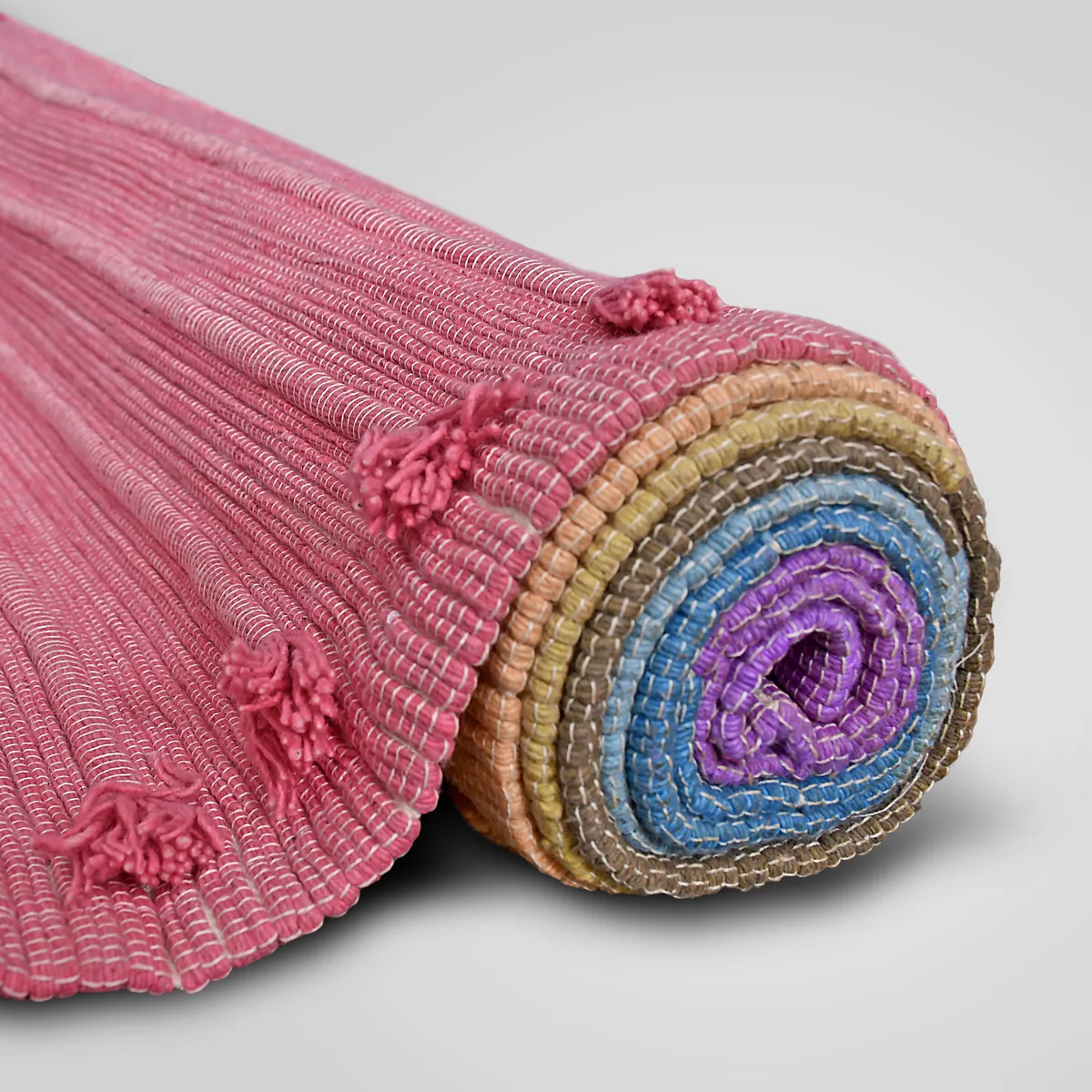
It is woven, not moulded. A rug is yarn crossing yarn on a loom; a sticky mat is a sheet of PVC, TPE or rubber foam. You can see a rug's structure in its ribs, its selvedge and its tassels.
It is a textile, so it washes. Sweat goes into the cotton rather than sitting on top, and the whole rug can be hand washed and dried flat; our Mat care page has the routine.
Its grip works the other way round. Foam grips best dry and gets slippery with sweat. Cotton is the opposite: bone dry it can slide a little under the palms, and once your hands warm and the fibres take a little moisture, it holds. That is why cotton rugs are a familiar sight in strong, sweaty practices.
Before the sticky mat
The purpose-made yoga mat is a recent object. According to the Wikipedia article on the yoga mat, meditational yoga in India was practised on kusha grass, on bare earth, or on a rug of deer or tiger skin. When yoga travelled west in the twentieth century, practitioners often used towels or cotton mats on wooden floors, and found their feet skidding.
The same article credits the teacher Angela Farmer with the first "sticky mat": in 1982, teaching in Germany, she cut carpet underlay to towel size and used it in class. Her father went on to retail the material, and the first purpose-made yoga mats followed in the 1990s.
The rug, in other words, is not a modern alternative to the mat; the mat is the modern alternative to the rug. We still weave the grass part of that history, darbha or kusha grass, into a meditation mat.
Why rugs came back
A few things brought the cotton rug back into yoga rooms.
- Sweat. In vigorous practices, a rubber mat becomes a slide. Many practitioners lay a cotton rug over the mat so the rug takes the sweat and the mat takes the rug. We go into this in Ashtanga on a yoga rug.
- Hygiene. A rug can be washed after every sweaty session. Foam cannot.
- Materials. People started asking what their mat was made of. A rug is cotton, plant dye and, in our case, a thin coat of natural tree latex. There is no PVC and no synthetic foam.
To be fair to the other side: foam is softer under the knees than 5 mm of cotton, it is waterproof, and it is usually cheaper. If you want bounce, a rug alone will not give it to you; a rug over a mat might. Our yoga mat vs yoga rug article weighs this up properly.
How we weave ours
We weave in Komarapalayam, a handloom town on the Cauvery in Tamil Nadu, with our own weavers and our own dye shed, and no middleman.
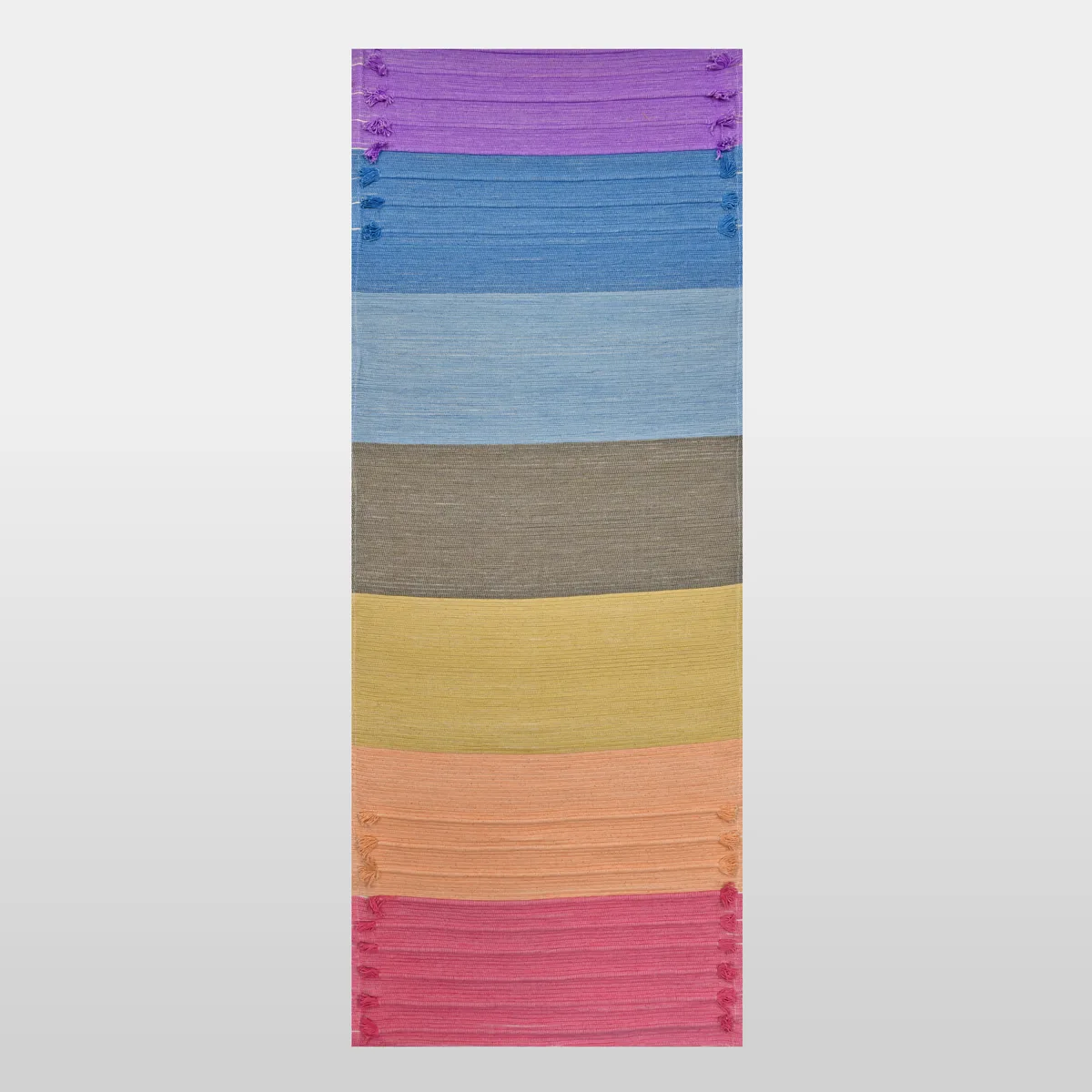
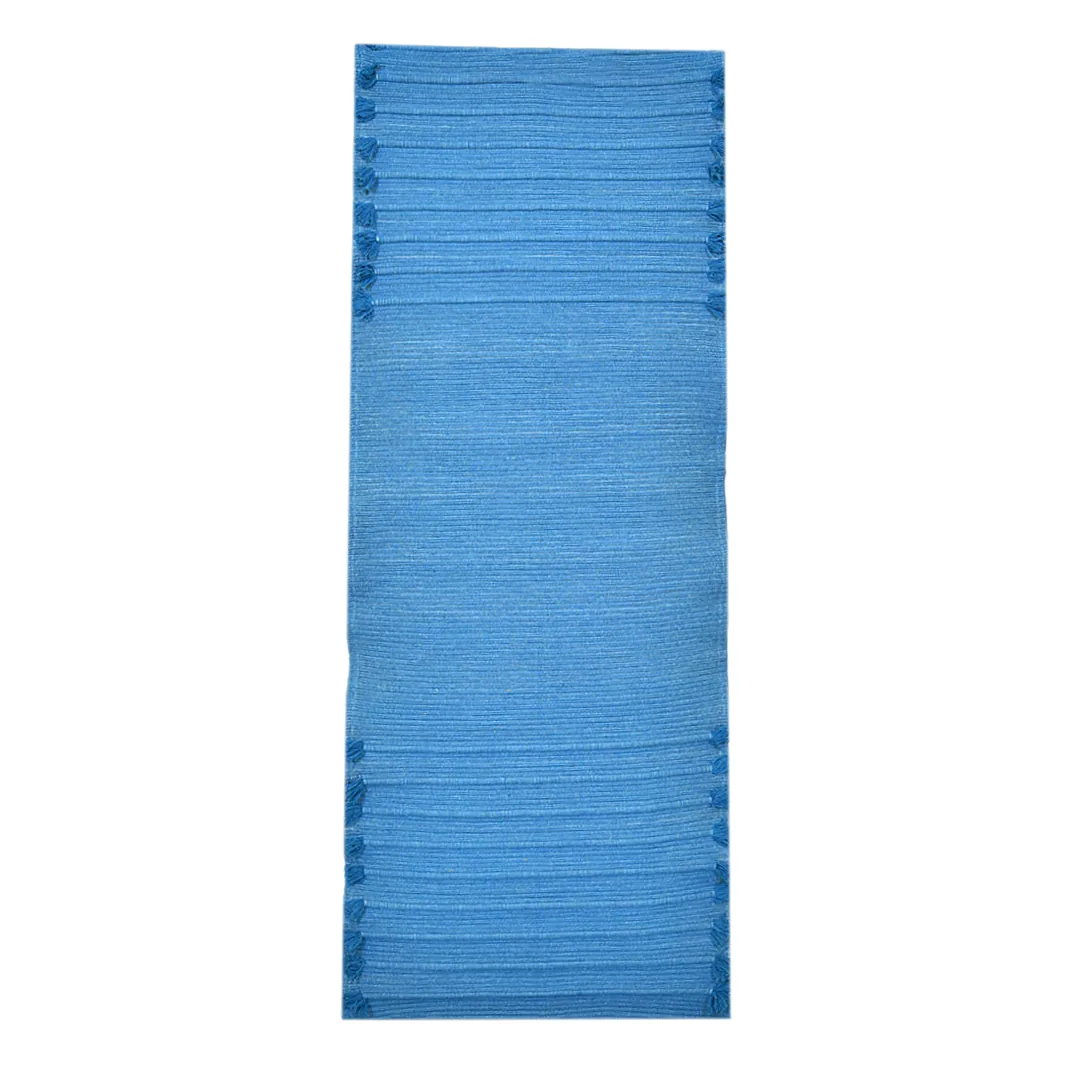
Our rugs are woven from GOTS-certified organic cotton. The chakra rugs, Prana Shakti and Prithvi, are six-ply, 5 mm thick, 188 × 69 cm and about 1.5 kg, with seven colour bands drawn from a palette of more than twenty herbs that includes turmeric, neem and tulsi. Indico is the simplest rug we make: one plant, indigo, on a 5 mm ribbed weave, 183 × 68 cm, about 1.4 kg, with hand-knotted tassels. Prices at the time of writing are about ₹3,500–₹4,500.
Every rug has a thin layer of natural tree latex brushed onto the underside by hand. It holds the rug on tile, marble and wood, which is what many Indian homes have. After many washes it can soften; a thin fresh coat restores it. If you are allergic to natural latex, choose with care and write to us first. Plant colour, for its part, varies between batches and softens over years; we think of that as the nature of the dye, not a fault.
Rug or sticky mat? A quick comparison
| Cotton yoga rug | Foam sticky mat | |
|---|---|---|
| Made of | Woven cotton yarn, plant dye, natural latex underside | PVC, TPE or rubber foam |
| Grip when dry | Can slip a little until warm | Good |
| Grip when sweaty | Improves as it dampens | Falls off; often needs a towel |
| Cushioning | Firm; 5–7 mm of dense weave | Soft; depends on foam thickness |
| Washing | Hand wash cold, dry flat | Wipe only |
| Over time | Softens, colour mellows, can be re-coated | Can flake, crumble or go sticky |
Who a rug suits
A rug suits you if you sweat, if you want to wash what you practise on, if you practise on hard floors, or if you want cloth rather than plastic underfoot. It is a poorer choice if you need deep padding under sensitive knees and will not fold a blanket; there, a 7 mm weave like Diamond Clay, or a rug over your foam mat, is the better compromise.
Frequently asked questions
Is a yoga rug used on its own or over a mat?
Both. On a clean hard floor, a 5 mm handloom rug with a natural latex underside is used alone. In sweaty or shared rooms, many people lay the rug over a rubber mat so the rug absorbs the sweat and the mat stays put underneath.
Does a cotton yoga rug slip?
A new, bone-dry cotton rug can slide a little under the palms. Once your hands warm and the fibres take a little moisture, the grip steadies, which is the opposite of how foam behaves. Lightly dampening your palms helps in the first week, and the latex underside keeps the rug itself from moving on the floor.
How do I wash a yoga rug?
Hand wash cold with a mild natural detergent, wash separately for the first few washes, and dry flat in the shade. Avoid bleach, fabric softener, tumble dryers and direct sun, all of which can fade plant dyes. A little colour in the first rinse is normal for plant-dyed cotton.
If you would like to see the rugs side by side, our cotton mats are all in one place, with sizes, weights and care notes on every page.