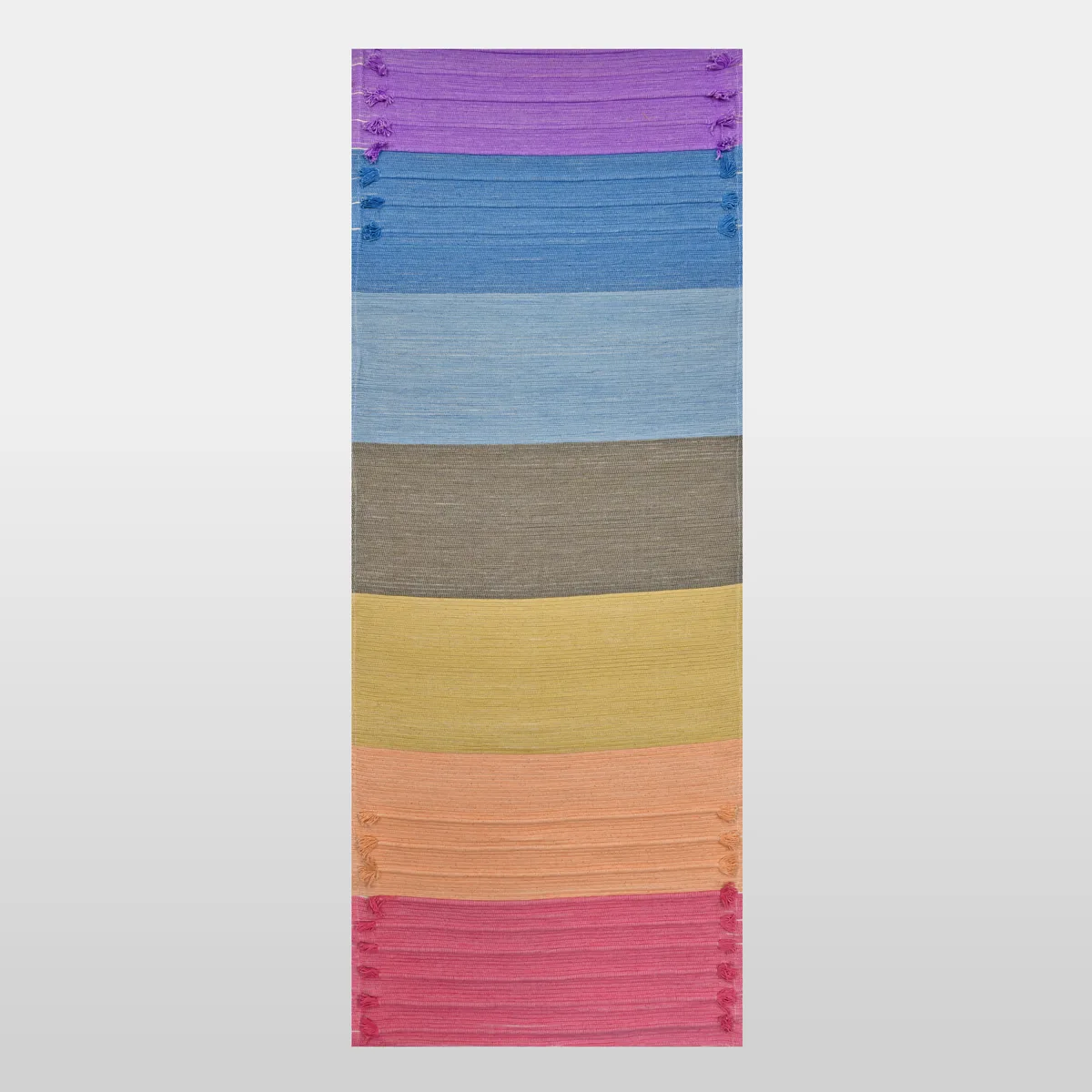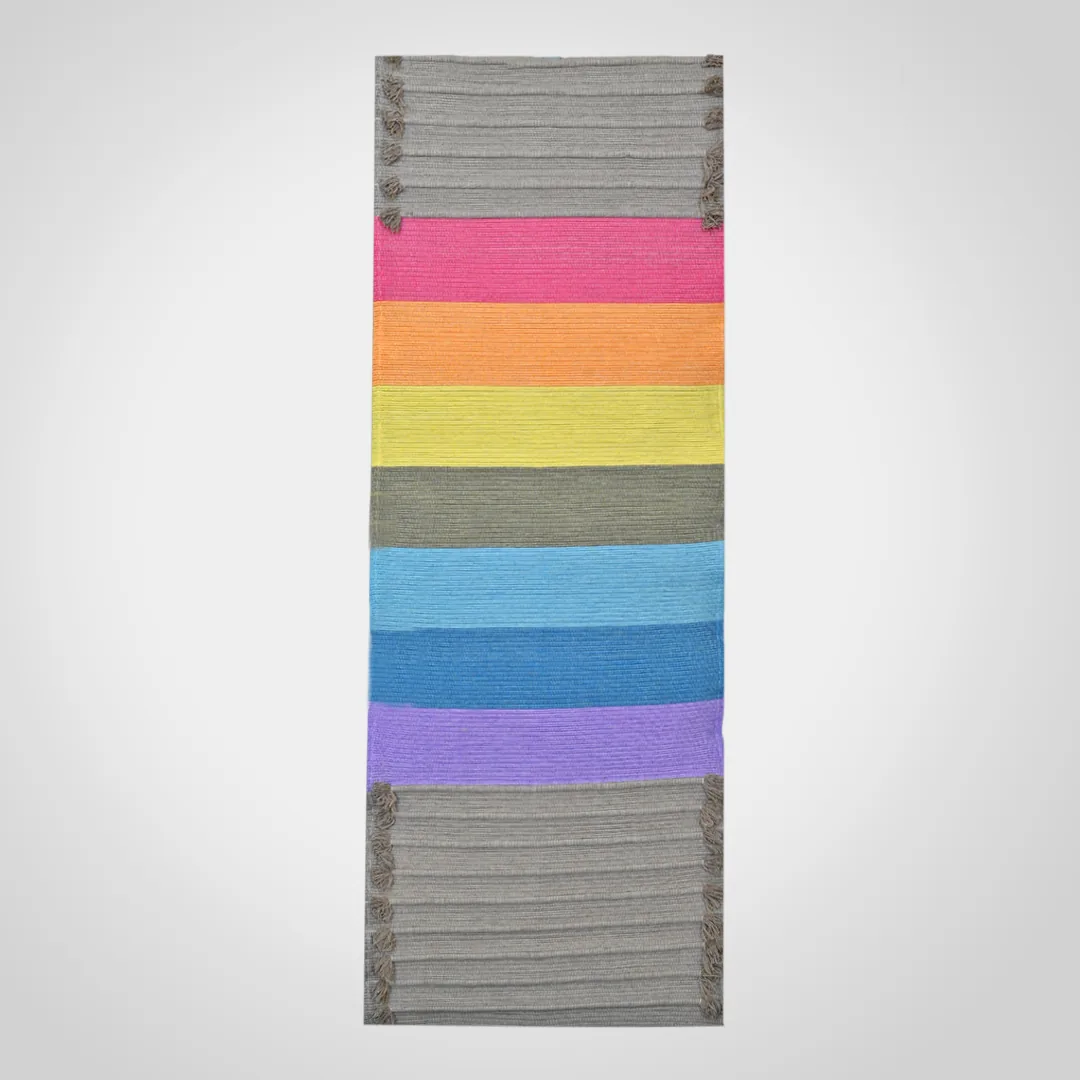
The seven-colour chakra rug is a modern weaving design, not an ancient object. What it borrows is older: the idea of seven chakras in the yogic tradition, and a popular scheme that gives each of them a colour of the rainbow. Weavers took that sequence and set it into a cotton rug as seven bands. We weave ours that way in Komarapalayam, and we would rather tell you honestly which part is tradition and which part is design.

What is tradition
The chakras belong to the yogic and tantric traditions of India: centres along the spine that practitioners work with in meditation, breath and visualisation. Seven is the common modern count, and the names you hear in a yoga class, from the root at the base of the spine to the crown at the top of the head, follow that scheme.
The colours are a separate layer. In the popular chakra colour scheme used in yoga rooms today, the seven centres run through the rainbow: red for the root, orange for the sacral, yellow for the solar plexus, green for the heart, blue for the throat, indigo for the brow and violet for the crown. These associations are widely taught, and that is why they work on a rug: anyone who has sat in a class can read the sequence at a glance.
We present them as tradition, in the sense of a shared symbolic language, and nothing more. A colour band on a rug does not do anything to a chakra, and we make no claim that it does. For what each colour is said to stand for, and which plants give us each hue, see The seven chakra colours on a mat.
What is design
Nothing we have found suggests that a rug with seven rainbow bands has an old pedigree, and we are weavers rather than historians, so we will not invent one. As far as we can tell, the chakra rug belongs to the recent history of the cotton yoga rug: handloom weavers in India making rugs for yoga practitioners, and reaching for a colour sequence those practitioners already knew. It is a good design because it is legible, because the bands give you a guide for where your feet and hands land, and because seven stripes on a plain ground is simply a handsome thing to weave.
So the honest description is a traditional craft (handloom cotton weaving) and a traditional symbolism (the chakra colours) brought together in a modern design. We think that is a better story than a false antiquity.
How we weave ours
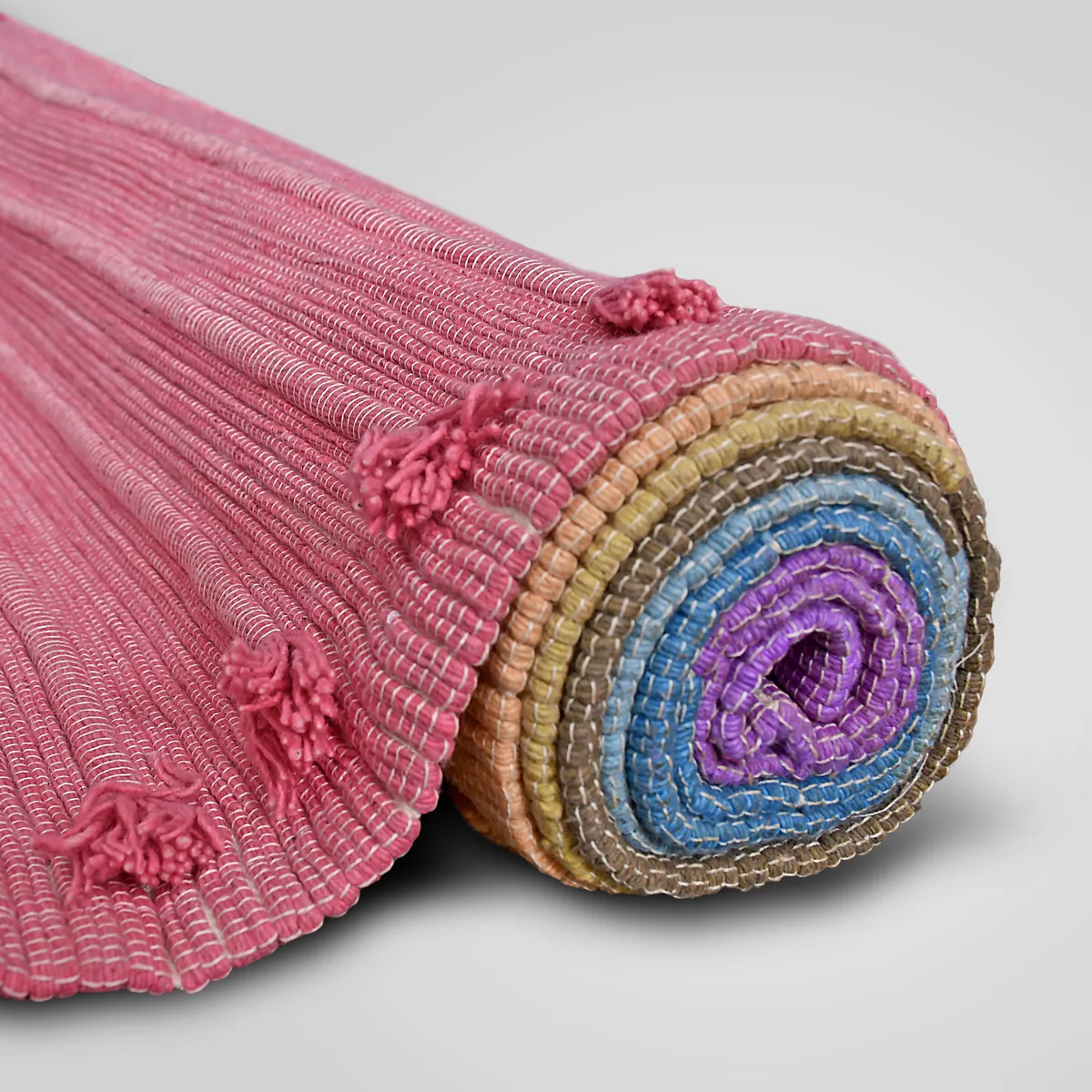
Both of our chakra rugs are six-ply, GOTS-certified organic cotton, 5 mm thick, 188 × 69 cm and about 1.5 kg. Six-ply means six strands twisted into each yarn, which gives a dense cloth when it is beaten in firmly on the handloom. The seven bands are counted by the weaver as the rug grows, so band widths vary slightly from rug to rug; that is a mark of the hand, not a fault.
| Prana Shakti | Prithvi | |
|---|---|---|
| Ground colour | Rose | Earth tones |
| Bands | Seven chakra colours | Seven chakra colours |
| Finish | See product page | Hand-knotted tassels |
| Dyes | Ayurvedic plant dyes: turmeric, neem, tulsi among more than twenty herbs | Plant dyes |
| Price at the time of writing | About ₹3,500 | About ₹4,400 |
Plant colour matters for a design built on colour. Turmeric gives the yellows, indigo the blues, and a palette of more than twenty herbs covers the rest. No dye bath is identical to the next and plant colour softens over years, so your rug's bands will differ a little from the photograph and will mellow with you; we explain why in Herbal and plant dyes on yoga mats. We claim no health effect from the dyes; they are plant-based colours traditionally used in Tamil Nadu.
The underside carries a thin layer of natural tree latex, brushed on by hand, so the rug holds on tile, marble and wood. If you are allergic to natural latex, choose with care and write to us first.
Caring for the colours
Hand wash cold with a mild natural detergent, wash separately for the first washes, and dry flat in shade. Machine washing and direct sun can fade plant dyes, and a little colour in the first rinse is normal. The full routine is on the Mat care page.
Frequently asked questions
Is the seven-colour chakra rug a traditional Indian design?
The rug is a modern design; the symbolism is older. The chakras belong to the yogic tradition and the rainbow colour scheme is widely taught in yoga today, but we have found nothing to suggest that a seven-band rug itself has an ancient history. We describe it as a modern handloom design drawing on traditional colour associations.
What is the order of the chakra colours on the rug?
In the popular scheme the bands run red, orange, yellow, green, blue, indigo and violet, matching the root, sacral, solar plexus, heart, throat, brow and crown chakras from the base of the spine upward. Our rugs follow the same sequence.
Does the chakra rug have any effect on the chakras?
No, and we do not claim that it does. The colours are a symbolic language that practitioners recognise; the rug is a dense cotton surface for practice. Any meaning you bring to the colours is yours.
Why do the colours on my rug look different from the photo?
Because they are plant dyes. Each dye bath is slightly different, and plant colour softens gently with washing and time. Expect a shade warmer or cooler than the image, and bands of slightly uneven width, on any handwoven rug.
If the sequence speaks to you, the Prana Shakti sets it on a rose ground and the Prithvi on earth tones with tassels; both are in the cotton collection.