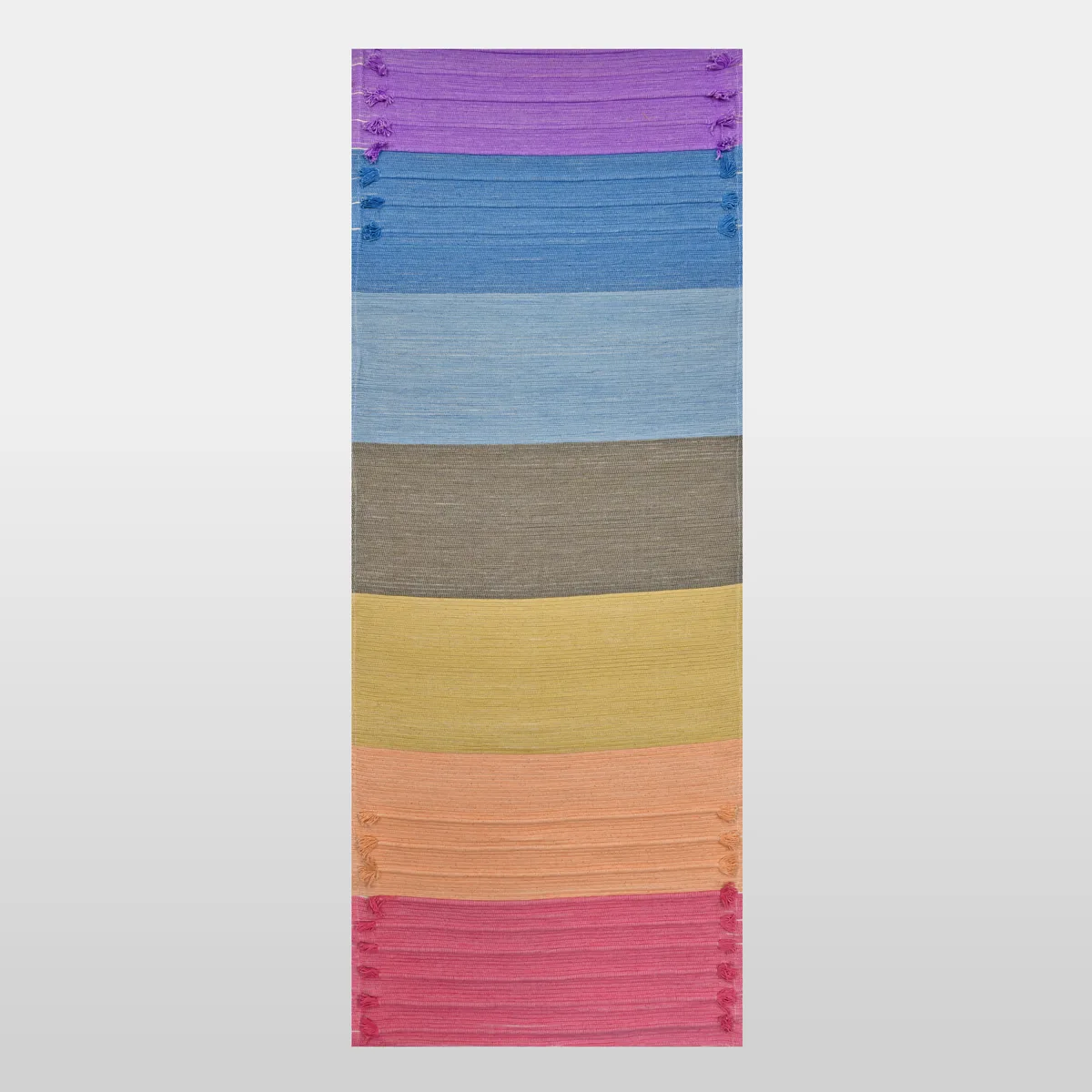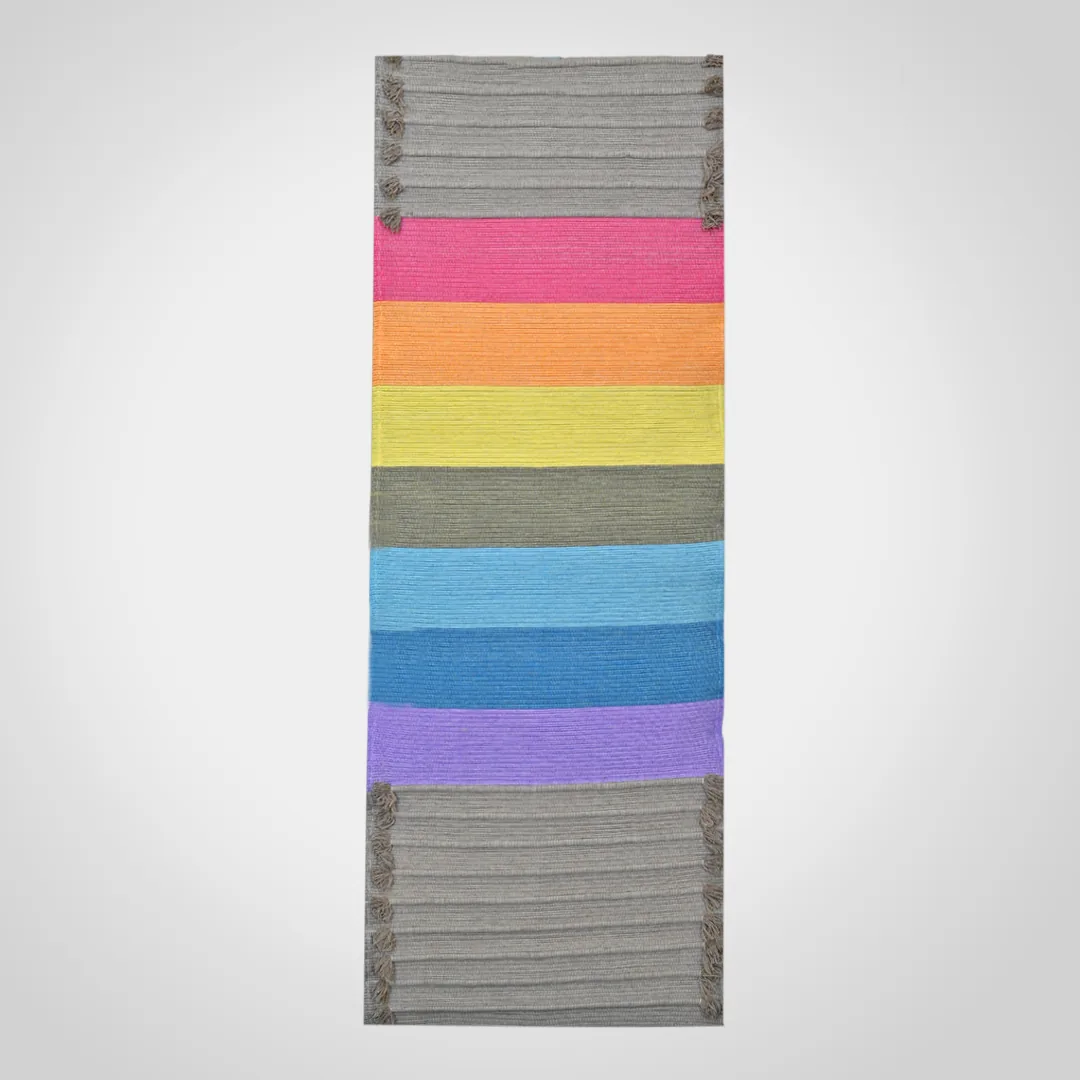
The seven chakra colours on a yoga mat are, from the root upwards, red, orange, yellow, green, blue, indigo and violet, matching the seven centres of the modern chakra tradition from the base of the spine to the crown. On our chakra rugs each band is woven in plant-dyed cotton: turmeric gives the yellow, and the other bands come from a herbal palette of more than twenty plants. The colour meanings below are tradition, not claims about health or energy.

Where the seven colours come from
The chakras themselves are old. They belong to Hindu and Buddhist tantric traditions, where texts describe subtle centres along a central channel of the body; different texts count four, five, six or more, and the familiar seven-centre system reached English readers largely through Sir John Woodroffe's 1919 translation of a sixteenth-century Sanskrit text (Wikipedia: Chakra).
The rainbow colours are much newer. The same source is clear that the colours are modern: the seven rainbow colours were attached to the chakras by Charles W. Leadbeater in 1927, and the now-standard pairing of colours with a list of qualities first appeared together in 1977. We say this plainly because we would rather you knew what you are buying. A chakra rug is a modern weaving tradition carrying a twentieth-century colour scheme over a much older map of the body. We find that history interesting rather than embarrassing, and we follow it further in where the seven-colour rug comes from.
The seven colours and what the tradition says
The right-hand columns below are what the modern chakra tradition associates with each centre. We present them as tradition and make no claim that a colour on a mat affects the body or the mind.
| Order | Chakra (Sanskrit) | Place on the body | Colour | Traditional association |
|---|---|---|---|---|
| 1 | Muladhara | Base of the spine | Red | Grounding, stability, the element earth |
| 2 | Svadhisthana | Lower abdomen | Orange | Feeling, creativity, the element water |
| 3 | Manipura | Navel | Yellow | Will, the element fire |
| 4 | Anahata | Heart | Green | Compassion, openness, the element air |
| 5 | Vishuddha | Throat | Blue | Speech and expression, the element space |
| 6 | Ajna | Brow | Indigo | Insight, inner seeing |
| 7 | Sahasrara | Crown | Violet | Awareness, the meeting with the whole |
Teachers differ on details, and some systems use white rather than violet at the crown; the version above is the one most people in a yoga class today would recognise.
Which plants give which hue
- Yellow: turmeric. The dried rhizome of the turmeric plant has coloured cloth in India for a very long time, including the robes of monks and priests. It is not light fast, so the yellow band is the one that mellows first (Wikipedia: Turmeric). We accept that in exchange for a yellow that comes from the kitchen plant.
- Red, orange, green, blue, indigo, violet: the herbal palette. These bands come from a palette of more than twenty herbs that includes tulsi (holy basil) and neem. A green is, as always, a yellow and a blue meeting. We do not publish the recipe band by band, partly because it shifts a little with the season, and we would rather not name a plant we cannot promise is in every lot.
Most plant colours are fixed to cotton with a mordant, a metal salt that binds the dye to the fibre and shifts the final shade; indigo, as a vat dye, is the exception, as told in natural indigo on cotton. The general method is in herbal and plant dyes explained.
How the bands are woven
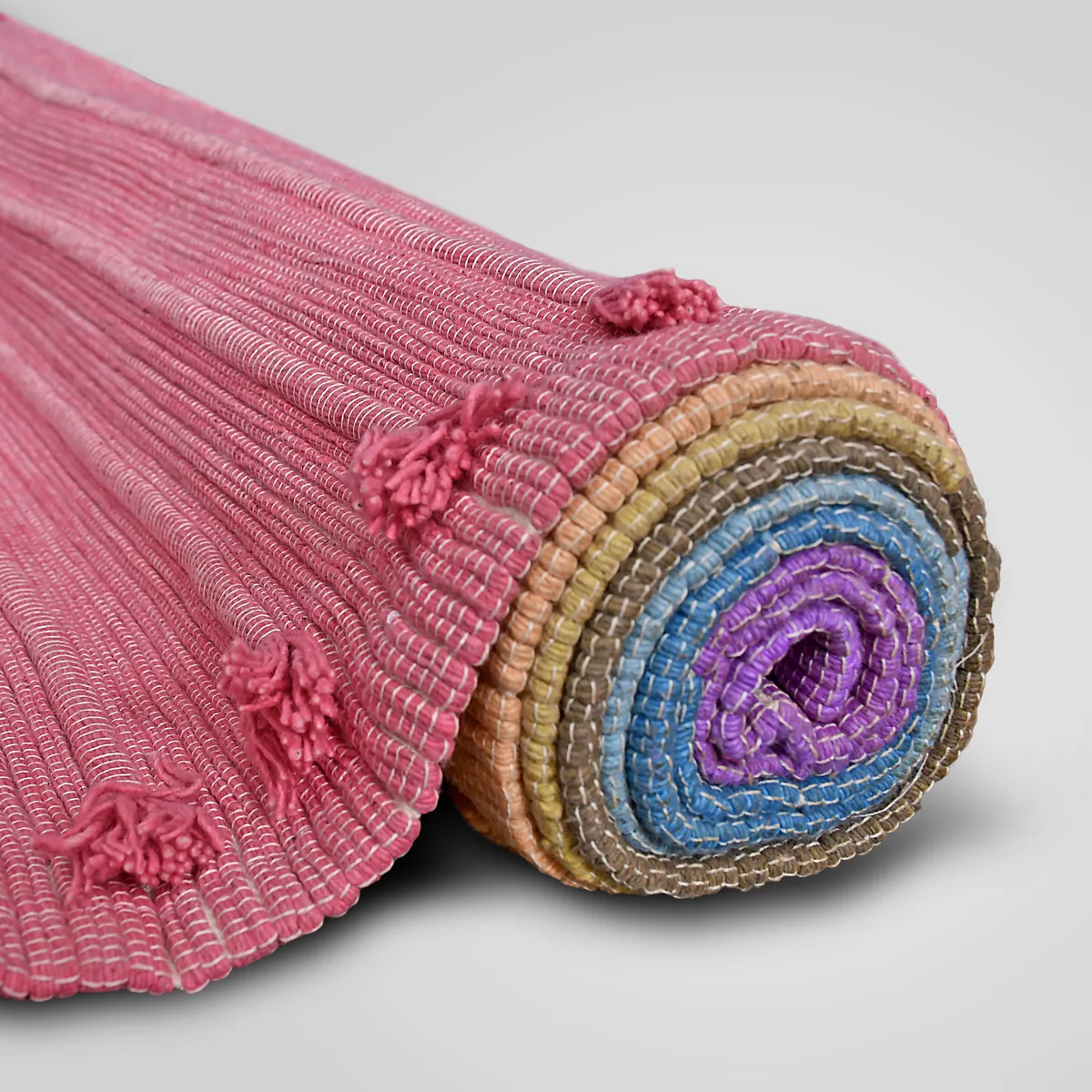
A chakra rug is not printed. Each band is a run of dyed weft yarn beaten into the warp on the handloom, so the colour goes right through the cloth and the edge of every band has the slight softness of a hand-thrown shuttle. Both chakra rugs are six-ply GOTS-certified organic cotton, 5 mm thick, 188 × 69 cm (74 × 27 in) and about 1.5 kg, with natural tree latex brushed onto the underside for grip. If you are allergic to natural latex, choose with care and write to us first.
Prana Shakti
Prana Shakti carries the seven bands on a rose-coloured ground. The warm ground lifts the yellow and orange and lets the indigo and violet sit deep. At the time of writing it is ₹3,499.
Prithvi
Prithvi means earth. The seven bands cross the centre of an earth-toned cotton ground, with hand-knotted tassels at either end, so the colours read as a stripe of light across bare cloth. At the time of writing it is ₹4,400.
Because every band is plant-dyed in small lots, no two rugs match exactly, and the colours soften with washing and sun over years. Hand wash cold with a mild natural detergent, separately for the first few washes, and dry flat in shade.
Using the colours in practice
Some people lay the rug so the red band sits under the hips in seated practice and the violet beyond the head in rest; others simply like the order of colours as a visual rhythm for Surya Namaskar. There is no rule, and we would not invent one. The rug is a surface for your practice; the colours are a tradition you may use as a reminder, a decoration, or not at all.
Frequently asked questions
What are the seven chakra colours in order?
From the root to the crown, the modern chakra tradition assigns red (Muladhara, base of the spine), orange (Svadhisthana, lower abdomen), yellow (Manipura, navel), green (Anahata, heart), blue (Vishuddha, throat), indigo (Ajna, brow) and violet (Sahasrara, crown). Some systems use white at the crown instead of violet.
Are the chakra colours ancient?
The chakras are ancient, described in Hindu and Buddhist tantric texts, but the rainbow colours are modern. They were attached to the seven chakras by Charles W. Leadbeater in 1927, and the familiar pairing of colours with a list of qualities appeared together in 1977. A chakra rug carries a twentieth-century colour scheme over a much older map of the body.
Does a chakra yoga mat balance your chakras?
We make no such claim. In the tradition each colour is associated with a centre and a set of qualities, and many people find the sequence a pleasant reminder during practice. The rug itself is handwoven, plant-dyed cotton; it has no effect on the body beyond being a comfortable, grippy surface to practise on.
Which plants dye the chakra colours on your rugs?
Turmeric rhizome gives the yellow; the other bands come from a herbal palette of more than twenty plants that includes tulsi and neem. We name only the plants we can confirm in every batch, and the colours vary slightly from lot to lot.
For the seven colours on a warm ground, start with the Prana Shakti; for the same bands on bare earth-toned cotton with tassels, the Prithvi. Both sit in the cotton collection.