TPE stands for thermoplastic elastomer: a family of materials that are either copolymers or a physical blend of a plastic and a rubber, so they stretch like rubber but soften and reshape with heat like a plastic. A TPE yoga mat is a foamed sheet of one of these materials, usually sold as a lighter, PVC-free "eco" alternative to the standard sticky mat. It has real strengths, cushioning, light weight and a low price, and some honest limits, which we set out below.

What TPE actually is
Thermoplastic elastomers are a class of copolymers or a physical mix of polymers, usually a plastic and a rubber, that behave like rubber at room temperature. The key difference from a vulcanised rubber mat is the bond holding the material together. Vulcanised rubber is permanently cross-linked and cannot be remelted. A TPE has reversible bonds, so it can be melted, moulded and extruded again.
There is not one TPE but several. The same reference lists six commercial classes under ISO 18064, including styrenic block copolymers, thermoplastic polyolefins and thermoplastic polyurethanes. A mat labelled "TPE" rarely says which.
Why TPE is marketed as eco
Three things are usually meant:
- No PVC. A TPE mat avoids PVC, and with it the questions about PVC's plasticisers covered in what PVC yoga mats are made of. A reasonable reason to choose it.
- Recyclable in principle. Because it remelts, TPE has the potential to be recycled: a clean, single-material TPE can be ground and reprocessed. The gap between principle and practice is covered below.
- Lighter. A TPE mat is typically lighter than rubber or PVC at the same thickness, so less material is shipped and carried.
None of that makes it a plant product. TPE is a synthetic plastic, and a worn TPE mat sheds plastic fragments like any other foam. The honest phrase is "a less troublesome plastic", not "eco".
How a TPE mat performs
Cushioning and weight. This is where foam wins clearly. A 6 mm TPE mat gives soft, springy support under the knees and is among the lightest mats at that thickness. For kneeling floor work on a hard floor, that padding is genuinely useful.
Grip. Dry, a new TPE mat grips well. Damp, it behaves like most smooth foams: sweat sits on the surface and the hands slide.
Wear. Foam compresses where you kneel and stand, and softer foams show this sooner. Edges tear if dragged over rough ground, and the surface can flake with age, heat and sun. A TPE mat is not a lifetime purchase, and most are priced accordingly.
The recycling reality
For a used mat to be recycled, three things must be true at once: it must be a single, identifiable polymer; a facility near you must accept it; and someone must collect, clean and sort it. Many TPE mats have a second layer, a printed surface or a different foam bonded underneath, making them mixed-material items. In most Indian cities there is no kerbside stream for foam mats, and we have not found a take-back scheme we could point you to.
So "recyclable" describes the material, not what will happen to your mat. Buy TPE planning to use it for years and then reuse it as a kneeler or a pet mat, rather than expecting it to be remade. More in what happens to your mat at the end of its life.
How TPE compares with a woven mat
| TPE foam mat | Sambhu grass mat (ours) | Woven cotton mat (ours) | |
|---|---|---|---|
| Made of | Plastic-rubber blend, foamed | Sambhu grass and organic cotton, natural latex underside | GOTS-certified organic cotton, natural latex underside |
| Cushioning | Soft, springy | Firm, almost none | Dense, moderate |
| Grip when sweaty | Slides without a towel | Stays cool, fibre takes the damp | Improves as it dampens |
| Weight | Light | About 1 kg | About 1.4–1.8 kg |
| Washing | Wipe only | Damp cloth, never soak | Hand wash or delicate cycle, by mat |
| Wear | Compresses, can flake | Grass softens, latex can be recoated | Fades gently, latex can be recoated |
| Price | Low to mid | About ₹1,700–₹2,000 at the time of writing | About ₹3,500–₹4,500 at the time of writing |
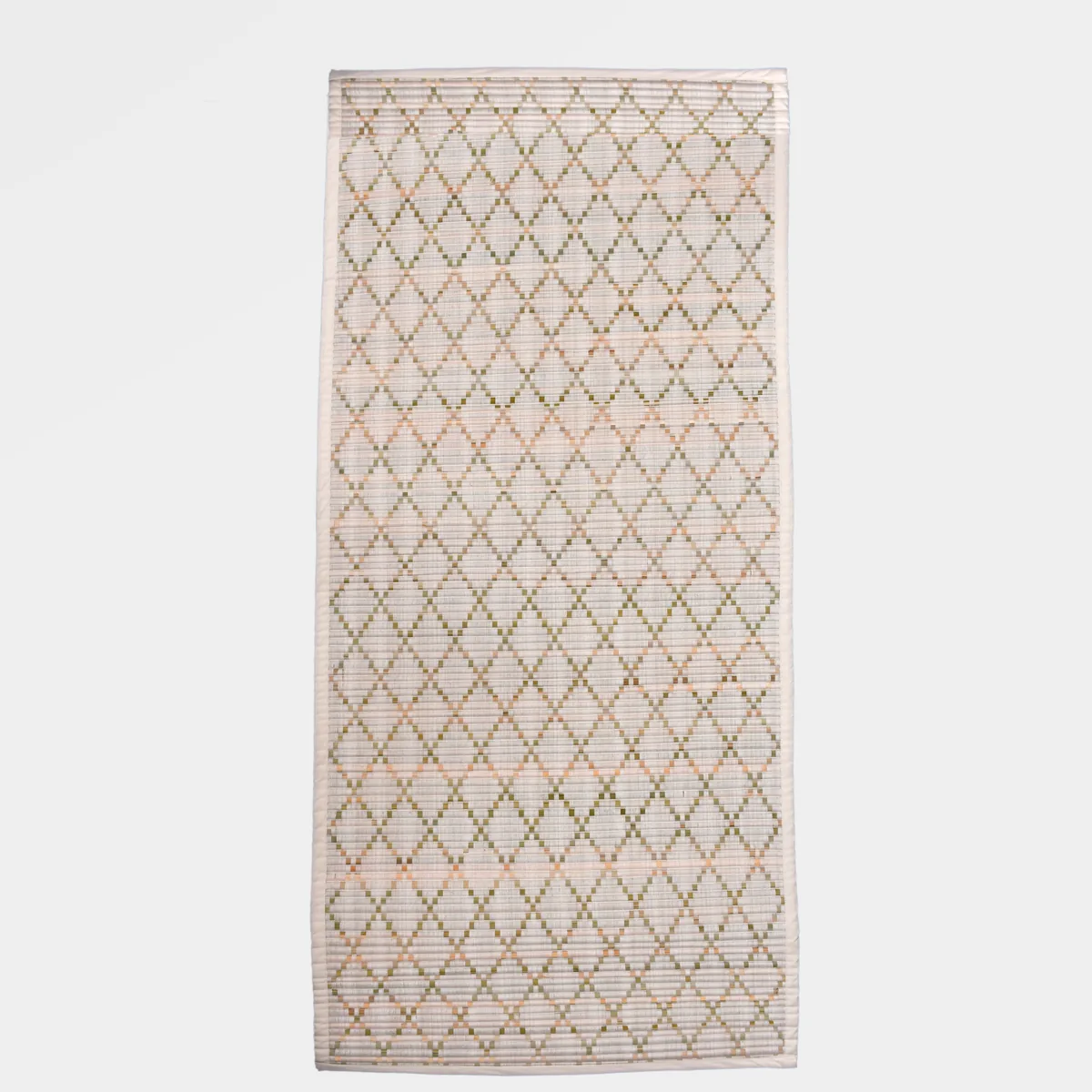
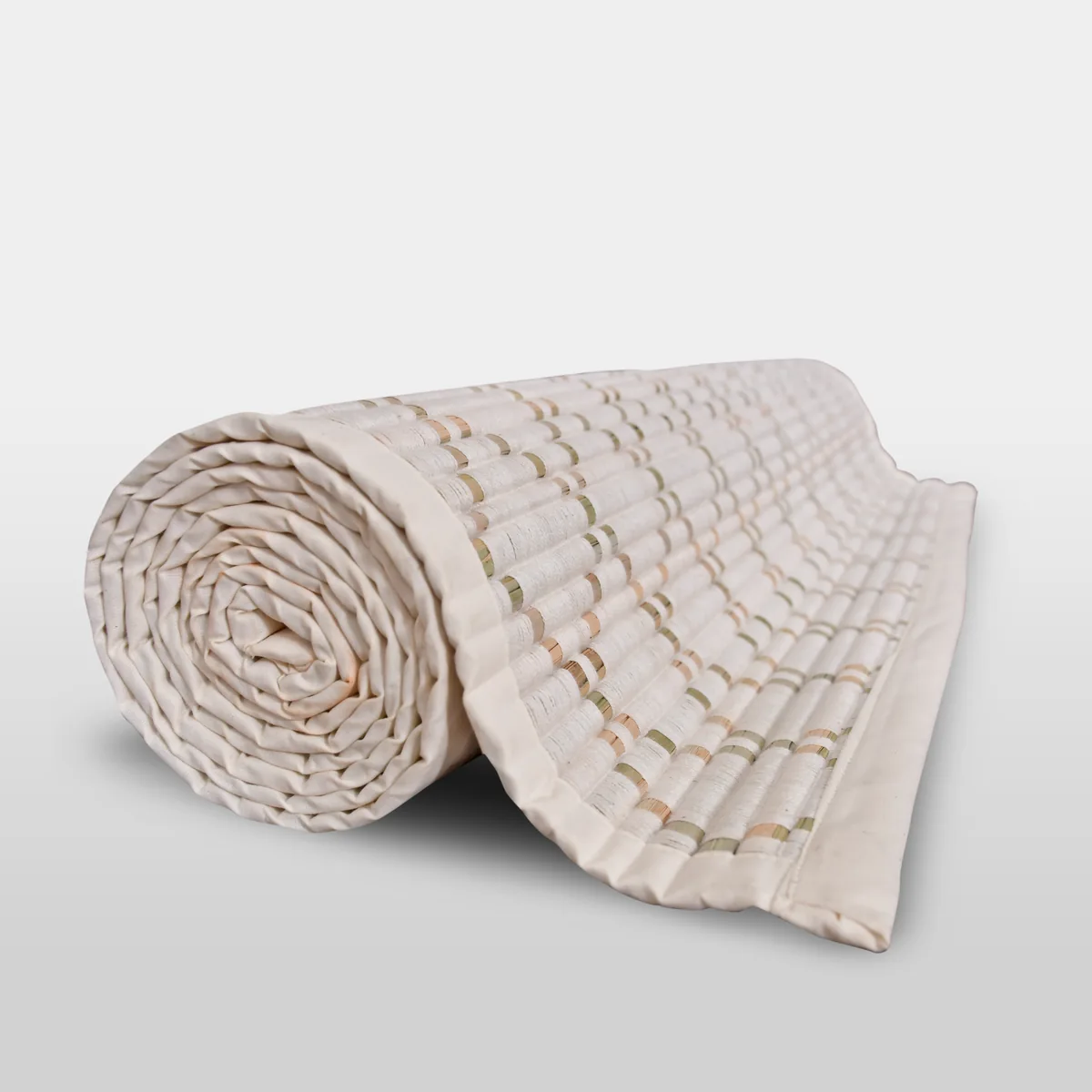
The grass and cotton columns do not win everything. If you want padding, foam gives more of it for less money. If you want something that is not plastic, grips better the sweatier you get, and can be washed and recoated instead of replaced, a woven mat is the honest answer. Our Sambu Diamond is the one we would put beside a TPE mat for weight: about 1 kg, 3 mm, with a thin hand-brushed layer of natural tree latex underneath. If you prefer cotton, the Indico is our plainest. If you are allergic to natural latex, choose with care and write to us first.
For a comparison that includes PVC, see cotton vs PVC and TPE yoga mats.
Frequently asked questions
Is TPE the same as PVC?
No. PVC is polyvinyl chloride, a chlorine-containing plastic softened with plasticisers. TPE is a thermoplastic elastomer, a plastic-rubber blend or copolymer that is not PVC. Both are synthetic plastics foamed into mats.
Is a TPE yoga mat eco-friendly?
Partly. It avoids PVC, can in principle be remelted, and is usually lighter than rubber or PVC. It is still plastic, it sheds fragments as it wears, and in practice there is rarely a facility that will recycle a used, mixed-layer mat. "Lower impact than PVC" is fairer than "eco".
How long does a TPE yoga mat last?
Like other foams, TPE compresses and can flake with use, especially with heat and sun. How long one lasts depends on the mat, your practice and your storage; we have not seen a reliable figure.
Can a TPE yoga mat be recycled?
The material can, if it is a single clean polymer and a facility accepts it. The mat often cannot, because many have bonded layers or printed surfaces, and most Indian cities have no collection stream for foam mats. Plan to reuse a worn TPE mat around the house.
If you are weighing a TPE mat against something woven, start with the Sambu Diamond, or browse all our grass mats to compare the three patterns.