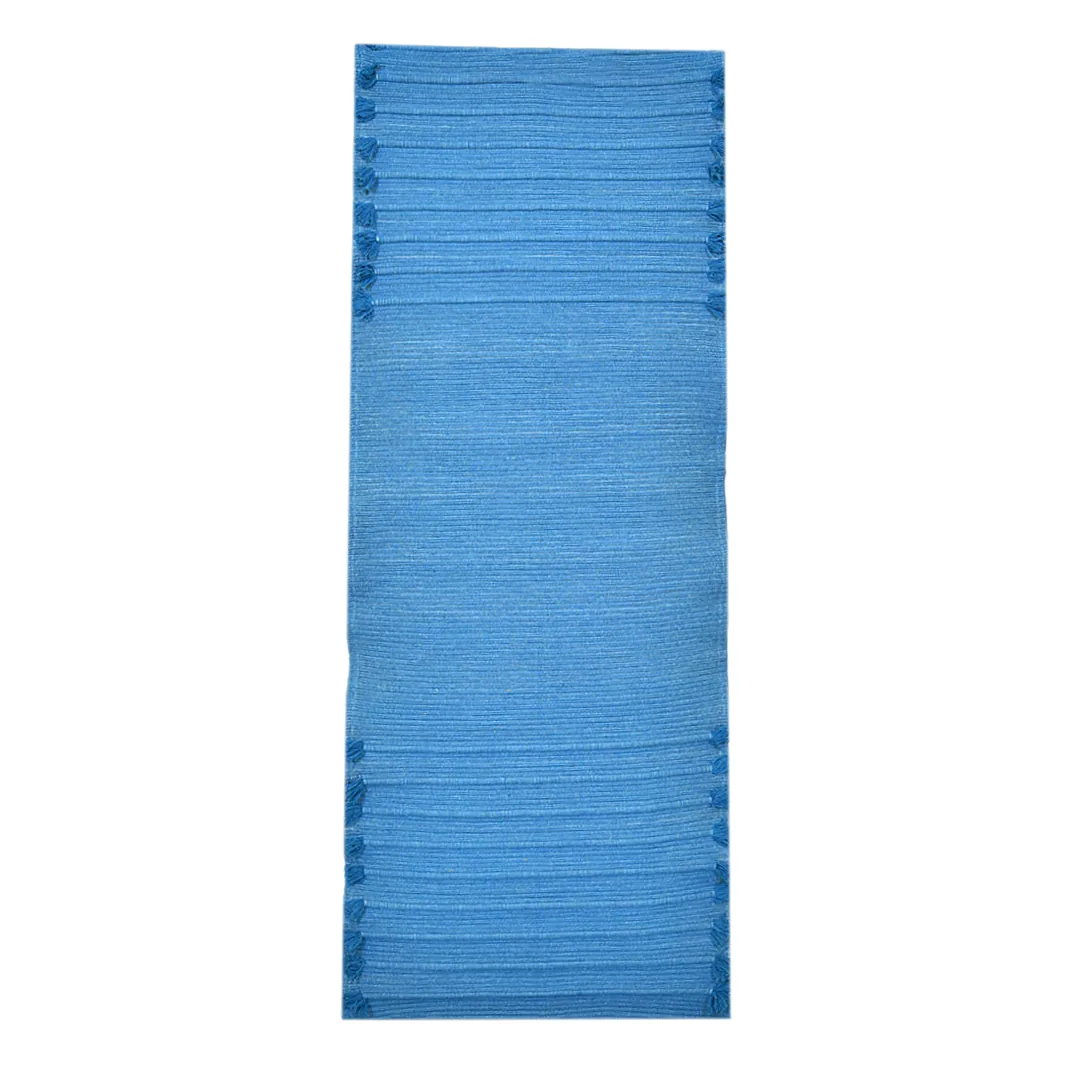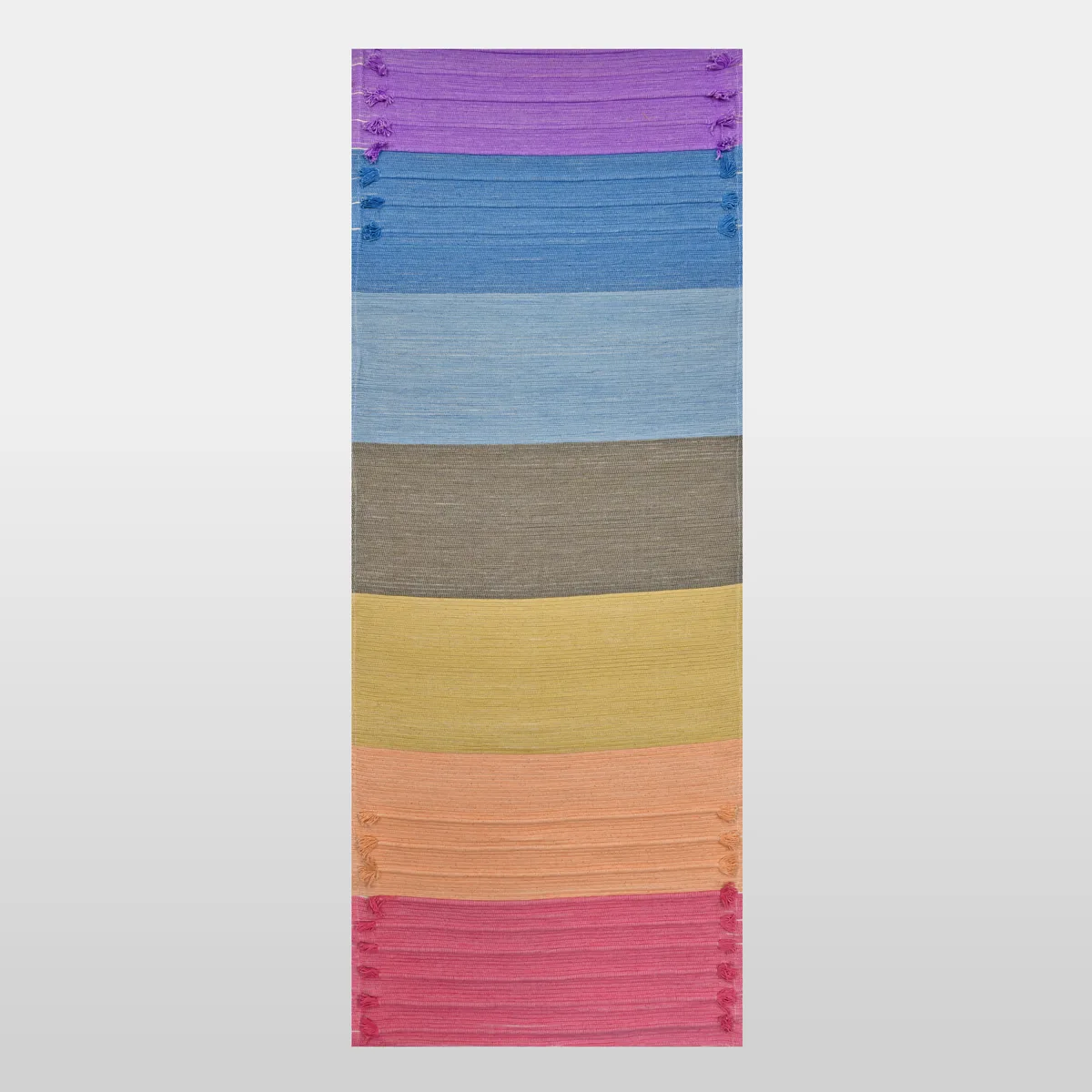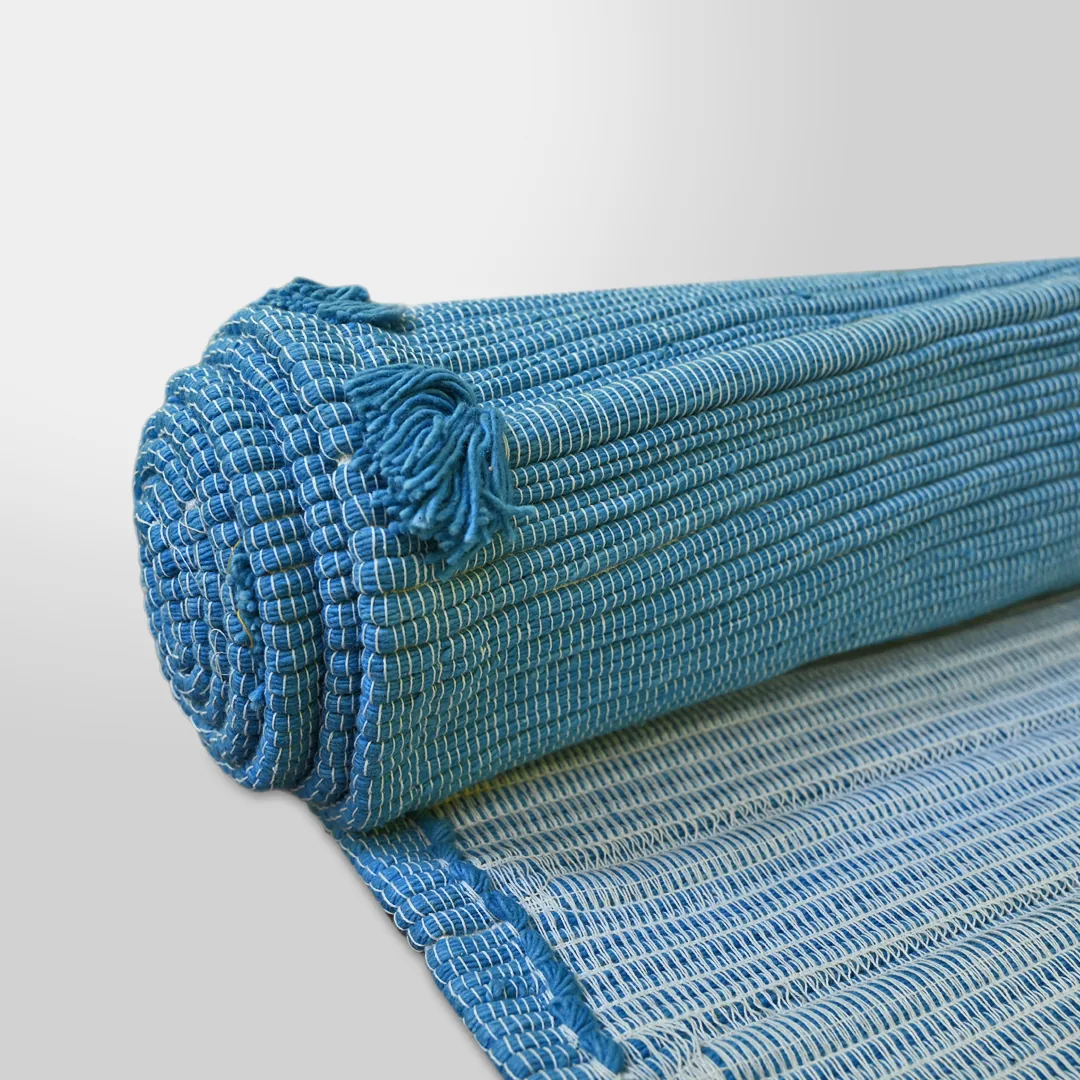
A cotton yoga mat is not automatically eco-friendly, and we would rather not use the phrase at all. Cotton is a crop that takes land, water and inputs to grow; how much depends on where and how it is farmed. What a well-made cotton mat can honestly offer is organic fibre, plant dyes, no plastic, hand-weaving without electricity and a long life with repair. This article sets out what the evidence says and what we can and cannot claim.
What cotton costs to grow
Water
Cotton has a reputation as a thirsty crop, and the picture is more mixed than the slogan. A global analysis by the International Cotton Advisory Committee covering 2020–2024 (Water footprint in cotton: a global analysis, Keshav Kranthi, April 2025) puts the average water footprint at about 6,238 litres per kilogram of lint, of which roughly 4,690 litres is rainwater taken up by the crop and about 1,593 litres is irrigation water. The same paper finds that 56 per cent of the world's cotton area is rainfed and that rainfed fields contribute more than 45 per cent of production, with cotton occupying about 2.2 per cent of the world's arable land.
Two honest conclusions follow. First, a kilogram of cotton does take thousands of litres of water, most of it rain. Second, the irrigation part varies enormously by region and farming method, so a single number for "cotton" tells you little about a particular mat. Textile Exchange makes the same point in its guide to organic cotton: cotton farming requires significant water, and each farm and region has different water usage and impacts. We do not have farm-level water data for our own cotton, and we will not pretend to.
Inputs
The clearer difference is in what goes onto the field. Textile Exchange's guide states that organic cotton is grown without toxic and persistent pesticides or synthetic fertilisers, under organic farming rules that also exclude genetic engineering. Conventional cotton depends on those inputs. That is the main thing "organic" buys you: not less water as such, but fewer synthetic chemicals in the soil, the water and the farmers' lives. We compare the two systems in detail in Organic cotton vs conventional cotton.
What GOTS does and does not cover
Our cotton mats are GOTS-certified organic cotton. It is worth being exact about what that means, because the certificate is often described more broadly than it deserves. According to the standard's key features, GOTS covers the processing chain from certified organic fibre to the finished product, requires at least 95 per cent certified organic fibre for the "organic" label grade, restricts the chemical inputs used in processing, requires wastewater treatment, and sets social criteria such as safe working conditions and a prohibition on child and forced labour. The farming itself is certified separately under organic agriculture standards, which GOTS requires as a prerequisite.
So the certification is about the cotton, from field to cloth. It is not a certificate for the whole mat, which is why we say "GOTS-certified organic cotton" and never "GOTS-certified mat". The grass mats are not covered by it at all. We explain the scope in What GOTS-certified organic cotton means on a yoga mat.
Where a cotton mat earns its keep
Longevity and repair
The strongest environmental case for a handwoven cotton mat is that you buy one and keep it. A dense, hand-beaten rug does not flake, crumble or peel the way foam does; it can be washed, re-coated and repaired. The weak points of a rug, the tassels and selvedge, are made by hand and can be mended by hand. We give realistic lifespans and the signs of wear in How long does a cotton yoga mat last. A mat that lasts years replaces several that do not, and that arithmetic matters more than any label.
Materials you can name
Our cotton mats are cotton, plant dye and natural tree latex, packed without plastic. No PVC, no synthetic foam. The dyes are plant extracts: indigo for the Indico, turmeric, neem, tulsi and more than twenty other herbs for the Prana Shakti. Natural dyeing still uses water and mordants, and we say so rather than present it as impact-free; the honest comparison is in Water, dyes and rivers.
Hand-weaving without electricity
The weaving itself uses no power: the loom is worked by hand and foot. That is a true and specific statement, and it is as far as we go. We have not measured the footprint of the cotton, the dyeing or the courier, so we do not quote a carbon figure.
The natural latex layer
The underside of our cotton, sambhu grass and banana fibre mats carries a thin layer of natural tree latex, brushed on by hand, so the mat holds on tile, marble and wood. Natural latex is the milky sap tapped from the bark of the rubber tree, Hevea brasiliensis, which the encyclopaedia entry describes as the primary source of natural rubber. It is a plant product, not a petroleum foam, but it is still an input with its own farming and processing, and once applied it is part of the mat. The Darbha mat is the exception: it is backed in cotton cloth and has no latex. If you are allergic to natural latex, choose with care and write to us first.
What we can and cannot claim
| Claim | Can we make it? | Why |
|---|---|---|
| "Eco-friendly" or "sustainable" | No | Too vague to be checked; we say what is specifically true instead |
| "Biodegradable" or "compostable" | No | We have no certification, and the latex layer and dyes complicate it; see What happens to your mat at the end of its life |
| "GOTS-certified organic cotton" | Yes, for the cotton mats | We hold GOTS certification for our organic cotton |
| "No PVC, no synthetic foam, plastic-free packaging" | Yes | Plain statements of what the mat is and is not |
| "Plant-dyed" | Yes | Named plants; variation and fading are the nature of plant colour |
| "Handwoven without electricity" | Yes | Our looms are worked by hand and foot |
| "Low water" or "low carbon" | No | We have not measured either |
If a brand uses the words in the "No" rows, it is fair to ask what they are based on. We set out the questions to ask any mat maker in Choosing an eco-friendly yoga mat in India without falling for green labels.
Frequently asked questions
Is cotton a water-hungry crop?
Cotton uses a lot of water per kilogram, but most of it is rain. The International Cotton Advisory Committee's 2020–2024 analysis gives a global average of about 6,238 litres per kilogram of lint, of which about 4,690 litres is rainwater and about 1,593 litres irrigation, with 56 per cent of cotton area rainfed. Irrigation varies widely by region, so a single figure says little about any one mat.
Does organic cotton use less water than conventional cotton?
Not reliably, and that is not the main point of organic. Textile Exchange notes that water use depends on the farm and region whichever way the cotton is grown. What organic farming changes is the inputs: no toxic and persistent pesticides, no synthetic fertilisers and no genetically engineered seed. The difference you are paying for is in the soil and water around the farm, not a guaranteed saving in litres.
Is a cotton yoga mat biodegradable?
We do not claim that ours are. Cotton and plant dyes are plant materials, but our mats also carry a natural latex grip layer, and we hold no certification for biodegradability or composting. We would rather tell you what the mat is made of and let you judge than use a word we cannot back.
What is the most honest environmental case for a cotton mat?
Longevity. A dense handwoven cotton rug lasts for years, washes clean, can be re-coated and repaired, and does not shed foam. Add organic cotton, plant dyes, hand-weaving without electricity and plastic-free packaging, and you have a list of specific, checkable facts rather than a label.
If those specifics are what you are looking for, the Indico and the Prana Shakti are the two cotton mats we would start with; the rest of the cotton range is in the cotton collection.